
What PPWR Means for Shrink Sleeves: 2030 Rules & Routes
How the EU Packaging and Packaging Waste Regulation turns recyclability and recycled content into market-access conditions for shrink sleeves — the timeline, what each clause means for the label, and which compliant film routes answer it.
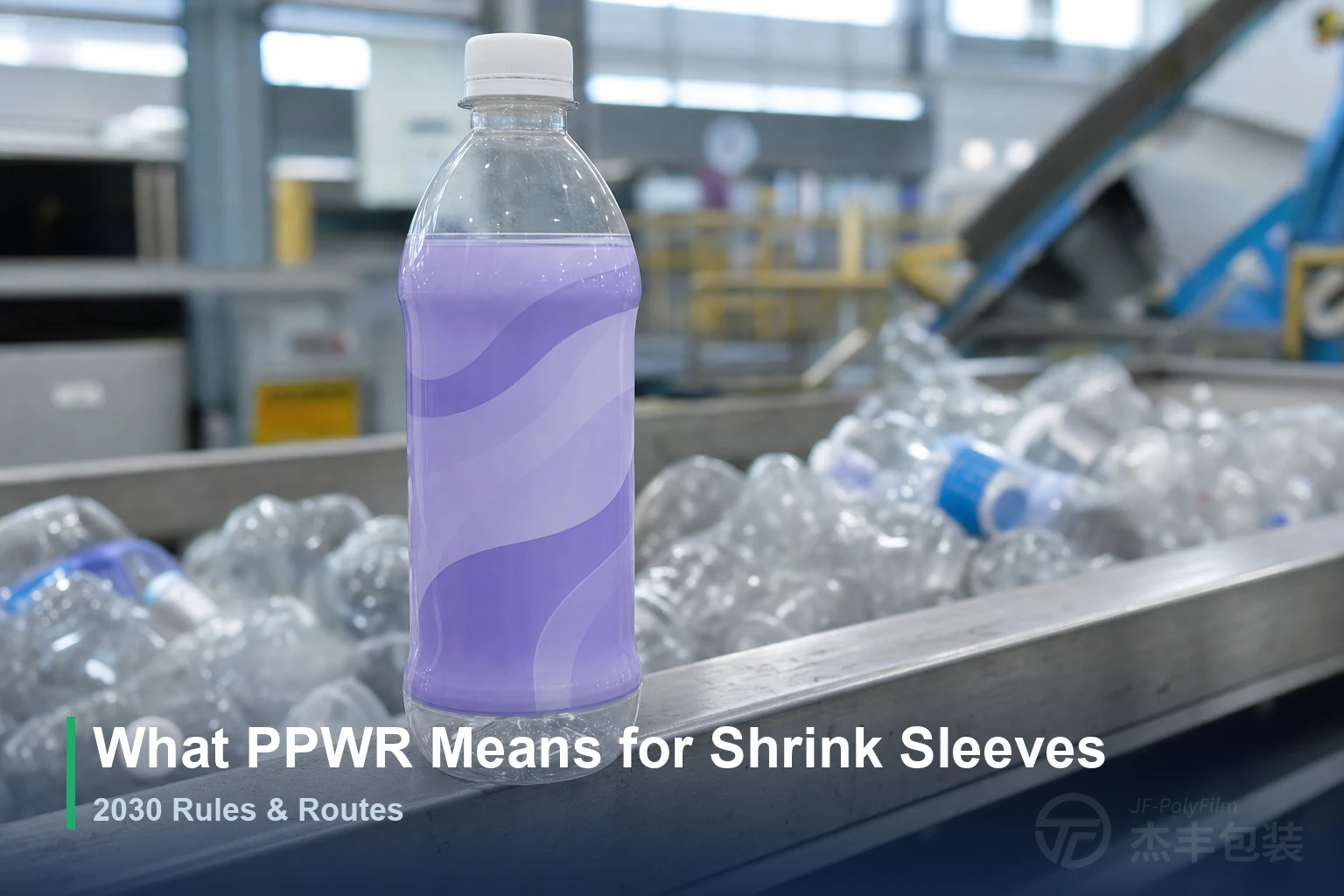
PPWR — the EU Packaging and Packaging Waste Regulation, formally Regulation (EU) 2025/40 — is the directly applicable law that replaces the old packaging directive and turns recyclability and recycled content into conditions for staying on the EU market. For a shrink sleeve, that reframes the label from a decorative choice into a compliance decision.
Key takeaways
- PPWR entered into force on 11 February 2025 and generally applies from 12 August 2026, with the recyclability grade C floor arriving on 1 January 2030 and the bar rising to grade B from 1 January 2038.
- A sleeve is judged as part of its host bottle: an incompatible full-body sleeve can drag an otherwise grade-A PET bottle below the market-access floor, which is why sleeve material choice now carries the whole pack.
- Three film routes answer the requirements — same-stream crystallizable PET, a separable wash-off/float design, and recycled-content RPET — each addressing a different clause rather than a single fix covering all of them.
Why PPWR is not the directive it replaces
What changes the most under PPWR is its legal form: it is a Regulation, not a directive.
| Milestone | Date | What it means for a sleeve program |
|---|---|---|
| Recyclability grade C floor | 1 January 2030 | Every package must reach at least grade C or lose EU market access |
| Recycled-content minimums begin | 1 January 2030 | Contact-sensitive PET packaging must carry 30% post-consumer content |
| Grade B floor | 1 January 2038 | The bar rises to grade B; grade C designs drop out of the market |
What PPWR actually asks of a sleeve
Recyclability (Article 6). From 2030 every package must be designed for recycling and graded on an A-to-E scale by the share of its weight that can be recycled — grade A at ≥95%, B at ≥80%, C at ≥70%, with D and E below 70% barred.
The meaning for a sleeve is direct and often underappreciated: the label is scored as part of the host bottle. A single incompatible full-body sleeve can pull a bottle that would otherwise grade A down toward C or below — enough to breach the 2030 floor.
Alongside separability, PPWR adds harmonised labelling and sorting-information requirements, so artwork and format have to leave both the sortation marking legible and the bottle body readable.
The material decisions the regulation forces
PVC is the clearest casualty. Nothing in PPWR names it, yet a full-body PVC sleeve contaminates the recovered PET and drags its host bottle below grade C, so the 2030 floor removes it from the market by consequence rather than by prohibition.
Being PETG does not, on its own, satisfy Article 6. Compliance means choosing a specific route:
- Same-stream crystallizable PET. A CPET sleeve shares the bottle’s chemistry and survives the recycling-line heat, so label and bottle are recovered together in the RIC 1 PET stream — the route explained in how CPET recycles in the RIC 1 stream.
- Separable wash-off or float-off designs. A construction built to release or float away from the bottle during washing keeps the recovered PET clean, the path covered in bidirectional wash-off shrink film.
- Recycled-content RPET. For the Article 7 obligation rather than the Article 6 one, an RPET grade raises the post-consumer share in the pack, detailed in the RPET explainer.
Frequently Asked Questions
Does PPWR ban PVC shrink sleeves outright?
When do the PPWR recyclability rules actually start to bite?
Is a standard PETG shrink sleeve automatically compliant because it is PET-family?
Related Articles
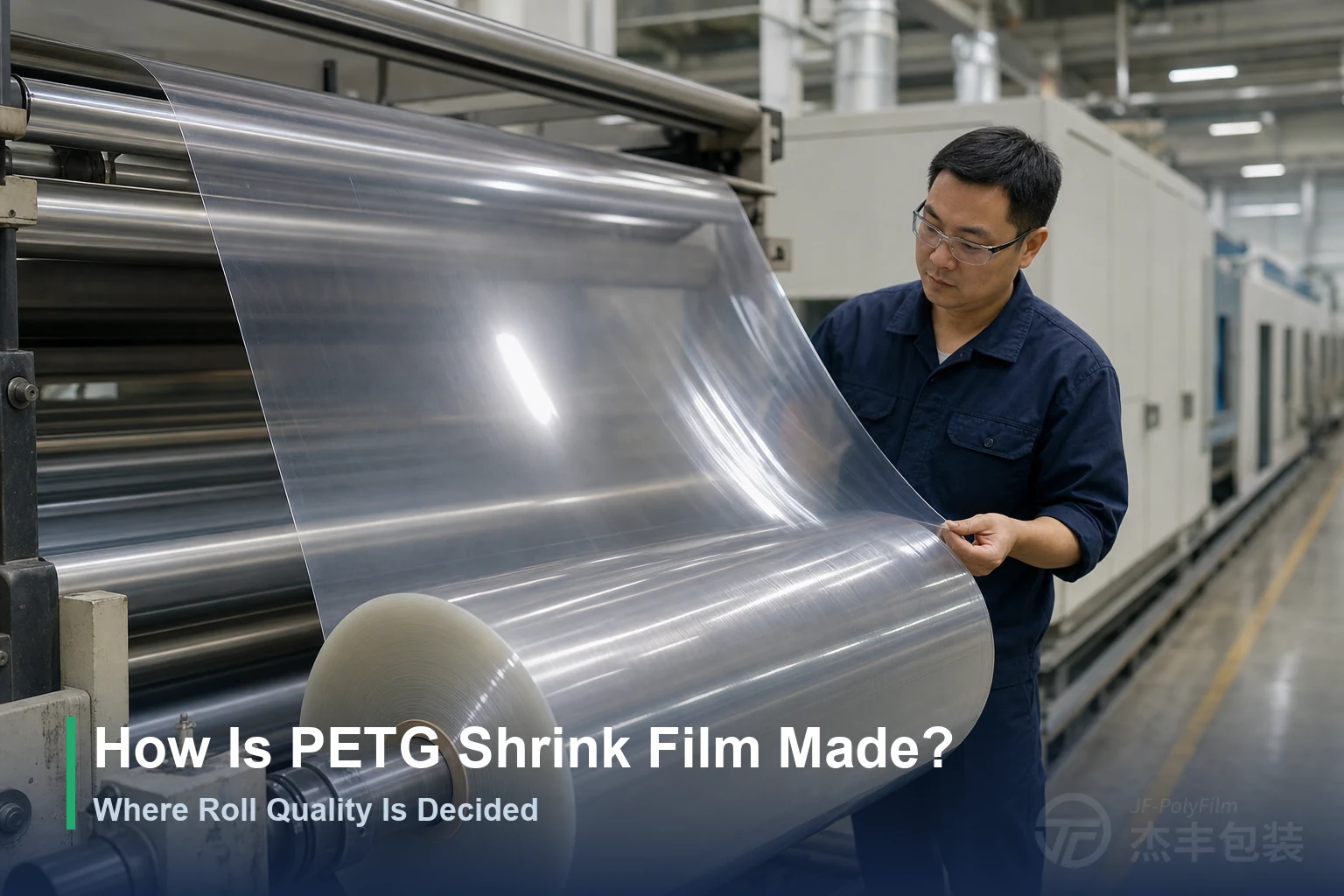
How Is PETG Shrink Film Made? Where Roll Quality Is Decided
How PETG shrink film is made, and which production stage sets each line buyers check on arrival: gauge tolerance, TD/MD shrink, haze, tensile strength, roll labels.
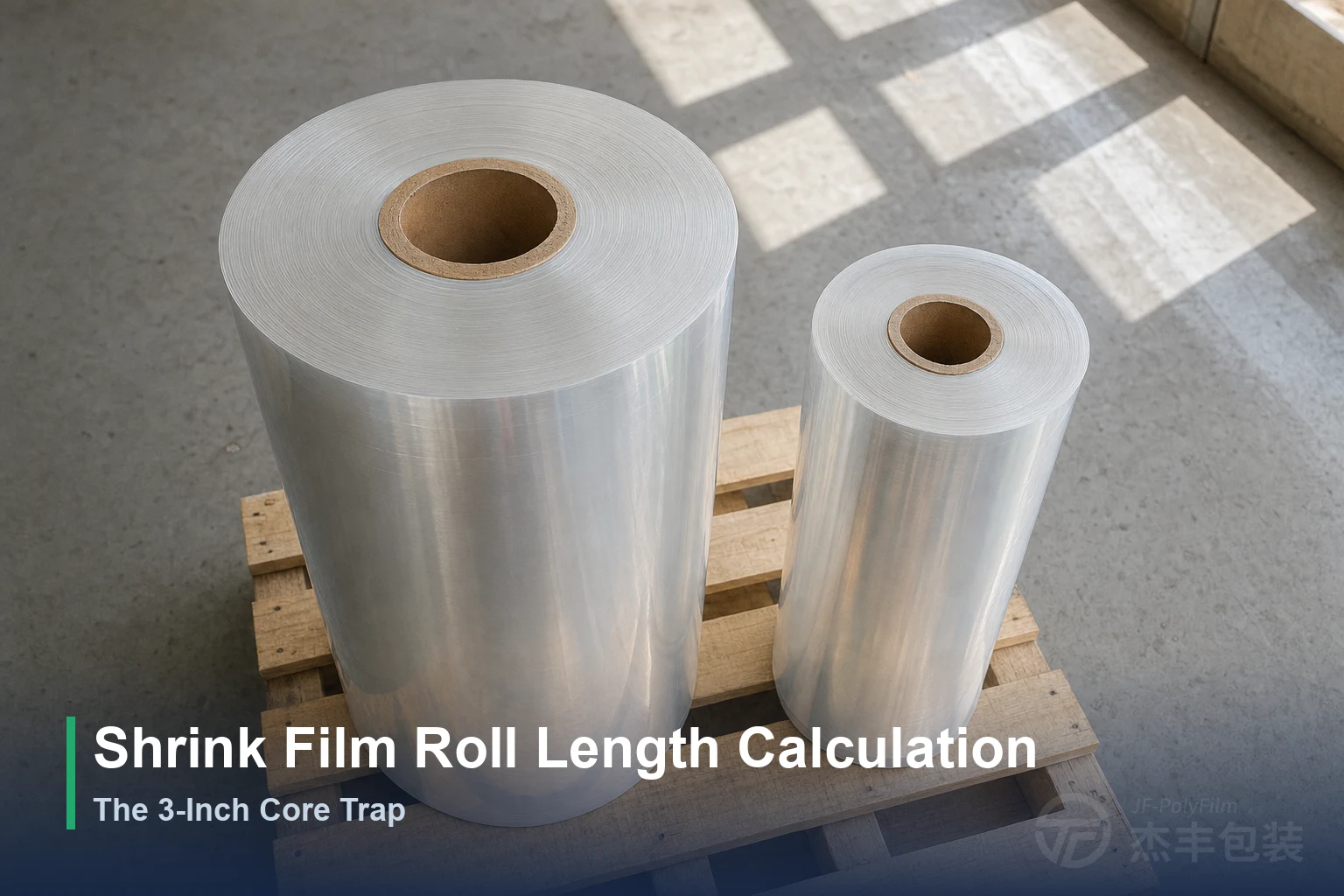
Shrink Film Roll Length Calculation: The 3-Inch Core Trap
Formulas linking roll diameter, length and weight, worked metric and imperial examples, a 30–60 μm diameter table, and why core size and trapped air shift the result.
Need Expert Advice on Shrink Film?
Our technical team can help you choose the right film for your application.
Contact Us