
How to Choose a PETG Shrink Film Supplier
A buyer's framework for sourcing PETG shrink film: which specs, COA line items, certifications, sample terms, and export-packing details to demand before paying.
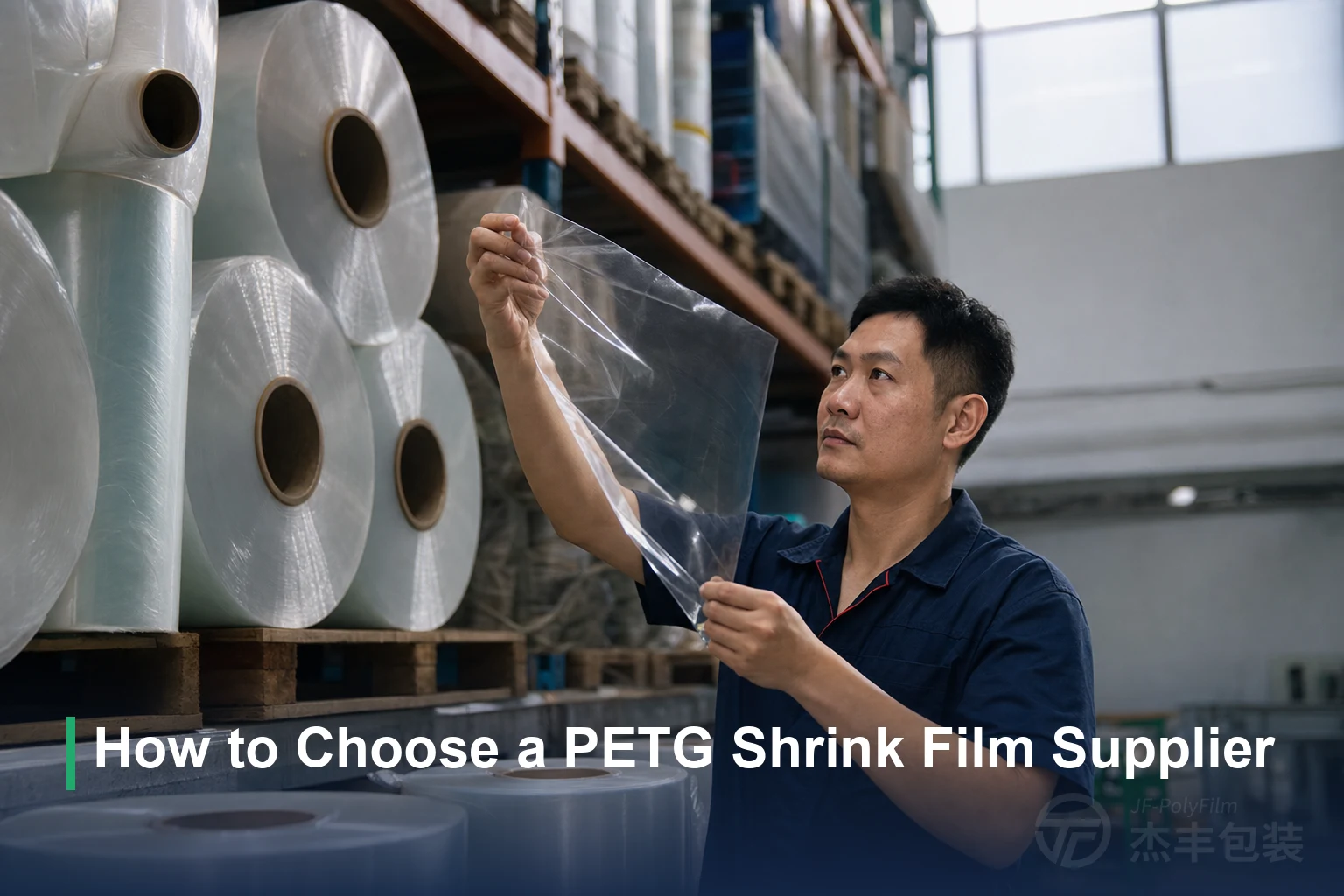
Choosing a PETG shrink film supplier means judging it on records it will release before payment — verified specifications, a per-batch certificate of analysis, roll traceability, scoped certifications, and proof of stable supply — rather than on reputation or polish alone.
Key takeaways:
- Because finished PETG shrink film sits in a roughly 1.28–1.33 g/cm³ density band, two quotes at the same price per kilogram rarely deliver the same number of labels; cost per finished sleeve is what actually tells the two quotes apart.
- A Certificate of Analysis carrying a batch number is the single most revealing document, and a supplier that cannot produce a sample COA before an order is usually not testing every batch.
- “Certified” has four separate meanings — recycled-content, substance-restriction, material, and quality-management — and none of them certifies end-use food safety for an outer label that never touches the product.
- TD shrinkage for these films runs about 70–80%, so a quote is only comparable when TD and MD are stated separately and tied to a method such as ASTM D2732 or ASTM D882.
- Sourcing straight from the mill that extrudes the film keeps traceability, process control, and continuity of supply under one roof; the documents below are how a buyer confirms that control sits with the manufacturer rather than a layer removed from the line.
Reliability in a PETG shrink film supplier: reputation or records?
A reliable supplier is one whose claims each resolve into a record a buyer can request, while an unreliable one answers only in adjectives. The distinction is whether “high shrinkage,” “consistent quality,” and “fully certified” each turn into something specific — a transverse-direction figure tied to a test method, a Certificate of Analysis carrying a lot number, a certificate scan that names its own scope. Scale says little here; a large, polished operation can still resolve into nothing once paper is requested.
Reputation is the weakest screen on its own because it trails reality by months. A plant that ran cleanly last season may be on a worn line or a fresh resin lot today, so a warm reference says little about the next container. Records close that gap. Six areas carry the decision — specification fit, per-batch quality control, traceability, certification scope, the economics of sampling and ordering (MOQ and lead time included), and the safeguards that bridge distance — and each one converts into a question with a documentable answer. That checklist reads the same for every candidate, and a mill that extrudes on its own lines can answer each point straight from its own records.
Which specifications must match — and how is a quote made comparable?
Specification fit comes down to verification, not guesswork: a quote becomes comparable only when every number is stated against a method and against the buyer’s own container, not pulled from an ideal datasheet. The cross-material decision sits upstream of this article — those trade-offs live in PETG vs PVC shrink film and PETG vs POF shrink film, how to pick a target rate in choosing a PETG shrink rate, and which grade to specify in clear vs white vs CPET vs RPET. This guide assumes PETG is already chosen and concentrates on confirming a quoted spec actually fits before money moves.
Shrinkage is reported in two directions for a structural reason. Transverse-direction (TD) shrinkage governs how a full-body sleeve hugs a tapered or contoured container, while machine-direction (MD) shrinkage is held low so artwork and registered features do not distort lengthwise. A quote that gives a single blended “shrinkage” figure has hidden the half that protects the print. Optical clarity sits on the same list, since haze read flat does not always predict how a sleeve looks once shrunk — a behaviour explored in transparent label film performance. The properties worth pinning down on every candidate, each against a named method:
| Property | What it governs | How to make it comparable | Method anchor |
|---|---|---|---|
| TD shrinkage (~70–80%) | Conformance to container geometry | Stated alone, never blended with MD | ASTM D2732 / ISO equivalents |
| MD shrinkage | Lengthwise distortion of the artwork | Reported separately and held low | ASTM D2732 / ISO equivalents |
| Thickness (~30–60 μm) | Material used and sleeve stiffness | Quoted with a tolerance, not a nominal figure | gauge per spec sheet |
| Density (~1.28–1.33 g/cm³) | Labels per kilogram, and so true unit cost | Compared as cost per finished sleeve | resin / grade data |
| Tensile strength | Behaviour on a high-speed applicator | Referenced to a stated test | ASTM D882 |
| Width | Fit to the converter’s press and seamer | Slit to order, given as a range | spec sheet |
Density quietly drives material cost, since it sets how many square metres of label come from each kilogram of resin. Grade datasheets put finished PETG shrink film in a roughly 1.28–1.33 g/cm³ band that shifts with formulation, against about 1.35 g/cm³ for PET. The arithmetic that turns this into a comparison is short:
- Area per kilogram ≈ 1 ÷ (density × thickness): a lower density or a thinner gauge yields more square metres — and therefore more labels — from each kilogram.
- Labels per kilogram = area per kilogram ÷ the area of a single sleeve.
- Cost per finished sleeve = price per kilogram ÷ labels per kilogram.
At an identical headline price per kilogram, a film at the low end of the density band returns more finished sleeves than one at the high end, which makes the denser quote the more expensive of the two per unit — the right basis for comparing them. Whether a grade needs corona pre-treatment before it takes gravure or flexographic ink is confirmed per product; the downstream options are laid out in PET shrink sleeve printing methods, and the anatomy of the sleeve itself in what is a shrink sleeve label. As one worked example, the JFPolyFilm PETG family maps grades to these figures:
| JFPolyFilm grade | TD shrinkage | MD shrinkage |
|---|---|---|
| Clear PETG | ≥75% | ≤3.0% |
| CPET | 74±2% | ≤5.0% |
| RPET / GRS | ≥75% | ≤3.0% |
What a Certificate of Analysis and per-batch testing should contain
A Certificate of Analysis (COA) is the document that proves a specific batch met spec — a measured result beside the required range, each value tied to a test method and a lot number. Per-batch testing means a defined test panel runs on a sample pulled from every batch, and the resulting COA travels with the shipment — the line between documented control and a verbal promise.
The standard panel measures shrinkage in both directions, thickness uniformity across the web, haze, and tensile strength referenced to ASTM D882. A film COA worth the name carries, at a minimum, the batch or lot number for the rolls in the container, the measured TD and MD shrinkage stated separately, the thickness with its tolerance, the haze or optical-clarity result, the tensile result with its method, and the test date and supplier identity. A certificate that reports bare pass/fail without numbers, or omits the lot identifier, offers little once a dispute opens.
Rigor varies across the trade — some suppliers test and document every batch, others spot-check between runs — so the practical screen is whether a sample COA can be produced before an order. A supplier that cannot show one is, in effect, signalling that testing is occasional. JFPolyFilm, as one benchmark rather than the only acceptable model, pulls a sample of at least 5 metres from every batch, runs the full panel, and attaches the COA to each shipment; a roll that later behaves oddly then links back to a measured value, not an argument. Many of the faults a batch record helps trace are catalogued in solving common PETG shrink film problems.
Roll and pallet traceability — and why splice count matters
Traceability turns “it might have been a bad batch” into “this roll belongs to a named lot, and here is its test record.” Well-run operations build it in physically, with fields that are consistent across the trade and visible to any buyer who asks, and none of them costs anything to request:
- Roll labels on every roll, identifying batch number, length, width, and production date — the link from a physical roll back to its COA.
- A documented splice count. A splice is a taped join between two film lengths; on a high-speed sleeving line it can jam the applicator or leave a visible mark, so extended runs call for zero. Asking for the count reveals whether the field is even tracked.
- Pallet SKU labels on the outside of each pallet cover, so a warehouse can stage rolls without breaking the packaging open.
Splice count earns its own line because it is where a low headline price often hides. Joining shorter offcuts into a saleable length keeps yield high for the mill and quietly shifts the cost downstream as an applicator stoppage. A count printed plainly on the label means the field is monitored; a supplier that cannot quote it has likely never tracked it. On JFPolyFilm rolls, for instance, the splice count is printed on each roll label and is in most cases zero — a concrete reference for what good looks like.
Which certifications matter — and which claim is a red flag
Certification trips up buyers more than any other axis, because “certified” gets used as if it named one thing. It names four distinct families, each verifying something different, and a procurement-ready buyer requests only the family a project and destination market require — not a blanket reassurance of safety:
| Certification family | What it verifies | When it applies | Key threshold |
|---|---|---|---|
| Recycled-content (GRS, RCS) | Recycled percentage and chain of custody | Buying recycled-content film | RCS from 5% input; GRS from 20%, with the on-product label from 50% |
| Substance-restriction (REACH, RoHS) | Absence of restricted hazardous substances | Sleeves on goods sold into regulated channels | Conformity to the lists in force |
| Plastics material standard (e.g. EU 10/2011) | Composition and migration limits at the material level | Brand-owner material due diligence | Specified migration limits |
| Quality-management (ISO 9001) | An audited quality-management system | Supplier-level process assurance | Certifies the process, not any individual roll |
Two distinctions carry most of the confusion. Both GRS and RCS are administered by Textile Exchange, whose published thresholds admit recycled input to RCS from 5%, qualify a product for a GRS business claim from 20%, and reserve the on-product consumer label for 50% and above; past those percentages, GRS reaches further into social, environmental, and chemical-management conduct across the supply chain — the depth a brand owner needs when a precise claim has to be substantiated, with the recyclability picture set out in PET shrink sleeve recyclability. REACH and RoHS become relevant mainly when the sleeve wraps a product sold into regulated channels, where the finished good carries obligations the label is expected to inherit. EU 10/2011, by contrast, describes the plastic at the material level — composition and migration limits — never the end-use safety of a sleeve applied to a container’s exterior.
That last point is also where the most common red flag appears: a supplier that pitches an outer sleeve film as if it carried an end-use food-safety approval it cannot hold is describing an application the product does not have. The accurate language stays at the material level — food-grade resin meeting the applicable material standard — not a safety claim about the wrap itself. As one example of how the families combine, the JFPolyFilm RPET shrink film is GRS-certified with recycled content customisable per order, and its PETG grades are produced to REACH and RoHS restricted-substance requirements. Reading a scope certificate to confirm it is genuine and current is a separate skill, covered in how to verify shrink film certifications.
What a sample program reveals — and what realistic MOQ and lead time look like
A sample program opens a low-cost window into how a supplier thinks, and its structure says more than the minimum order quantity ever does. A supplier that treats sampling as an engineering step behaves differently from one that treats it as a sales hurdle, and the difference shows up long before tonnage is committed. Small samples are commonly free or nominal across the trade, while a full validation roll is more often invoiced or credited against a later order — worth settling in writing rather than assuming. The sampling formats seen across the trade, and at JFPolyFilm as one example, run from A4 sheets for a clarity and colour check, through 300 m short rolls for a small applicator trial, to 2000 m short rolls for fuller validation under running conditions.
What a buyer does with a sample matters as much as obtaining one, and the sequence is the same regardless of who supplies it:
- Clarity and haze are read against the artwork held in hand, before any line trial.
- A shrink trial follows on the actual container at the line’s own tunnel temperature, with conformance to the contours inspected as the sleeve settles.
- Ink adhesion is tested after shrink rather than before, on the proofed or printed design.
- The seam is closed and the seal checked under normal handling.
Minimum order quantity reflects production physics rather than pure sales policy. Each unique combination of grade, thickness, width, and colour is a separate machine setup, and switching colour or shrink grade means purging and re-running the line, so very small fully-custom quantities are uneconomical to make well. Wholesale shrink film economics follow from that fixed setup cost: MOQ varies widely, and the honest figure is one stated against an exact specification — a tiny MOQ quoted on a fully custom grade deserves the same scrutiny as a flat refusal to discuss it. Standard PETG orders at JFPolyFilm begin at around 1 ton depending on the spec, with the buyer covering only sample shipping. Lead time belongs on the same list and meets the same test of specificity: a window stated against the exact spec and order size, covering whether sampling and approval are included or only the production run and how peak-season load stretches it, separates a firm commitment from an optimistic one.
How bulk PETG shrink film should be packed for export
Export packing protects the order commercially rather than serving as an afterthought, because damage in transit means paying for material that cannot run. Roll goods ship on pallets in one of two orientations, each a deliberate trade-off between loading density and edge protection: vertical packing (“eye to the sky”) fits more rolls per pallet and lowers freight per roll but loads the edges, while horizontal packing (“eye to the wall”) protects delicate edges at lower density.
The orientation is a line a buyer can set in the purchase order rather than leave to the supplier. Edge-sensitive printed sleeve stock is specified horizontal; freight-cost-driven bulk is specified vertical; protective boards top and bottom are required either way. Suppliers run both — JFPolyFilm, for instance, packs at roughly 20 rolls per pallet vertically or 6 horizontally, PE-wrapped with protective boards. On arrival, photographing the pallet before the stretch wrap is broken, and logging batch numbers against the COA, preserves the record any transit-damage claim depends on. Storage carries the same logic once the goods land: PETG shrink film keeps best cool, around 10–30°C, dry, and out of direct sunlight, since sustained heat and UV pre-shrink the film and erode the very performance a line was qualified against — JFPolyFilm states a shelf life on the order of 12 months in original packaging.
De-risking a supplier across an ocean: inspection, payment, recourse
When a supplier sits across an ocean, a COA is necessary but not sufficient, because a certificate only helps if it can be trusted. Distance is bridged with four structural safeguards, all of them standard procurement practice:
- Verifying the supply base before the first order. An onsite visit, a third-party factory audit, or a live video walk of the line — plus confirming that business and certification registrations are current — lets a buyer see the floor before committing, ahead of any inspection at shipment.
- Third-party pre-shipment inspection. An independent agency attends before the container is sealed, pulls rolls at random, and verifies quantity, dimensions, labelling, and packing against the purchase order — turning a self-reported COA into something an outside party has checked. It is common on first orders and high-value runs, and cheap insurance against a wasted container.
- Payment that releases against documents. Terms are commonly structured so the balance releases against shipping and quality documents — a deposit plus balance against documents, or a letter of credit conditioned on the COA and inspection report — keeping part of the buyer’s leverage attached to the paperwork. The Incoterm (EXW, FOB, or CIF) is fixed in writing alongside, since it sets exactly where cost and risk transfer.
- A written claim path agreed before ordering. Film can pass inspection and still fail in the shrink tunnel weeks later, so settling in advance how defects are handled — retained samples, an evidence standard combining line data with the batch COA, and whether the remedy is replacement, credit, or refund — means a dispute follows a defined process rather than a fresh negotiation. Sample turnaround during evaluation is a fair proxy for how an after-sales claim will be handled.
When a single PETG shrink film supplier is the wrong choice
A single source is sometimes the wrong structure even behind a strong supplier, and naming those cases is part of sourcing honestly. The deciding question is whether one source can absorb a line going down, a peak beyond one plant’s capacity, or a specification outside one line’s range — continuity, capacity, and spec breadth are the three dimensions that pull toward a second qualified source.
- Mission-critical, high-volume lines with no buffer. Where a stockout halts production, concentrating everything in one source is a real exposure regardless of how reliable that source is. A second qualified source at a smaller share is a low-cost contingency planned ahead rather than improvised during a shortage. Qualifying a second mill — or a second production line at the same maker — builds that buffer while keeping traceability and process control intact at each source, so the backup meets the same documentary bar, with no extra layer between the buyer and the line.
- A specification beyond one line’s range. Where a sleeve must recycle with the PET bottle, a CPET grade answers a need clear PETG does not, and a specialised geometry or colour may exceed what one line runs well. Breadth of qualified sources, rather than loyalty to one, serves these cases best.
- Documentation or sampling missing at evaluation. A supplier that resists providing a COA or a test roll while still courting the order does not improve after it lands; that gap is decisive on its own.
A reusable PETG shrink film supplier checklist
The whole framework reduces to one test: does the record show up before the order, and does it travel with the container? Any supplier worth an order runs against the same demandable list, and a mill running its own lines answers each point from its own records:
- Specification sheet with TD and MD shrinkage stated separately, thickness and tolerance, density, and width — every number against a method.
- A sample Certificate of Analysis from a recent batch, carrying a lot number and measured values, produced before payment.
- Roll labels, a documented splice count, and pallet SKU labels.
- Certification scans scoped to the destination market — recycled-content, substance-restriction, material, or quality-management — and no food-safety claim about an outer label.
- A sampling path priced as engineering, an MOQ and a lead time each stated against an exact spec, and storage guidance in writing.
- Supply-base verification up front, pre-shipment inspection, document-linked payment with a named Incoterm, and a written claim path agreed in advance.
Any qualified supplier should clear this list, which makes it a fair way to compare a shortlist on evidence rather than on tone. The JFPolyFilm clear PETG shrink film is one candidate that ships with the COA, batch-labelled rolls, and material documentation already in place — a useful reference point for what a complete answer looks like.
Frequently Asked Questions
Which documents are worth requesting from a PETG shrink film supplier before placing an order?
How can a quoted shrink rate be checked rather than taken on trust?
GRS or RCS — which recycled-content certificate should a buyer specify?
Does an ISO 9001 certificate remove the need for per-batch testing?
Which clauses belong in an overseas shrink film purchase order?
Related Articles
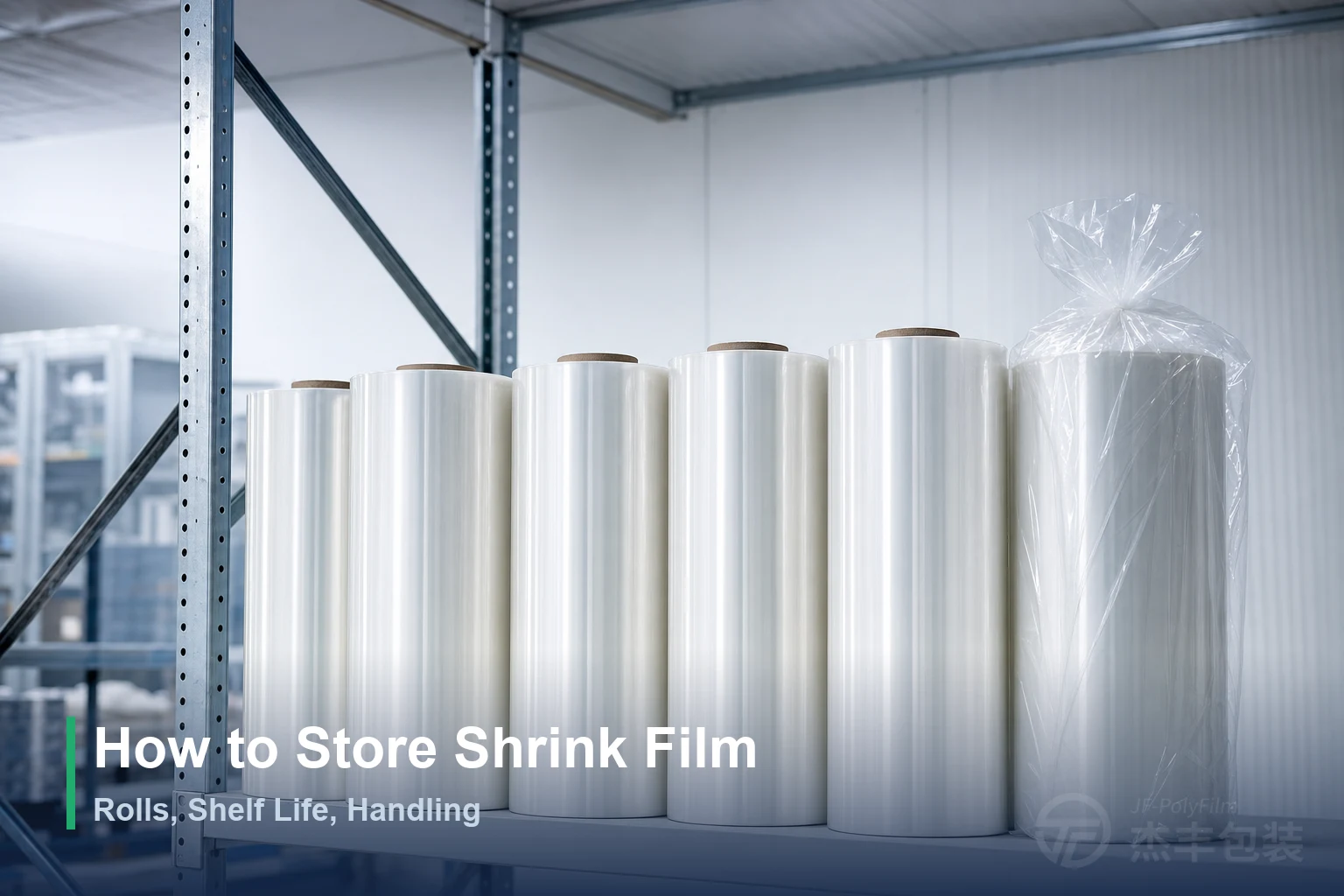
How to Store Shrink Film: Rolls, Shelf Life, Handling
What the 10–30°C, 12-month storage window actually protects, how to stand rolls so they don't flat-spot, and why film has to acclimate before it reaches the line.
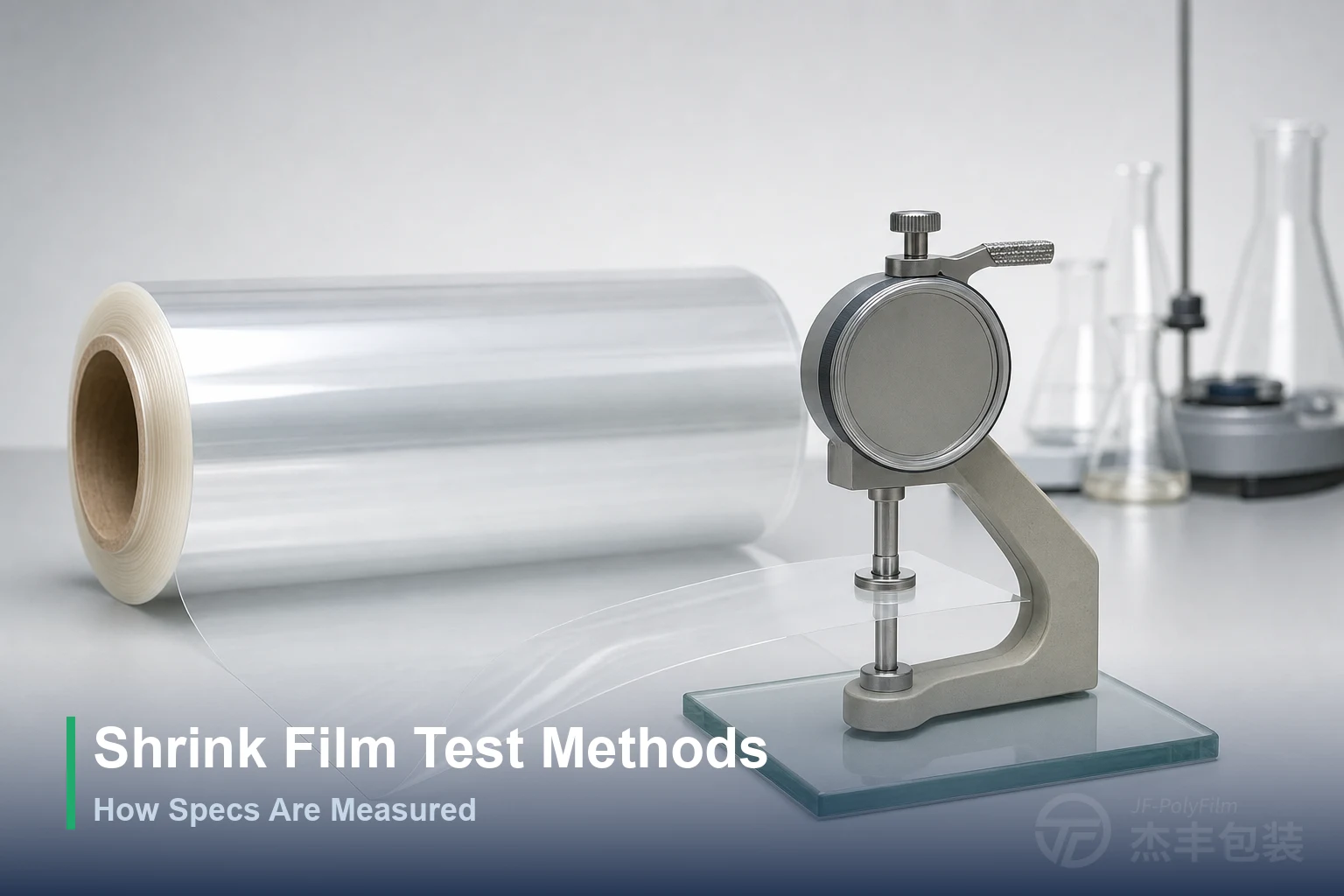
Shrink Film Test Methods: How Specs Are Measured
Every figure on a shrink film datasheet or COA traces back to a standard method. See which ASTM and ISO tests measure shrinkage, tensile, haze, and gauge, and how to read the report.
Need Expert Advice on Shrink Film?
Our technical team can help you choose the right film for your application.
Contact Us