
What Is a Shrink Sleeve Label?
How shrink sleeve labels wrap a container 360°, why the film shrinks, the materials they use (PETG, PVC, OPS, PLA), how they print and recycle, and how to choose a grade.
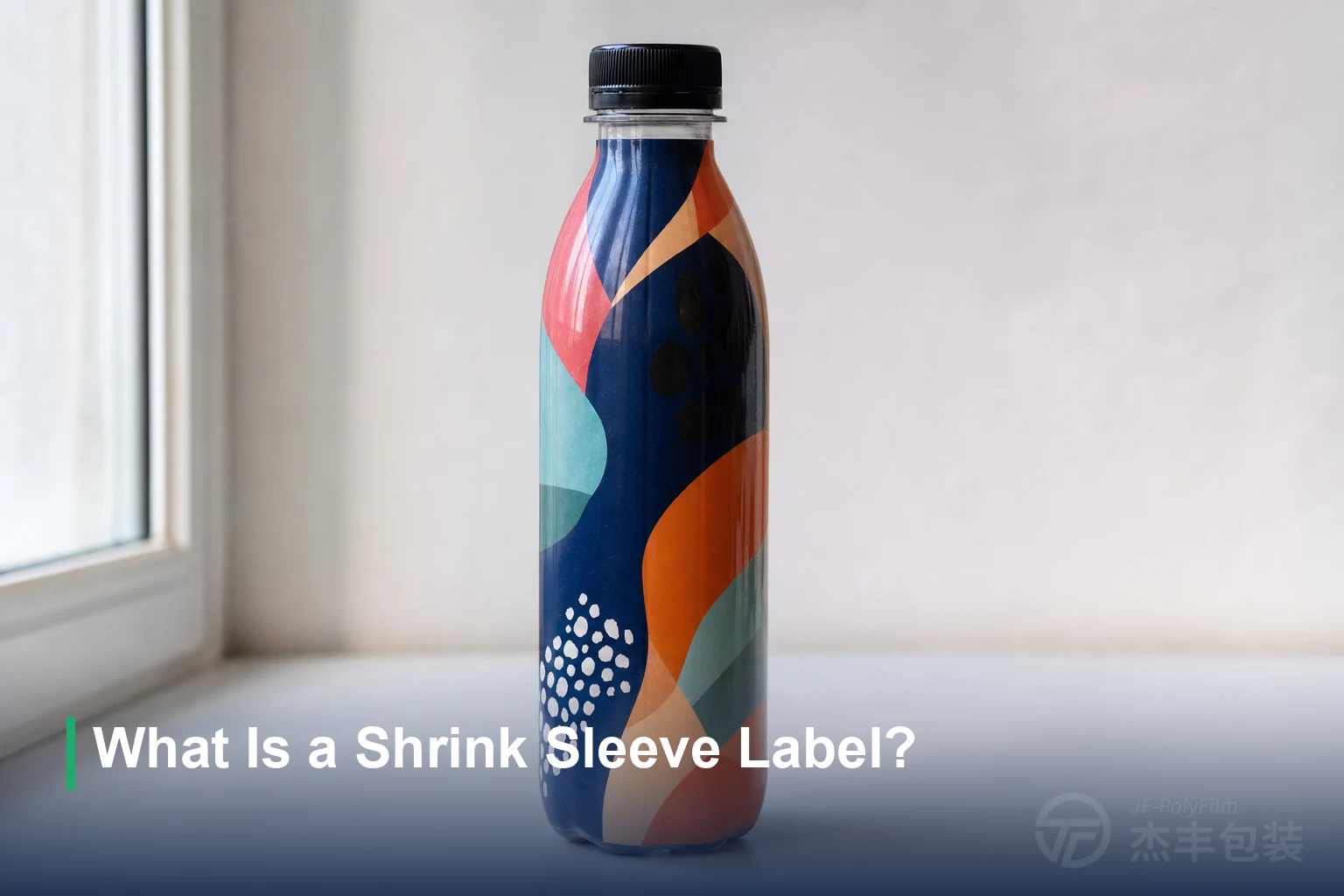
A shrink sleeve label is a printed plastic film, formed into a tube, that is slid over a container and heated so it shrinks tightly around the full 360° of the surface — no adhesive, no separate front and back panels.
Key takeaways
- A sleeve grips its container because the film carries “heat memory”: stretched and frozen during manufacturing, it contracts back toward its original size when reheated in a shrink tunnel.
- Sleeve film is oriented mainly across its width, so it shrinks around the circumference (transverse direction) while vertical (machine-direction) movement stays minimal and the artwork keeps its position.
- PETG, part of the PET polyester family, reaches high transverse shrink (up to roughly 75-78%), suiting tapered and hourglass shapes; PVC offers a wider, lower-cost shrink window (about 40-65%).
- Recyclability turns on density: PET sits near 1.38 g/cm³ and PVC sinks with it, contaminating the PET wash, whereas a floatable film below 1.0 g/cm³ separates cleanly.
- The Resin Identification Code marks the resin — RIC 1 is PET, RIC 3 is PVC — but it does not by itself mean an item is collected curbside.
What a shrink sleeve label actually is
Three traits set a sleeve apart from a flat label, and all of them follow from the wrap. First, there is no adhesive between film and container; heat alone holds the sleeve once it grips the profile. Second, the decoration usually prints on the inside surface of the film, so the ink sits between the plastic and the container and resists scuffing in handling and transit. Third, the tube slides on before any heat is applied, so a single piece of film can hug tapered, hourglass, and compound-curved shapes that a flat label would have to wrinkle, lift, or split across to cover at all.
Shrink sleeves vs. pressure-sensitive labels
A shrink sleeve wraps the full body of a shaped container with no adhesive, while a pressure-sensitive label is a die-cut sticker pressed onto one flat or gently curved panel. The split decides which container geometries and which graphics each format can serve.
The sleeve’s wrap-around tube turns the whole package into print area, giving substantially more design surface than a one- or two-panel sticker and a seamless graphic with no visible label edge to peel or catch. It conforms where adhesive labels fail — necks, waists, and compound curves — and the same film can bridge a cap to add tamper evidence. A pressure-sensitive label, by contrast, applies in a single pass without heat and stays simpler and cheaper on straight-walled bodies that need only a front panel. The full economics and decoration trade-off between sleeves and other label formats runs deeper than this overview can settle. In practice, a shaped container or one that needs print across its whole body calls for a sleeve, while a plain cylinder that needs only a single front panel is cheaper to label with a sticker.
Why the film shrinks: heat memory and orientation
Shrink film contracts because of orientation locked in during manufacturing. Above its softening point the film is stretched, then quenched so the stretched molecular chains freeze in their extended arrangement; reheating in a tunnel lets those chains relax back toward their original, unstretched state, and the film pulls in.
That stored strain is the whole mechanism. A cast, un-oriented film of the same resin would barely move under the same heat — it carries no memory of a stretched state to return to. The amount a sleeve recovers depends on how far it was stretched and how completely the structure was frozen, which is why a single resin can be engineered into a low-shrink or a high-shrink grade. It also explains the activation window: the film does almost nothing until the tunnel reaches the temperature where the chains regain enough mobility to relax, then contracts quickly over a narrow band, which is why tunnel temperature and dwell time are tuned to the grade rather than guessed.
TD vs. MD: the direction that makes sleeves work
A sleeve has to grip the container’s girth without shrinking vertically and dragging the print out of register, so the two shrink directions are engineered apart. Transverse shrink (across the film width, which becomes the circumference) is made high; machine-direction shrink (along the running length) is kept low.
In a finished sleeve, the transverse direction runs around the bottle and does the gripping, while the machine direction runs top to bottom and must hold still so the design does not foreshorten. Specifications therefore list two figures, not one. The clear PETG grade in the JF range measures TD ≥75% with MD ≤3.0% — high circumferential pull, almost no vertical movement. Necks and shoulders have smaller diameters than the body, so they demand more circumferential travel; a high-TD material is exactly what lets a sleeve seat cleanly on a shaped bottle instead of tenting across the shoulder. The opposite orientation balance belongs to roll-fed wrap film, where shrink along the length matters and the application logic differs.
The films sleeves are made from
Shrink sleeve materials come down to a short list of plastics, each with a different shrink ceiling, cost position, and recycling behavior. No resin is best on every count — one shrinks tightest, another costs least, a third recycles cleanest — so the choice tracks container shape, clarity, and end-of-life target rather than a single headline number.
| Film | Shrink ceiling (TD) | Cost position | Recycling note |
|---|---|---|---|
| PETG | up to ~75-78% | premium | PET polyester family; sinks, so design-for-recycling matters |
| PVC | ~40-65% | low | sinks; releases chlorine compounds on incineration |
| OPS | moderate | low-mid | density near 1.0 g/cm³; lower shrink ceiling than PETG |
| PLA | moderate | premium/niche | bio-based; industrial-compost route, limited supply |
PETG, a glycol-modified PET, has become the dominant clear-sleeve material because its high transverse shrink seats cleanly on deeply tapered and hourglass containers. PVC carries a wide, forgiving shrink window at the lowest cost and was historically the most-used sleeve material, but it sinks in the recycling wash and releases chlorine compounds when incinerated. OPS (oriented polystyrene) shrinks less aggressively and sits at a density near water, but its lower shrink ceiling limits it to gentler shapes. PLA is bio-based and aimed at industrial composting, with supply and cost keeping it niche. The PET family also branches into recycling-oriented variants covered further down.
How a shrink sleeve is made: print to tunnel
A sleeve travels from flat film to finished package in four stages — print, seam, apply, shrink — and the film has to perform at every one: accepting ink, taking a seam, sliding over the container, and contracting evenly without distorting the artwork.
- Print. The design prints on the film, usually on the interior surface so the cured ink ends up protected between plastic and container. PET-family films generally carry enough surface energy to accept gravure, flexographic, or UV inkjet ink directly, often without a corona pre-treatment step. That property is confirmed per grade in the supplier specification rather than assumed. Two constraints shape this stage: the artwork is deliberately pre-distorted in prepress so it reads correctly only after the film shrinks, and the ink must cure without the hot-air drying that would prematurely shrink the web, so presses rely on chilled drums and UV or LED curing. The print methods and their trade-offs are covered separately; what matters here is that the film prints cold and shrinks later.
- Seam. The printed web is folded into a continuous tube and bonded along one edge with a seaming solvent, producing a flattened sleeve stock wound onto reels.
- Apply. The tube is cut to length and an applicator opens each sleeve and drops it over a container on the line.
- Shrink. The container runs through a shrink tunnel — steam, hot-air/electric, or radiant — that heats the film until it contracts. PET-family grades give their best result when the film reaches 95-100°C; because the tunnel air or steam runs hotter than that, the set point is tuned so the film hits its target without overheating. A heat gun is reserved for prototyping.
Where shrink sleeves are used
Shrink sleeves appear across consumer goods wherever full-body branding, an awkward container shape, or built-in tamper evidence carries weight. The same film that prints and shrinks cleanly serves beverages, cosmetics, household chemicals, and pharmaceuticals, with the grade tuned to each product’s clarity and opacity needs.
Beverage bottles take clear PETG for see-through 360° branding on water, juice, and energy drinks; the category’s specific demands — thin-wall bottles, high-speed lines, light-blocking grades for dairy — are detailed in shrink sleeves for beverage bottles. Cosmetics and personal care lean on high-TD clear or opaque film to seat on tapered bottles and jars. Household and cleaning products use durable sleeves on irregular detergent bottles and banding film to unite multipacks. Pharmaceutical closures rely on a sleeve or a short band that bridges the cap to signal interference, a sealing job the tamper-evident shrink band guide walks through. Across all of them the sleeve earns its place by doing two jobs in one heated film: decorating the package and, where needed, sealing or grouping it.
Recyclability: density, sink/float and the PET stream
Whether a sleeve is recyclable turns on what the resin does in the recycling wash, not on the number printed inside the triangle. Recyclers grind mixed plastic into flake and float it in water: material denser than water sinks, lighter material floats, and the two streams part. A sleeve’s density decides which side it lands on.
PET flake sits near 1.38 g/cm³ and sinks; PETG (around 1.28-1.33 g/cm³) and PVC also sink, so a PVC sleeve rides down with the PET flake and cannot be cleanly separated. That degrades the recycled PET. PVC additionally releases chlorine compounds if incinerated. Two engineered routes answer this. A floatable wash-off sleeve is built below 1.0 g/cm³ from a low-density resin such as a polyolefin, so it rises away from the sinking PET and is skimmed off the top of the wash tank. (OPS, near 1.05 g/cm³, sits just above water and sinks rather than floating, which is why it is not the resin used for the floatable route.) Alternatively, crystalline PET (CPET) keeps the sleeve in the same polyester family as the bottle, so it sinks and is recovered together with it. The Resin Identification Code (ASTM D7611) labels the resin type — RIC 1 PET, RIC 3 PVC — but it certifies identity, not curbside acceptance; how CPET and the PET stream interact in practice is set out in CPET and RIC 1 recycling explained.
The PET shrink-film family: PETG, RPET, CPET, BO-PETG
Inside the PET polyester family sit several sleeve grades that look similar but answer different end-of-life targets. Sorting them out is what lets a buyer match a film to a recycling goal rather than guessing from the word “PET” alone.
- PETG — the workhorse glycol-modified grade; a clear or white film is specified by two shrink figures and a gauge, which a buyer should see on the supplier’s datasheet and confirm by Certificate of Analysis (the JF clear and white films, for instance, measure TD ≥75%, MD ≤3.0%, thickness 30-60 μm).
- RPET — recycled PETG with post-consumer content specified per order (30%, 50%, or higher) and performance matching virgin film, certified under the Global Recycled Standard for verifiable recycled-content claims; how that supports packaging credentials is covered in RPET packaging explained.
- CPET — crystalline PET that shares the bottle’s chemical family and a high enough melting point to survive PET recycling, so it is recovered in the RIC 1 PET stream with the bottle with no separation step; the exact shrink figures and melt point are on the grade’s datasheet.
- BO-PETG — a biaxially oriented (BO) wash-off grade that shrinks along both axes so an adhesive-backed label releases in a hot-water wash for glass-bottle reuse, with the dual-axis figures specified per grade.
Each variant gives up one property to win a recycling route: RPET adds certified recycled content, CPET co-recycles with the bottle in the same stream, BO-PETG strips clean off returnable glass in the wash.
Choosing and specifying a shrink sleeve film
Choosing a sleeve film is a process of matching one grade to four things at once — the container’s shape, its clarity needs, the end-of-life target, and the press. Each factor narrows the field before any sample is cut.
- Container shape → shrink %. Deeply tapered or hourglass containers need high TD shrink (PETG-class); straight bodies tolerate lower-shrink, lower-cost film.
- Clarity vs. opacity. Clear film for see-through branding; white or opaque film to block light for sensitive contents such as dairy.
- Recycling target. CPET for co-recycling with the bottle, RPET for recycled content, or BO-PETG for glass-bottle wash-off — chosen against the market’s collection system.
- Print method. Gravure, flexographic, and UV inkjet all run on PET-family film; the method affects run economics and finish.
Once the grade is fixed, the specification turns into a quality question, and roll-to-roll consistency is where it is won or lost. A buyer can hold any supplier to the same short checklist rather than taking a datasheet on trust. Ask for a per-batch Certificate of Analysis that records shrinkage rate, thickness uniformity, haze, and tensile strength; ask what minimum sample length each batch is tested against; ask the splice policy and how many splices a roll may carry; and ask for traceable batch numbers so a problem roll can be traced back. JF film is built to clear those checks — five-meter minimum batch sampling, a Certificate of Analysis on every shipment, splice counts printed on the roll label — the same standard this checklist is meant to draw out of any vendor.
Then verify the sample before committing to volume: run a shrink test at the target tunnel temperature on the actual container, inspect the seam for a clean unbroken bond, and check the film for haze or distortion against the artwork. Vetting a supplier on the full set of points — MOQ, certificates, sampling, traceability — has its own guide in how to choose a PETG shrink film supplier. For a specific container and shrink target, sharing the required shrinkage rate and thickness lets the matching PET-family grade be confirmed against it.
Frequently Asked Questions
Are shrink sleeve labels recyclable?
What is the difference between a shrink sleeve and a wrap label?
What temperature does a shrink sleeve need?
Can shrink sleeves be tamper-evident?
Related Articles
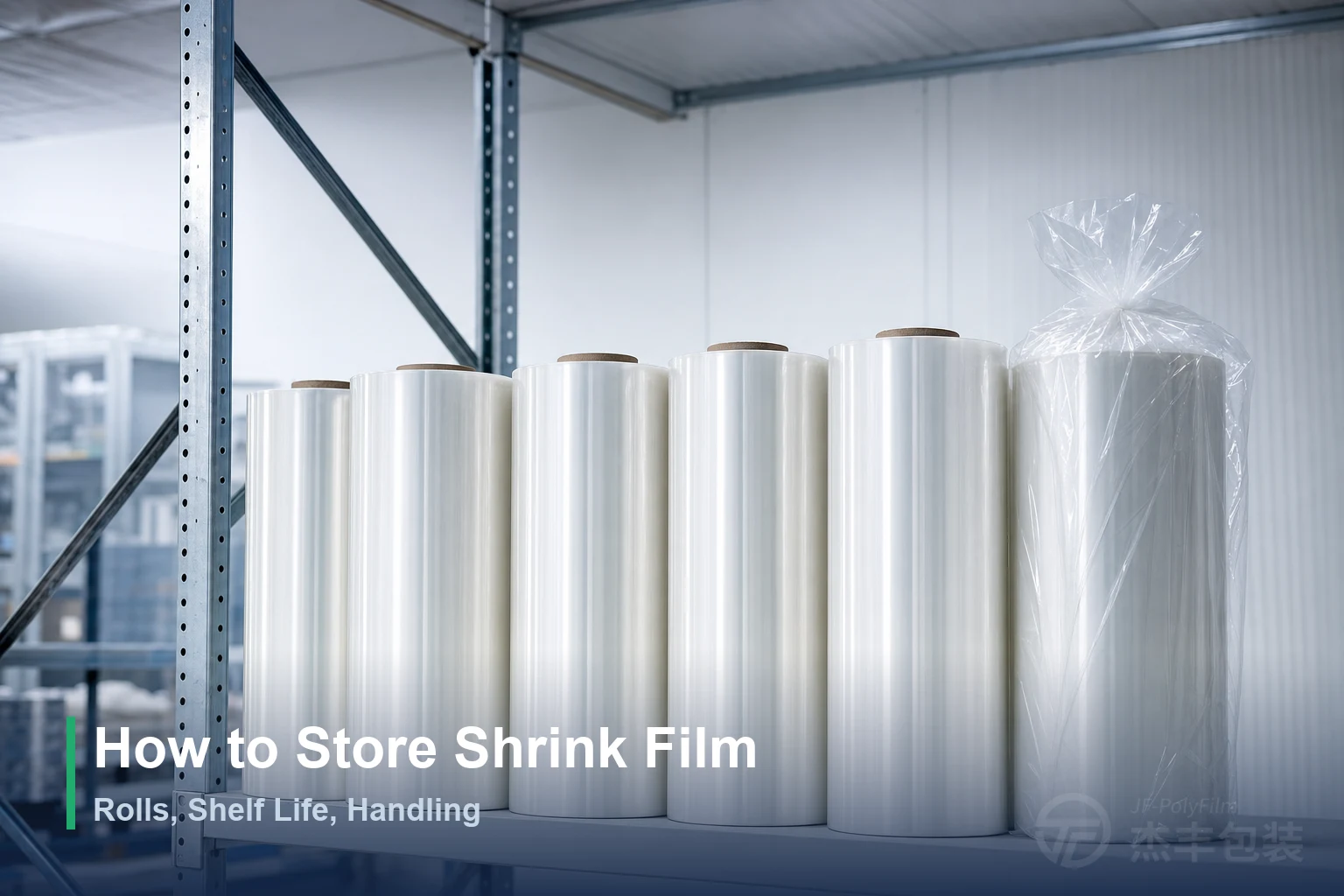
How to Store Shrink Film: Rolls, Shelf Life, Handling
What the 10–30°C, 12-month storage window actually protects, how to stand rolls so they don't flat-spot, and why film has to acclimate before it reaches the line.
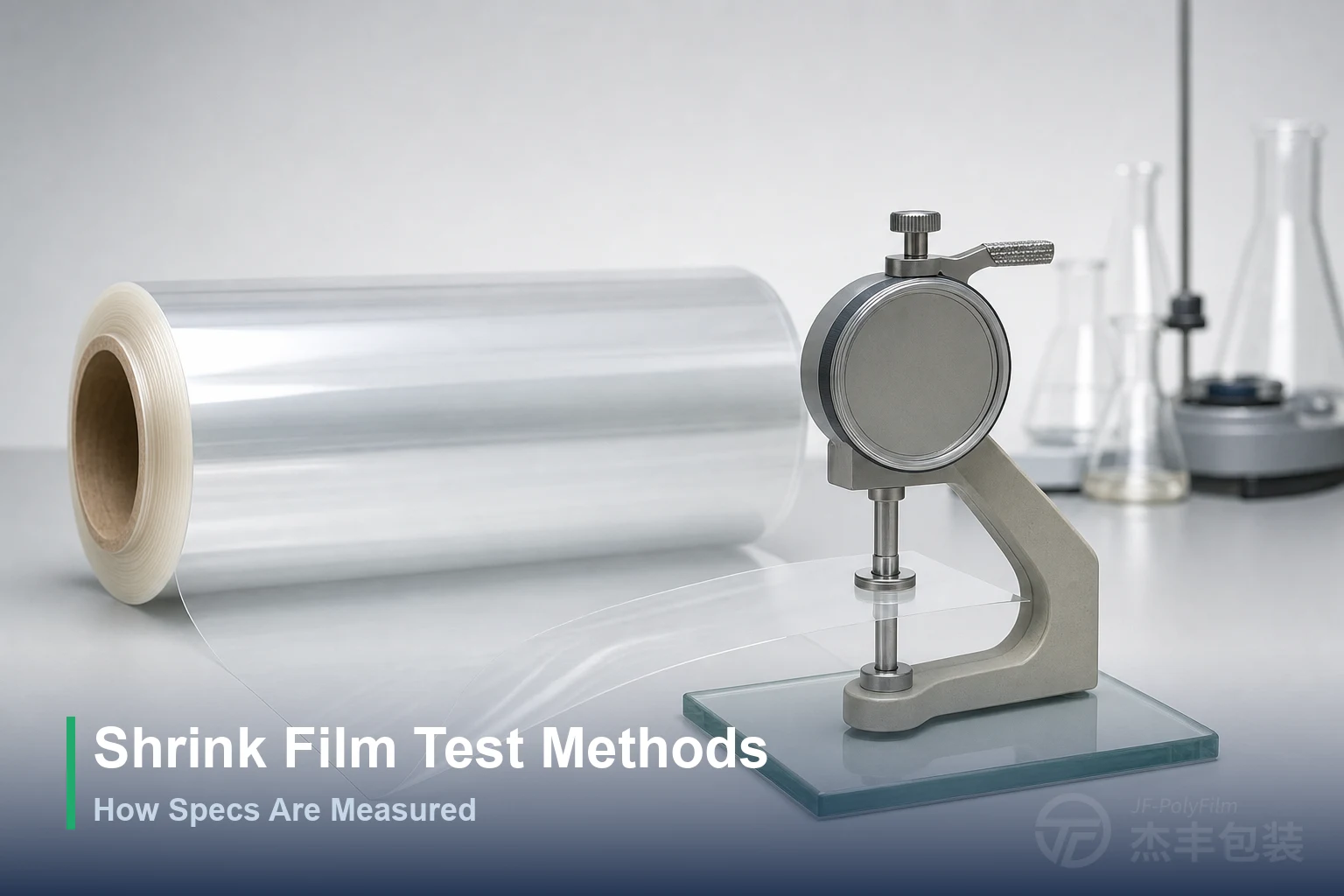
Shrink Film Test Methods: How Specs Are Measured
Every figure on a shrink film datasheet or COA traces back to a standard method. See which ASTM and ISO tests measure shrinkage, tensile, haze, and gauge, and how to read the report.
Need Expert Advice on Shrink Film?
Our technical team can help you choose the right film for your application.
Contact Us