
Are PET Shrink Sleeves Recyclable? Routes & Trade-offs
How PET shrink sleeve labels move through bottle recycling — the three design routes that keep them out of the contamination pile, and how US, EU, and China rules now judge them.
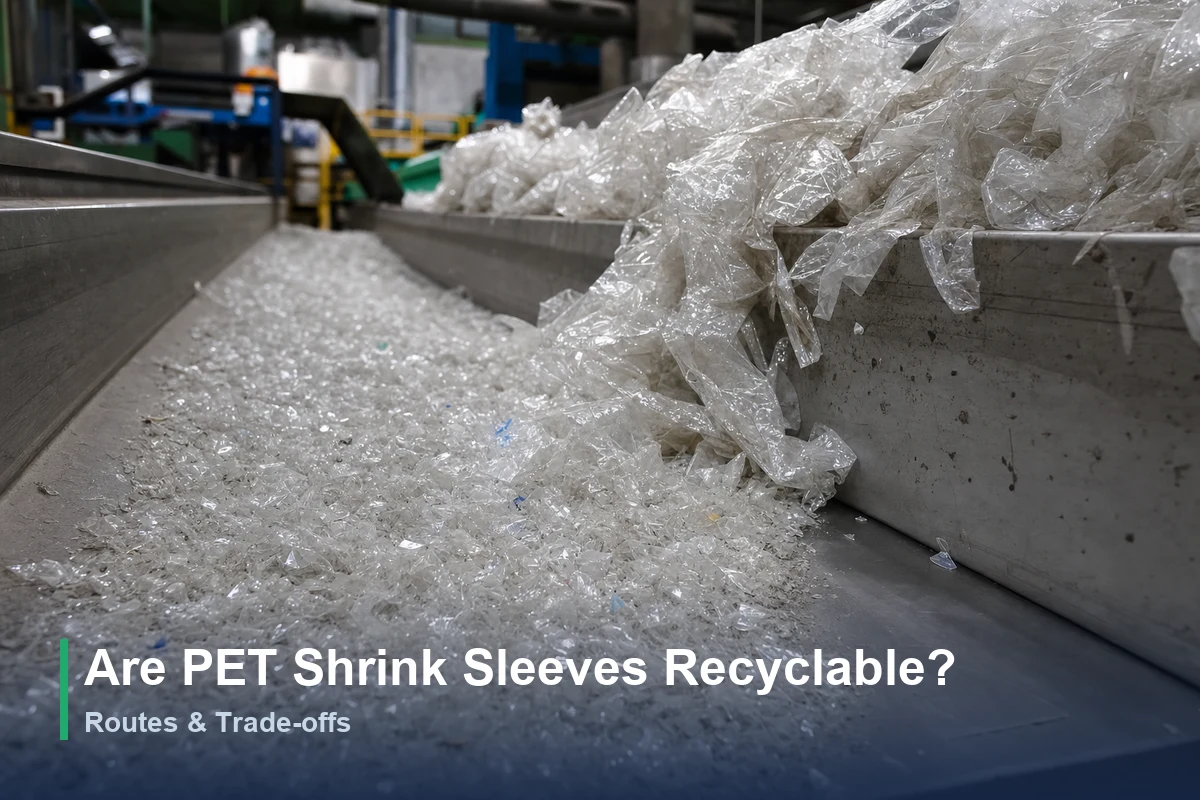
PET shrink sleeves can be recycled, but only when designed to do one of three things — travel with the bottle, separate cleanly during sorting, or release for bottle reuse. The deciding factor is the sleeve’s design, not the fact that it is made of PET.
That distinction matters because the same three letters cover materials that behave very differently at the recycler. The sections below trace how a sleeve actually moves through a recycling line, map the three design routes that keep a label out of the contamination pile, and set out how authorities in the United States, the European Union, and China now judge whether a sleeve passes.
Key facts before the detail:
- PET carries Resin Identification Code 1 and is one of the most-recovered plastics worldwide; whether a sleeve helps or hinders that recovery is a design decision, not a property of the polymer name.
- Sink-float sorting separates materials by density: bottle flakes (~1.38 g/cm³) sink, and a sleeve must come in below 1.0 g/cm³ to float off cleanly. A standard glycol-modified PET sleeve sits near 1.3 g/cm³ — close enough to bottle PET that it sinks with the flake instead of floating off, so it ends up in the recovered resin rather than being skimmed away.
- Crystallizable PET (CPET) shares the bottle’s chemistry, withstands recycling-line heat without softening into clumps, and can be recovered together with the bottle in the same RIC 1 stream.
- Recycled content and recyclable design are independent: one measures recycled material going into the film, the other measures whether the film can be recovered after use. A label can satisfy one and fail the other.
Why a sleeve’s fate is decided by design, not by the word “PET”
Recyclability is set by how a sleeve behaves inside a sorting and washing line, not by the polymer printed on the spec sheet. “PET” covers bottle-grade resin, glycol-modified PET for shrink, and crystallizable PET — chemically related but distinct in density and heat response, the two properties recyclers actually test against.
The widespread assumption is that any PET label rides along harmlessly because the bottle is PET too. Recyclers see the opposite often enough to have written guidance against it. A glycol-modified PET sleeve has a density close to the bottle yet not identical, a softening point lower than bottle-grade resin, and frequently a full-body ink layer — any one of which can downgrade the recovered material. The polymer family is the same; the processing behavior is not. This is why “PET, so recyclable” tells a buyer almost nothing — recyclability is set by design behavior, not the material name. That output-side question is separate again from the recycled content already sitting inside a film, an input-side credential the two are easy to conflate.
The density problem: how sink-float sorting sees a sleeve
Most PET reclaimers separate labels from bottle flakes in a water tank, and that single step explains the majority of sleeve recycling failures. After bottles are ground into flakes and washed, the mixed flakes enter a sink-float tank where separation is purely a matter of density relative to water at 1.0 g/cm³.
PET bottle flake, at roughly 1.38 g/cm³, sinks and is collected from the bottom as clean recovered PET. A label engineered below 1.0 g/cm³ floats to the surface and is skimmed off. The trouble lies between those two outcomes. A standard glycol-modified PET sleeve sits near 1.3 g/cm³ — denser than water, so it sinks rather than floating off, yet it is not bottle flake. It fragments into pieces that ride down with the sinking PET, and because it carries inks and a slightly different melt behavior, those fragments show up later as haze, color, and lowered intrinsic viscosity in the recovered resin. A second failure happens earlier, at optical sorting: near-infrared scanners read the outermost surface, so a full-body sleeve covering the bottle can mask the PET underneath and misroute the whole container. Both failures are geometric and physical, which is exactly why they can be designed out. The base resin behind many of these sleeves is ordinary clear PETG shrink film, prized for its shrink and clarity — strengths on the shelf that become the recyclability question at end of life.
Three routes to a recyclable PET sleeve
Rather than one fix, three distinct design routes each solve the density and sorting problem in a different way, and the right one depends on the container and the recycling system it will meet. One keeps the sleeve with the bottle, one separates them cleanly, and one releases the label so the bottle can be refilled.
| Route | How the label leaves the contamination path | Density behavior | Best-fit container | Regulatory read |
|---|---|---|---|---|
| A — Same-stream | Stays on, recycled with the bottle as one PET unit | Matches bottle PET, survives line heat | PET bottles, full-body sleeves | Compatible (APR-preferred where confirmed) |
| B — Separation | Floats off in the sink-float tank, inks wash out | Below 1.0 g/cm³, floatable | PET bottles where mono-material is not required | Compatible when float + de-ink confirmed |
| C — Reuse | Detaches in the bottle washer for refilling | Releases under hot caustic wash | Refillable glass | Supports reuse mandates |
The three routes are not ranked best-to-worst; each suits a different end-of-life system. A brand feeding a curbside PET stream leans toward A or B, while a refillable-glass operation needs C. Each route below comes down to the material that delivers it.
Route A — Same-stream recycling: PET that travels with the bottle
The cleanest outcome is a sleeve that is never separated at all, because it is recovered as part of the bottle. This requires a film with the bottle’s own chemistry plus enough heat resistance to pass through the recycling line without softening into clumps that foul the flake.
Crystallizable PET answers both demands. Because CPET shrink film shares the chemical composition of a PET bottle, the sleeve and bottle become a single material once flaked — there is no foreign polymer to skim, sink, or sort out. Our CPET grade holds a 230°C melting point, comfortably above the temperatures a standard PET-bottle recycling line reaches, so the label material is recovered alongside the bottle rather than degrading the batch. The same-stream route also has a lighter-weight variant: a thin-gauge sleeve carrying a vertical perforation line. Perforation lets the consumer strip the sleeve before disposal and helps optical sorters read the bottle correctly, which is why a perforated thin sleeve is treated as a design-preferred fallback. The distinction matters: crystallizable PET is recovered whether or not anyone removes it, while perforation only helps if the consumer actually tears the sleeve off.
Route B — Separation recycling: float-off sleeves and washable inks
Where matching the bottle’s polymer is not required, the alternative is to make the sleeve obvious to the sink-float tank by sending its density firmly below water’s. A sleeve formulated under 1.0 g/cm³ — usually built on a polyolefin layer structure rather than PET — floats the instant it reaches the wash tank, the bottle flake sinks, and the two part company without any manual step.
Floatability handles the polymer; inks are the second half of the route. Heavy or solvent-bound ink layers can bleed into the wash water and tint the recovered resin even after the carrier film floats away. De-inkable and washable ink systems are formulated to lift off the film during the hot caustic wash stage — roughly 80–90°C — so the pigment leaves with the wash effluent instead of staining the flake. The ink choices that survive printing yet release in the wash are a printing-process decision as much as a material one, which is why recyclable separation depends on the PET shrink sleeve printing methods used as much as on the base film. Float-off films are widely available across the industry and are not specific to any one supplier. Because that polyolefin layer system sits apart from the PET-based routes elsewhere in this guide, a buyer specifying this route is not buying a PET sleeve at all and should source it as its own category. The two properties that decide whether such a film actually separates are worth verifying directly: ask the supplier for a measured base-film density (target below 1.0 g/cm³) and a de-inking result under hot caustic wash, since a floatable film printed with non-washable ink still loads the wash water with color.
Route C — Bottle reuse: wash-off labels for refillable glass
A third route applies when the container is not recycled at all but refilled. Refillable glass bottles are washed and reused many times, and the label needs to leave the glass cleanly inside the existing bottle-washing equipment rather than be scraped off by hand.
Clean release here is primarily an adhesive-chemistry function: a hot-caustic-activated adhesive swells in the wash bath and lets go of the glass, which is what carries most wash-off label systems. PETG bidirectional shrink film contributes the mechanical half — it shrinks along both axes, so when the bottle enters the wash the dual-axis tension helps peel the freed label clear of the glass rather than leaving it to soften in place. Standard bottle-wash cycles run at 70–85°C with caustic detergent for ten to twenty minutes, and both the adhesive release and the bidirectional shrinkage activate squarely in that window — the label comes off as part of the normal wash, with no separate de-labeling station added to the line. This keeps the glass in a closed bottle-to-bottle loop, where the same container is filled and refilled rather than melted down between uses. The route is narrower than the first two because it serves reusable glass specifically, but for breweries and beverage lines built around returnable bottles it is the design that makes reuse practical at speed.
Recycled content versus recyclable design: two things buyers keep confusing
Recycled content and recyclable design are not the same axis, yet buyers routinely pay for one believing they bought the other. Recycled content measures recycled material going into the film; recyclable design measures whether the film can be recovered after use. They move independently — a sleeve can score on one while failing the other.
Recycled content lives on the input side. RPET shrink film is built with verified post-consumer recycled material — our grade offers customizable content at 30%, 50%, or higher per order, certified under the Global Recycled Standard (GRS) with supply-chain traceability so the claim withstands audit. That credential supports carbon-reduction and circular-sourcing targets. What it does not automatically deliver is end-of-life recyclability: a recycled-content sleeve still has to clear the density and ink hurdles of whatever stream it lands in, exactly like a virgin one. The reverse holds too — a crystallizable PET sleeve made from virgin resin is highly recyclable while carrying no recycled content at all. A buyer with a recyclability target should specify the design route; a buyer with a recycled-content target should specify the percentage and certification; a buyer who needs both must ask for both, because neither implies the other.
How the US, EU, and China now judge a sleeve’s recyclability
Three major markets have moved recyclability from a marketing claim to a tested requirement, and each runs its own rulebook. A sleeve that satisfies one region’s framework is not automatically clear in the others, so an exporter has to read all three against the destination.
In the United States, the Association of Plastic Recyclers (APR) publishes design guidance that sorts label and sleeve choices as Preferred, Detrimental, or requiring testing against the PET stream. Materials that disrupt PET recycling — PVC and PLA among them — are classed as detrimental, which steers brands toward same-stream or float-off designs. In the European Union, the Packaging and Packaging Waste Regulation (PPWR) makes design-for-recycling mandatory: from 1 January 2030 every package must reach at least recyclability grade C, or it is classed non-recyclable and barred from the EU market, and from 1 January 2038 the floor rises to grade B — a trajectory that pushes full-body, hard-to-separate sleeves toward redesign well before those dates. In China, recyclable design is assessed through national standards including GB/T 16716 for packaging recyclability and GB/T 18455 for recycling marks, framing the same single-material and clean-separation principles in the domestic system. Across all three markets the rule matches the engineering: same-material or clean-separation designs pass, and density mismatch with heavy non-washable inks does not.
What still does not recycle well — the honest boundaries
Not every sleeve problem is solved, and a credible recyclability claim has to name the limits. Three cases still resist clean recovery regardless of the route chosen.
The first is decoration that overwhelms the wash. Very heavy ink coverage, metallic foiling, and unsuitable adhesives can survive the caustic wash and carry into the recovered PET, where they show as haze, brown tint, and reduced intrinsic viscosity — the resin still recycles, but to a lower grade. The second is the category confusion around bio-based film: a PLA or compostable sleeve may be certified to compost industrially, but in a PET recycling stream it acts as a contaminant, so compostable is an end-of-life path of its own and not a substitute for recyclable. The third is cross-polymer contamination, with PVC the long-standing offender — even small amounts degrade a PET batch, which is one of the clearest reasons the industry shifted shrink labels away from it, a shift covered in detail in PETG vs PVC shrink film. Naming these boundaries is what separates a designed-for-recycling sleeve from one merely labeled recyclable.
Matching the sleeve to its end-of-life route is the whole exercise: same-stream, separation, or reuse each point to a different film. For brands targeting recovery with the bottle as one PET unit, CPET shrink film is the starting grade to specify.
Frequently Asked Questions
Can shrink sleeves be recycled in home or curbside collection?
Does the consumer have to remove the sleeve before tossing the bottle?
Is an RPET sleeve the same thing as a recyclable sleeve?
Why does a full-body sleeve cause sorting problems even when it is PET?
Are bio-based or compostable shrink sleeves recyclable?
Related Articles
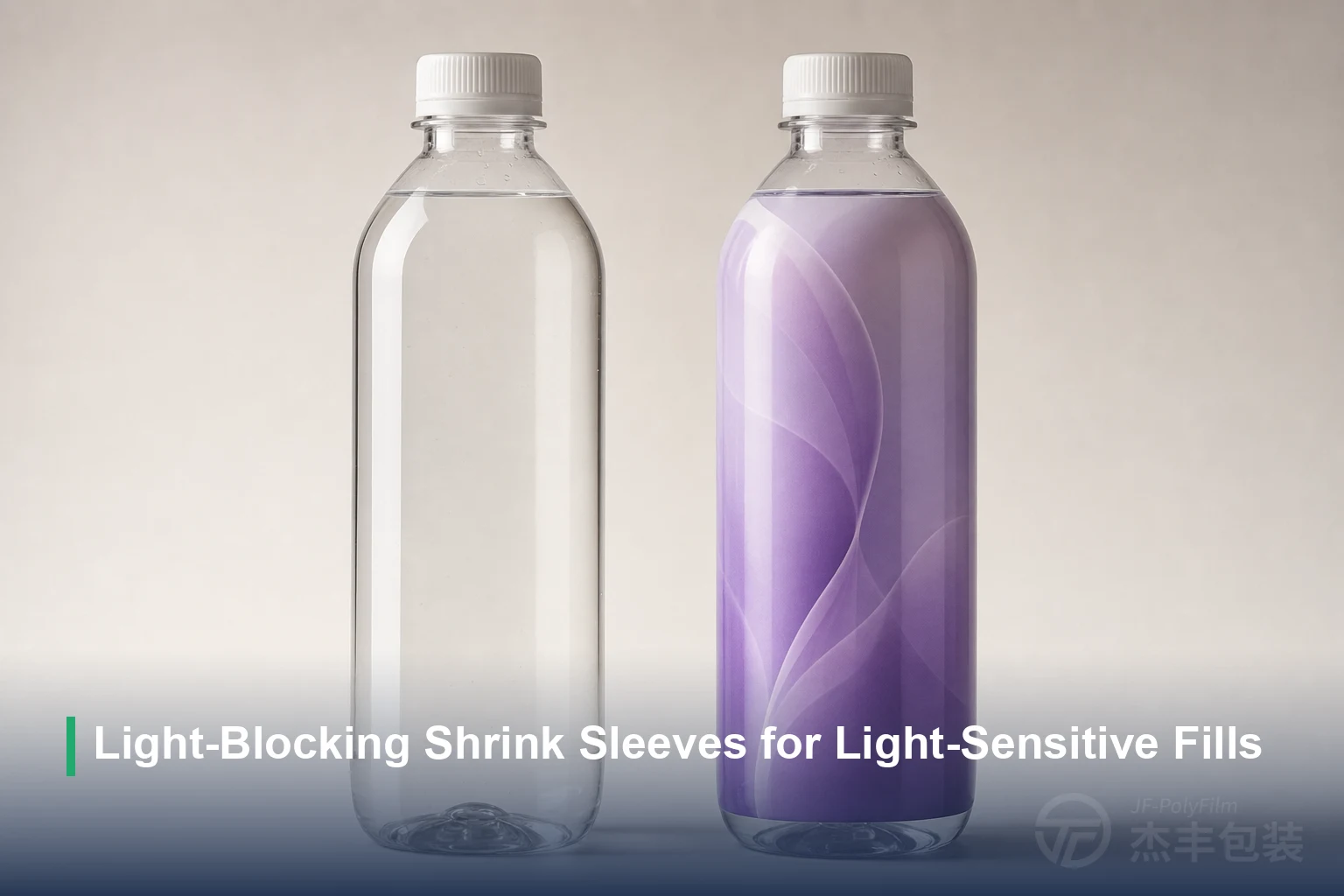
Light-Blocking Shrink Sleeves for Light-Sensitive Fills
Beer, dairy, supplements, and some medicines degrade under light. Which fills need protection, and how a full-body opaque PETG sleeve wraps the whole container to keep light off the contents.
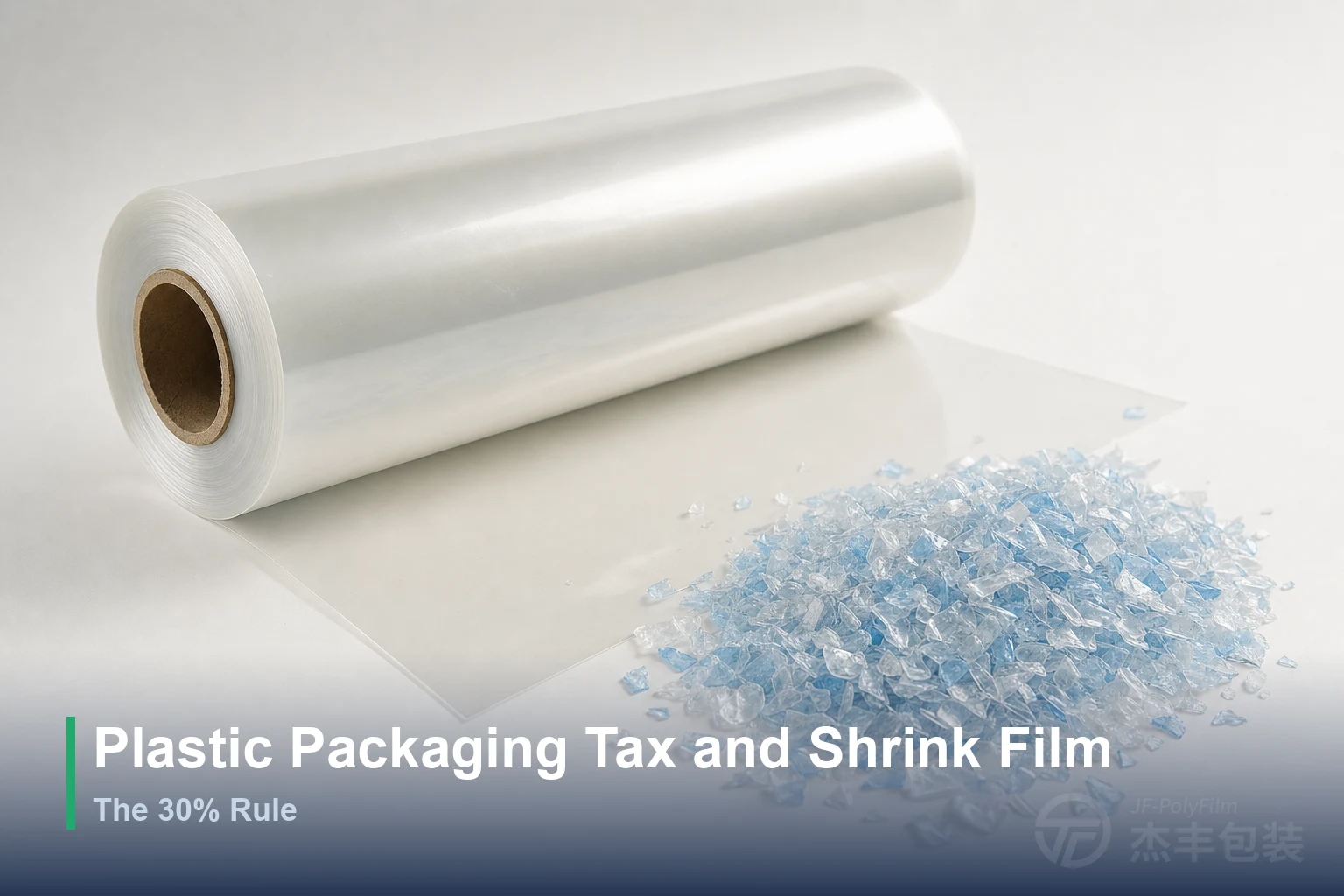
Plastic Packaging Tax and Shrink Film: The 30% Rule
How plastic packaging taxes in the UK, Spain, Italy and the EU treat shrink sleeves, why the 30% recycled-content threshold is the number worth remembering, and how RPET film helps a sleeve cross it.
Need Expert Advice on Shrink Film?
Our technical team can help you choose the right film for your application.
Contact Us