
PETG vs PVC Shrink Film: Shrinkage, Recycling & Cost
PETG vs PVC shrink film compared on shrinkage, distortion control, clarity, PET recycling, chlorine, and delivered cost — plus where each still fits.
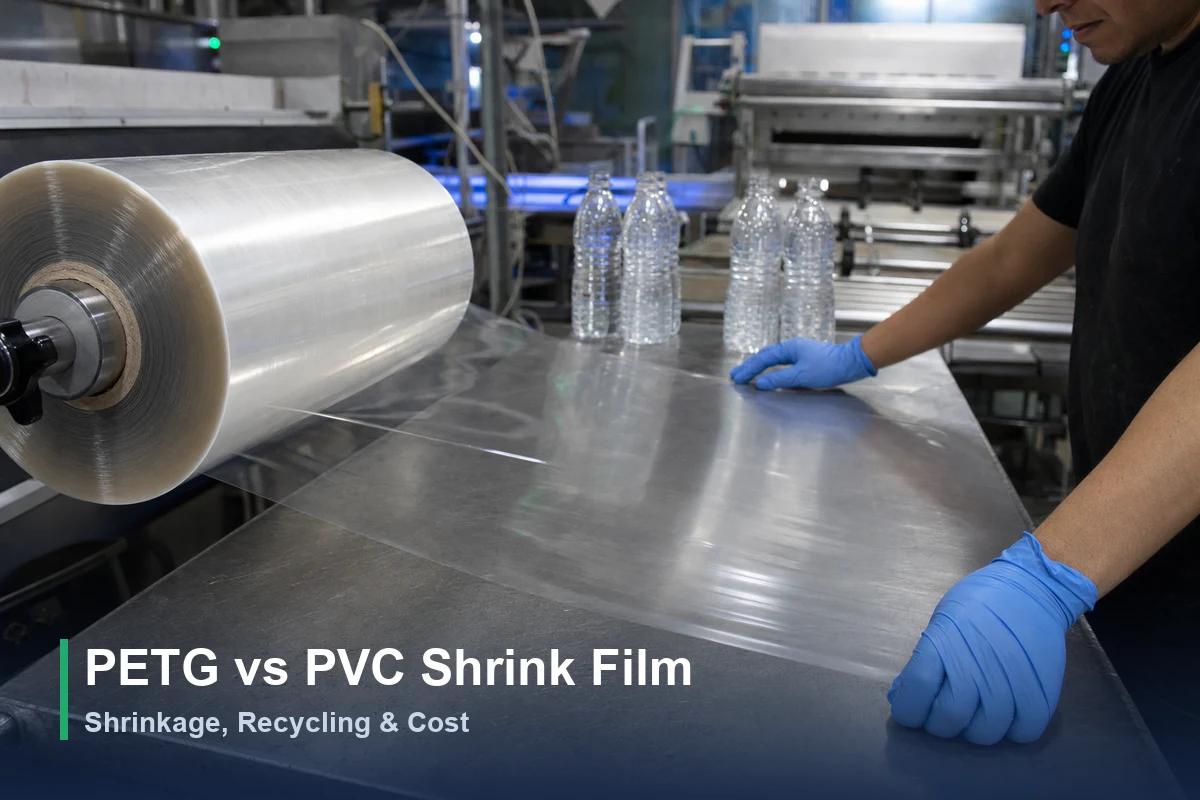
PETG is a higher-shrink, chlorine-free polyester film that conforms tightly to shaped bottles, while PVC holds a lower resin cost but a lower shrink ceiling and carries chlorine through incineration and recycling. A new sleeve program therefore usually defaults to PETG — though the recycling question is subtler than the slogans suggest, which is where most of this comparison goes.
- PETG reaches roughly 70-78% transverse shrink (commonly specified at ≥75%) against PVC’s ~50-60%, the single biggest reason brands switch for shaped containers.
- PET flake sits near 1.38 g/cm³, PETG runs slightly lighter at ~1.27-1.33, and rigid PVC lands around 1.30-1.45 — all three sink in water, so none separates from PET flake on density alone.
- PVC is about 57% chlorine by weight; incineration can form dioxins, and even trace PVC degrades recycled PET, whereas PETG entering the same stream is melt-filterable.
- The genuinely bottle-compatible sleeve is crystallizable PET (CPET), which recovers with the bottle in the RIC 1 PET stream and shares the bottle’s 230°C-melting chemistry.
PETG vs PVC at a glance
The films separate on a handful of properties that decide a sleeve specification. The table stays at the material level; resin cost is shown qualitatively, since pricing moves constantly and varies by region, gauge, and order profile.
| Property | PETG | PVC |
|---|---|---|
| Transverse shrink (TD) | ~70-78% (commonly ≥75%) | ~50-60% |
| Machine-direction shrink (MD) | Low, typically ≤3% | Higher, less controlled |
| Density | ~1.27-1.33 g/cm³ | ~1.30-1.45 g/cm³ |
| Clarity / gloss | Glass-clear, high gloss, holds clarity | Good, lower gloss, yellows with age |
| Chlorine | Chlorine-free | ~57% chlorine by weight |
| Printing | Gravure, flexo, UV inkjet | Gravure, flexo |
| Behavior in PET recycling | Off-spec but melt-filterable; CPET variant recovers with bottle | Trace amounts contaminate recycled PET |
| Relative resin cost | Modest premium | Lower |
The films supplied here sit on the PETG side of this table, with clear PETG specified at TD ≥75% and MD ≤3.0%, and a CPET grade at TD 74±2% for bottle-stream recovery.
Shrinkage and fit: why curvature decides
Transverse shrink settles most sleeve specifications, and it is where the two films are furthest apart. PETG reaches roughly 70-78% in the transverse direction, frequently specified at 75% or above, while PVC reaches only about 50-60%. The consequence is geometric rather than abstract. A sleeve has to contract by whatever percentage the deepest waist or narrowest neck demands, and a film topping out near 60% cannot close that gap on a deeply contoured or full-body shape. PVC handles cylinders and gentle tapers cleanly, but on compound curves it bridges across the tightest radii and leaves wrinkles or slack at the shoulders. Square and flat-oval bottles expose the limit fastest, since their bottom arcs ask for shrink PVC does not have in reserve. PETG’s higher ceiling lets the film draw in past those radii and decorate the full body edge to edge.
A rough routing follows from that gap. Cylinders and lightly tapered bottles stay inside PVC’s range; pronounced waists, square or oval cross-sections, and full-body wraps push beyond it and call for PETG. Usable shrink also sets how forgiving the sleeve is at design time. A film with reserve to spare can be cut slightly oversize and still pull in clean, widening the tolerance band the converter works within; a film near its ceiling must be sized tightly, so any drift in seam diameter or bottle dimensions shows as a loose or strained sleeve. That margin is part of why high-shrink polyester is the safer choice when one film has to serve a family of related bottle shapes rather than a single fixed geometry.
The higher shrink does demand process discipline: high-shrink film needs an even tunnel — a boiling-water bath, steam, or hot-air tunnel running near 90-100°C — so it draws down uniformly rather than locking in early on one face. The two materials respond to heat differently. PVC shrinks at lower temperatures and reacts fast, which suits short, low-energy tunnels but leaves a narrow window before over-shrink; polyester grades pull in over a broader, more gradual curve that tolerates line-speed variation. Uneven heat is the usual cause of distortion on either film — a tunnel-tuning matter rather than a material fault — and the common PETG application defects are treated separately.
Distortion control: where machine-direction shrink earns its keep
Machine-direction shrink is what protects the printed artwork. A sleeve is engineered to shrink hard around the bottle’s circumference (transverse) while holding its height almost constant (machine direction). PETG grades pair high transverse shrink with low MD shrink — commonly only a few percent — so as the film tightens around the container it does not also pull vertically and compress the graphics. Logos keep their proportions, barcodes stay scannable, and small type along the bottle’s height does not crush into itself.
PVC’s machine-direction behavior is less controlled by comparison, which is one reason long vertical text and tall logos distort more readily on a PVC sleeve over a contoured profile. On a plain cylinder the effect is mild, with little curvature to force uneven draw. On a shaped bottle, where transverse shrink is already working hard, a film that also moves in the machine direction stacks one distortion on another. Low, predictable MD shrink is therefore part of why high-shrink polyester reproduces a full-body design faithfully — the film carries the print through the tunnel rather than fighting it.
For the buyer, that low, repeatable MD shrink shows up at incoming inspection. Every label in a run draws to the same height, so the artwork reads consistently from one sleeve to the next rather than printing crisp on one bottle and squashed on another. Re-ordering, or shifting a job to a related bottle in the same family, rarely forces fresh proofing either, because the distortion compensation built into the artwork still holds. A film whose vertical shrink wanders run to run does the opposite: it widens the safety margin the design has to carry, blunts fine detail, and raises the odds of a reprint — and a reprint is lost time against a delivery date as much as lost film. That stability rarely earns a line on the spec sheet, yet it is the quiet reason a high-shrink polyester sleeve reproduces a full-body design faithfully and reorders cleanly.
Clarity, gloss and aging
On shelf, PETG reads as glass-clear with a high-gloss surface, and that optical quality is much of why premium brands moved to it. High-clarity PETG grades transmit upward of 90% of visible light at low single-digit haze, which keeps printed graphics crisp and makes a transparent “no-label look” workable where the design calls for one. PVC grades vary, but on a like-for-like premium grade PETG generally finishes glossier and lower in haze. PVC also tends to yellow with age and UV exposure and can whiten slightly after shrinking, while PETG holds its clarity over a longer service life.
That gap is not always load-bearing. On an opaque or heavily printed sleeve the film surface barely shows, and clarity rarely decides the spec. It matters most on transparent designs and high-end cosmetic finishes where the film itself is part of the brand impression. Optical targets — light transmission, haze, and gloss thresholds, and how to read them on a spec sheet — are covered in the transparent label film performance guide.
Aging also reaches past printing into storage and field life. A clear PETG film held cool and dry and used inside its rated shelf life keeps the optical properties it left the line with, so a roll specified at a given haze and gloss prints to that standard months later. PVC’s drift toward yellowing means the appearance a buyer signs off on a fresh sample can shift on stock that sits, on labels exposed to light at retail, or over a long product life on shelf. For a transparent or premium spec, that stability is part of the value — the impression the design was built around is the one the consumer still sees — though it matters little on opaque, fast-moving stock.
Printing and decoration
Both films accept the main sleeve print processes, gravure and flexography, and PETG additionally runs well on UV inkjet for shorter or variable runs. Ink anchorage is where the first practical difference appears: PETG grades with high inherent surface energy, including the films supplied here, take ink directly without corona pre-treatment, which removes one step on the press and one variable from the job. PVC generally needs the standard surface preparation that most label films do.
The substrates also behave differently once the ink is laid down. A solvent-printed PVC sleeve usually needs an extended degas-and-cure window — commonly several hours, often best left overnight — before the web is sound enough to convert, as residual solvent works its way out of the print. A PETG web is generally ready once the print is dry to the touch, which shortens the gap between printing and seaming and frees the floor space PVC ties up in curing stock. Against that, PVC is the more forgiving film through the tunnel, tolerating local touch-ups that a higher-shrink polyester resists — so the trade is a little shrink-stage latitude for a faster print-to-convert flow.
Past those substrate-specific points, the films behave similarly enough on press that the print decision usually turns on run length, color count, and finish. The trade-offs between gravure, flexo, and digital for sleeve work — resolution, plate cost, and economic break-even by volume — are laid out in the PET shrink sleeve printing methods guide rather than repeated here.
Seaming behaves comparably across the two materials at the bench. Both PETG and PVC sleeves are closed with a THF-based seaming solvent that tackifies the surface so the overlap welds to itself, so a converter switching a job from PVC to PETG keeps the same seaming principle rather than learning a new joining method. The practical differences are second-order. A PETG film carries higher inherent shrink, so the seam and the adjacent layflat are cut and registered for the larger draw, and the layflat width follows the bottle’s largest circumference and the film’s shrink reserve rather than a fixed rule of thumb. Because the solvents involved sit below ambient flashpoint, both materials run under the same ventilation and handling discipline — one more reason the move from PVC to a polyester film rarely forces new converting infrastructure, only a re-sized layflat and a re-mapped distortion profile.
Recyclability: the part most comparisons get wrong
Start with density, because the bottle-recycling line separates materials in a float-sink water bath. PET bottle flake sits near 1.38 g/cm³, PETG falls roughly between 1.27 and 1.33, and rigid PVC lands around 1.30-1.45. Every one of those numbers is greater than water’s 1.0, so all three sink. Only a polymer lighter than water — a polyolefin sleeve, for instance — floats clear of the sinking PET. A standard PETG sleeve does not, which is why “PETG floats off automatically” does not hold for an ordinary sleeve grade; the film sinks right alongside the flake.
From there the two materials diverge sharply once mixed in. PETG is chemically a polyester, the same family as the bottle, so when a full-body PETG sleeve reaches the extruder it does not poison the chemistry — small amounts are melt-filterable and tolerated, even if they still count as off-spec material that nudges recycled-PET quality down. PVC is the opposite case: a foreign polymer that recycled PET cannot tolerate even in minute quantities. Trace PVC introduces chlorine and visible specks and degrades whole batches of recovered resin, which is why bottle recyclers police PVC contamination down to very low limits. The honest, bottle-compatible route is crystallizable PET — CPET shrink film shares the bottle’s chemical composition and a 230°C melting point, so the sleeve recovers together with the bottle in the RIC 1 PET stream with no separation step required. The wider toolkit of floatable grades, perforations, and wash-off inks that let a sleeve release in the wash is covered in the PET shrink sleeve recyclability guide.
Chlorine, incineration, and the regulatory direction
Chlorine is the root of PVC’s regulatory exposure, and it is structural: PVC is about 57% chlorine by weight, not an additive that can be reformulated out. Incinerated, that chlorine can combine with organic matter to form dioxins and furans, a class of persistent pollutants, and the same chlorine is what contaminates recycled PET. Those two facts drive a steady tightening of PVC use in packaging across several markets, the direction of travel consistently toward more restriction rather than less.
The specifics matter, because the topic invites overstatement. There is no single EU-wide ban on PVC packaging. The EU’s Packaging and Packaging Waste Regulation (EU 2025/40) entered into force in early 2025 and generally applies from 12 August 2026; it caps the four regulated heavy metals — lead, cadmium, mercury, and hexavalent chromium — at a combined 100 mg/kg and presses every format toward recyclability, raising the bar for a chlorinated, hard-to-recycle film without naming it. In the United States, several states have advanced proposals targeting PVC in packaging. The accurate summary is a moving regulatory target rather than a prohibition. For a buyer the practical question is not whether PVC is legal today but whether it stays the right choice over the life of the artwork: a sleeve specified in PVC now can be the format that forces a material change, fresh testing, and a new approval cycle the year a key export market tightens. PETG sidesteps that path — chlorine-free films produce no dioxin pathway on incineration and carry none of cadmium, lead, mercury, or hexavalent chromium, keeping a multi-market program clear of the headwind for years at a time. Where third-party assurance is required, PETG can be supplied against recycled-content and material standards such as GRS, REACH, and the EU material framework.
Cost: resin price versus delivered cost
On raw resin, PVC is the cheaper film and PETG commands a modest premium — that part of the old reputation is accurate, and worth stating plainly. The picture shifts at the level of cost per finished sleeve. PETG’s higher shrinkage lets a single sleeve geometry run on less film, and the same shrink reserve allows down-gauging to thinner stock while still drawing in tightly, so each finished label consumes less material. Both effects pull consumption down and partly offset the higher per-kilogram price, making the delivered-cost gap narrower than the resin quotes alone imply. For many specifications it closes far enough that the recycling and regulatory factors, not price, decide the material.
Read across the life of a program rather than a single purchase order, PVC’s lower resin price also carries external costs that never appear on the per-kilogram quote: recycling penalties as bottle streams police contamination, exclusion from markets that restrict PVC, and the compliance documentation a chlorinated film increasingly demands. Those costs land on the total cost of the packaging even though they sit outside the resin invoice. Specifying a polyester film from the start also avoids the re-engineering cost hiding in the cheaper option — the redesign, re-test, and re-approval a PVC sleeve can need once a target market tightens. A delivered-cost comparison that leaves these factors out understates PVC’s true cost; one that includes them usually narrows or erases the apparent saving for any program with an export footprint or a recyclability commitment.
When PVC is still the honest choice
PVC has not vanished, and pretending it has would not help a buyer. It stays defensible in a specific corner: simple cylindrical or lightly tapered geometries that never test the shrink ceiling, cost-driven domestic or non-export runs where the lowest material price genuinely dominates, and lines built around existing PVC tunnels — PET-family labels generally run on those tunnels without major retooling, but a converter already amortized on PVC has little reason to switch on a job PVC handles well. Inside that box, PVC’s lower resin cost is a real advantage and the case for changing is weak.
Outside it, the factors line up the other way. Shaped and full-body bottles need shrink PVC cannot reach; markets tightening on chlorinated packaging make PVC a compliance liability; and any program with a recyclability commitment runs into PVC’s contamination problem in the bottle stream. For those programs the shrink, distortion, clarity, chlorine, and regulatory factors all point to PETG, and the resin premium is the smaller number in the equation. Whichever way a project lands, the decision is easier to defend when the brief asks the supplier to commit the load-bearing figures in writing — transverse and machine-direction shrink, whether the film is chlorine-free, and the intended recycling route (ordinary PETG versus a bottle-stream CPET grade) — so the material is chosen on specification rather than on a verbal assurance.
For shaped containers and recycling-conscious programs, the films supplied here include high-clarity PETG shrink film at ≥75% TD shrinkage, alongside a bottle-compatible CPET grade for RIC 1 recovery.
Frequently Asked Questions
Can PETG shrink film be recycled in the PET bottle stream?
Why does PETG sleeve a deep-waist bottle better than PVC?
Is PVC shrink film banned for packaging?
Does switching from PVC to PETG raise packaging cost?
What tunnel temperature suits a PETG sleeve versus a PVC one?
Related Articles
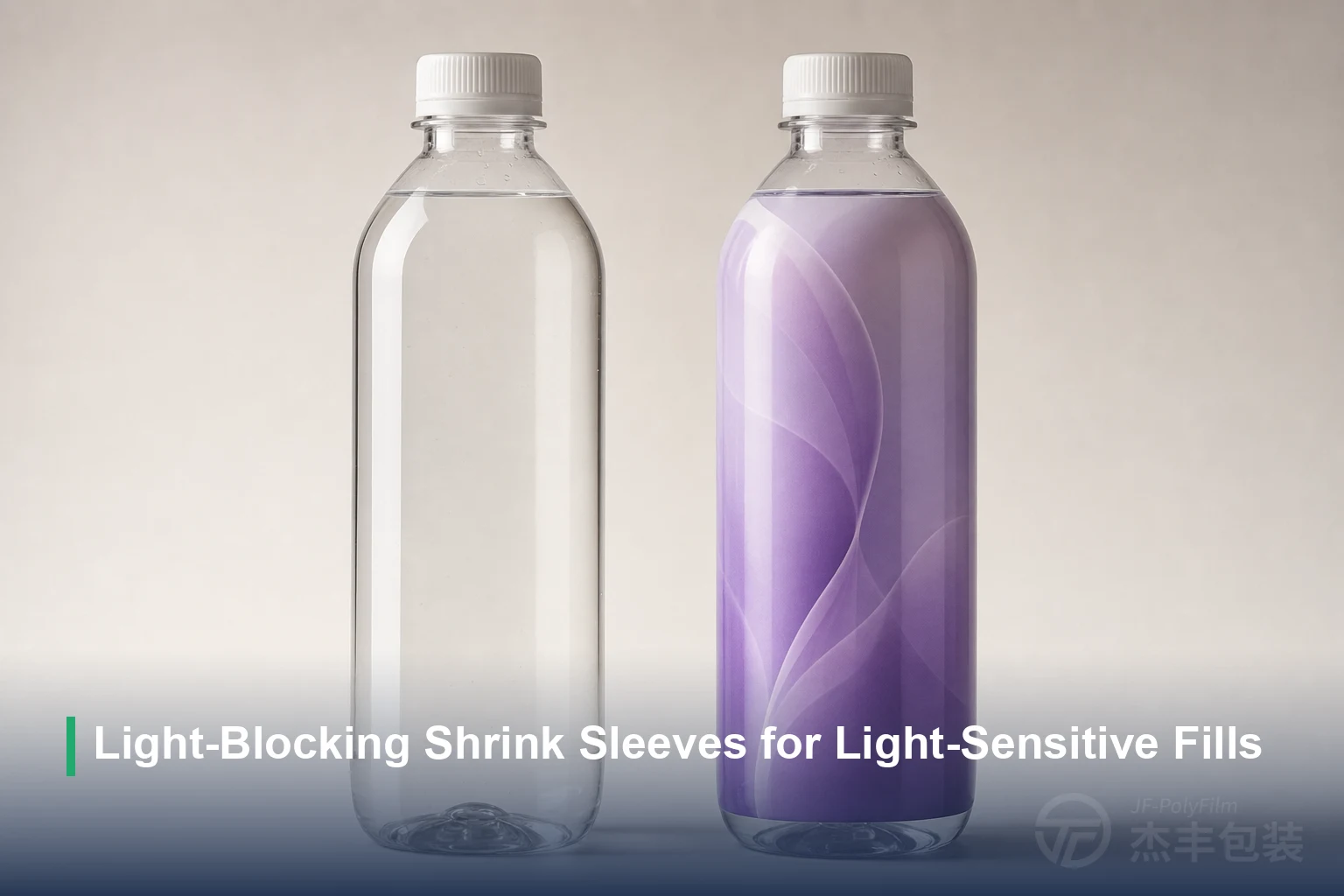
Light-Blocking Shrink Sleeves for Light-Sensitive Fills
Beer, dairy, supplements, and some medicines degrade under light. Which fills need protection, and how a full-body opaque PETG sleeve wraps the whole container to keep light off the contents.
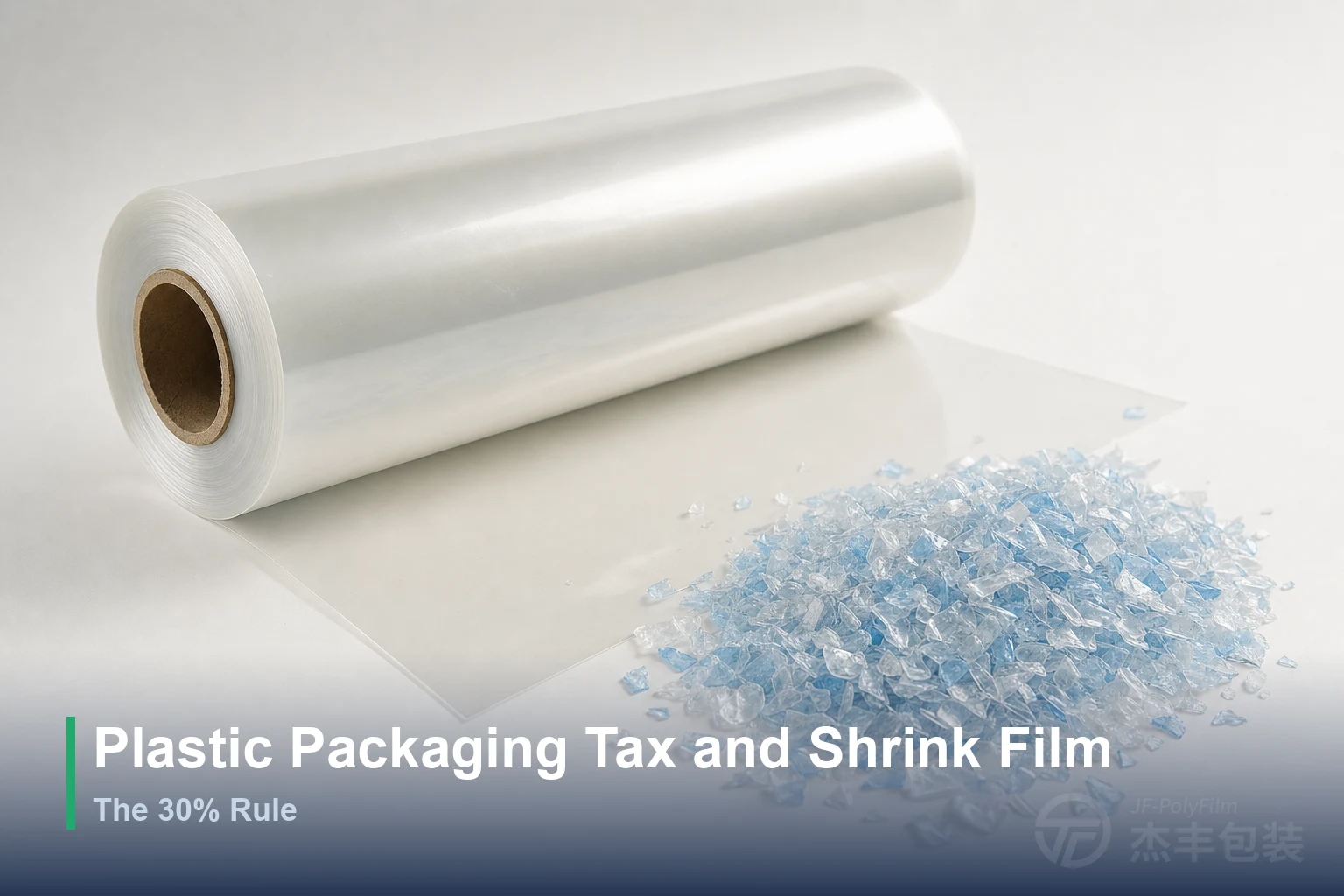
Plastic Packaging Tax and Shrink Film: The 30% Rule
How plastic packaging taxes in the UK, Spain, Italy and the EU treat shrink sleeves, why the 30% recycled-content threshold is the number worth remembering, and how RPET film helps a sleeve cross it.
Need Expert Advice on Shrink Film?
Our technical team can help you choose the right film for your application.
Contact Us