
Transparent Label Film: What Determines Optical Performance
How haze, transmittance, clarity, and gloss define a transparent label film, what material and thickness do to each, how shrinking changes the optics, and how to read a spec sheet.
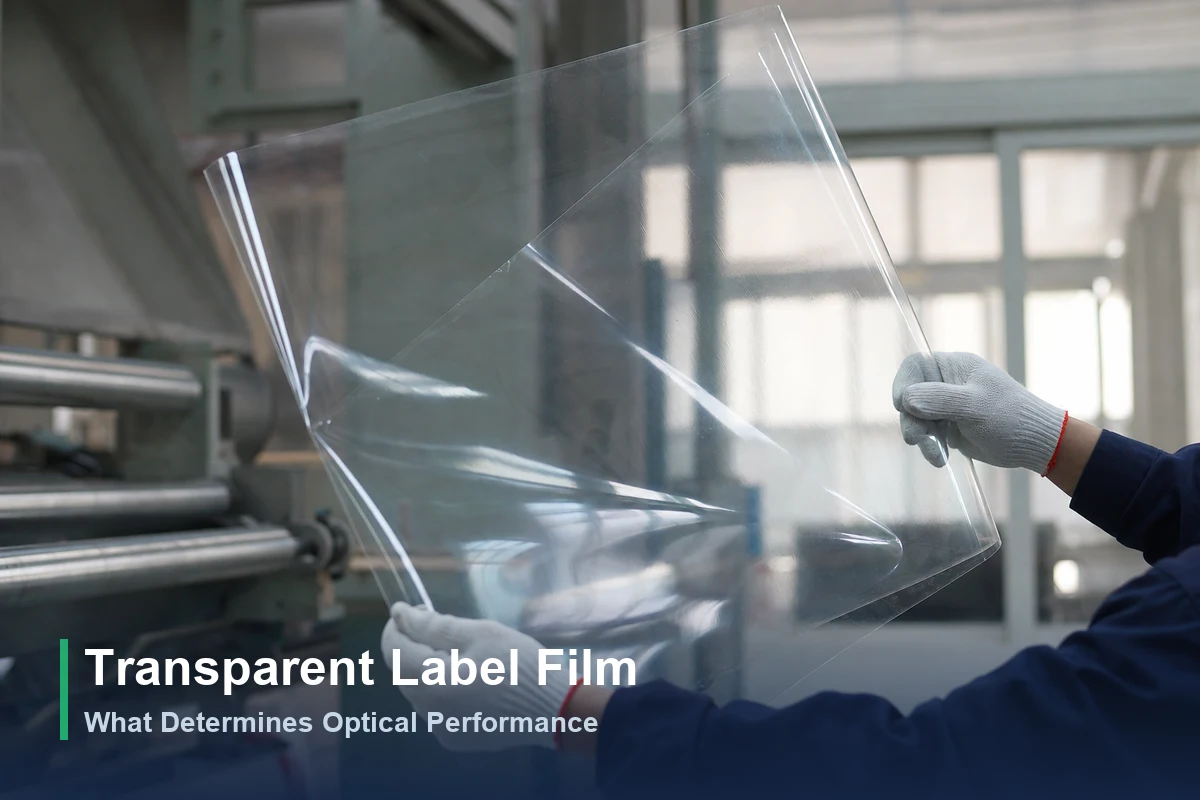
A transparent label film is a clear plastic film, usually amorphous PETG, printed and heat-shrunk into a full-body sleeve so the container shows through while branding and regulatory text ride on the film. Its “transparency” is not a single property but four measurable ones: light transmittance, haze, clarity, and gloss.
Key takeaways
- Optical performance is reported as four independent numbers: light transmittance and haze under ASTM D1003 / GB/T 2410, narrow-angle clarity under ASTM D1746, and 45-degree specular gloss under ASTM D2457 / GB/T 8807.
- Haze (wide-angle scatter beyond 2.5 degrees) and clarity (narrow-angle, under ~0.1 degrees) are physically unrelated; a low-haze film is not automatically a high-clarity one.
- Amorphous PETG reaches glass-like clarity because the glycol modification suppresses the crystallites that scatter light in ordinary PET.
- Transparent grades typically target light transmittance above 90 percent and haze in the low single digits, but heat shrinking adds a small amount of scatter, so optics should be judged on shrunk film.
- PETG resists yellowing far better than PVC, yet prolonged outdoor UV exposure still calls for a UV-stabilized formulation.
The four optical metrics that define transparency
“Transparency” on a spec sheet is four separate measurements, each capturing a different way light behaves as it passes through the film. Read together, they separate a sleeve that delivers a genuine no-label look from one that is merely clear in a generic way.
Light transmittance is the share of incident light that passes through the film, expressed as a percentage. Transparent shrink grades generally sit above 90 percent, meaning very little light is absorbed or reflected away, which keeps the underlying product bright and true in color rather than dim or grey.
Haze is the fraction of transmitted light scattered more than 2.5 degrees off the straight-through path, measured under ASTM D1003 (GB/T 2410 in China). It reads as a milky, washed-out veil spread evenly across the film. A low haze figure, typically low single digits on a quality grade, is what makes a film read as truly “clear” rather than faintly frosted.
Clarity measures light that stays almost perfectly on-axis, deflected by less than roughly 0.1 degrees, and follows ASTM D1746. It governs how sharply fine detail behind the film resolves, such as the crisp edge of printed text or the outline of the product inside, and is the see-through-sharpness number, distinct from the overall milkiness that haze captures.
Gloss is surface shine, measured as specular reflection at a 45-degree angle under ASTM D2457 (GB/T 8807). It describes the film’s outer face, not light passing through it; a high-gloss sleeve looks wet and premium under store lighting, while a matte finish scatters surface reflection for a softer look.
| Metric | What it measures | What it controls visually |
|---|---|---|
| Light transmittance | Share of light passing through | Brightness and color fidelity |
| Haze | Wide-angle scatter (>2.5°) | Milky vs. truly clear |
| Clarity | Narrow-angle scatter (<~0.1°) | Sharpness of detail seen through |
| Gloss (45°) | Surface specular reflection | Wet, premium shine vs. matte |
Why clarity is not haze
Clarity and haze answer two different questions and are not interchangeable, even though both describe a clear film. Haze describes how milky the film looks overall; clarity describes how sharply detail resolves through it. A film can score well on one and poorly on the other.
The split comes from the angle of scatter. Haze counts light deflected by more than 2.5 degrees, spread in all directions, which the eye perceives as an even haze laid over everything behind the film. Clarity comes from the narrow band of light that deviates by a fraction of a degree, which determines whether the edge of a printed letter or a product seam stays crisp or blurs. Because wide-angle and narrow-angle scatter arise from different optical causes, a haze reading carries no information about clarity and vice versa.
For the no-label look this distinction is practical. A sleeve with low haze but mediocre clarity looks bright and un-frosted from across the aisle yet softens fine print and outlines up close, undercutting the impression that there is no label at all. A film that earns the full effect has to be strong on both, which is why a thorough spec sheet lists them as separate lines instead of one transparency figure. The interaction between sleeve optics and printed artwork is its own subject, covered in the PET shrink sleeve printing methods guide.
What determines a film’s optical performance
Three things set optical performance before the sleeve is ever printed: the polymer chemistry, the film thickness, and the condition of the surface. Each one acts on the four metrics in a predictable direction, and together they account for why one clear film outperforms another.
Polymer chemistry is the dominant factor. Clear shrink film is also made in PVC, OPS, and PLA, each with its own optical and shrink trade-off; this guide centres on PETG because it leads the group on the clarity axis a no-label look depends on. Ordinary PET is semicrystalline, and the boundaries between its crystalline and amorphous regions scatter light, which is why crystalline PET turns white and opaque. PETG is glycol-modified: bulky cyclohexanedimethanol ring units are built into the chain, disrupting the regular packing that crystals need. The result is an amorphous polymer with essentially no crystallites to scatter light, which is the physical reason PETG reaches glass-like clarity and transmittance above 90 percent. The polymer’s refractive index, around 1.57 for PET-based films, sets how strongly light bends at the surfaces but does not by itself create haze; scatter from internal structure and surface roughness does.
Thickness works against optics in a gradual way. A thicker film gives light more material to travel through, so transmittance edges down and haze edges up as gauge increases. Transparent shrink film is typically run in the 30 to 60 micron range, and within that window the optical penalty of going thicker is modest, but it is real, which is why a heavier gauge chosen for stiffness or durability trades away a little clarity.
Surface condition is the factor most easily ruined after the fact. Scratches, scuffs, embedded dust, and die-line drag all roughen the film face and convert clean transmission into scatter, raising haze without changing the polymer at all. The same surface state also governs gloss, which is why that fourth metric behaves differently from the other three: gloss is a finish property set by how smooth or textured the outer face is, not a through-film limit imposed by the resin, so a glossy and a matte grade can share the same transmittance and clarity yet read very differently under store light. A pristine surface is therefore part of optical performance, not separate from it, and protecting it through winding, printing, and shrinking is as important as the resin choice.
How shrinking changes the optics
A flat transparent film and the same film after it has shrunk onto a bottle are not optically identical, a link most material guides skip. Heat shrinking reorients the polymer and changes local geometry, and both nudge the optical numbers, so the honest reference point for transparency is the shrunk sleeve, not the roll.
Three effects are at work. First, as the film contracts in the transverse direction it thickens locally, and the added material path raises haze slightly and trims transmittance, the same thickness effect introduced by the process rather than the order. Second, the shrink reorients polymer chains under heat; on a well-formulated grade this is uniform and nearly invisible, but uneven tunnel heat leaves zones of different orientation that scatter light and can read as faint banding. Third, the sleeve now wraps a curved surface, so light is refracted by the container’s geometry, which is expected but means the through-the-label view is never quite as flat-perfect as a film sample held against a page.
The practical consequence is that over-shrink, hot spots, and contamination magnify the small optical shift into a visible one, turning a clear sleeve cloudy or wrinkled in patches. Diagnosing and tuning those tunnel conditions is a process discipline in its own right, walked through in the guide on solving PETG shrink film problems. For optical sign-off, the reliable practice is to evaluate haze and clarity on a correctly shrunk sample under the intended tunnel settings, because that is what the shopper sees.
Staying clear over time: yellowing and UV resistance
Optical performance also has to survive the shelf, and the property that decides this is resistance to yellowing, the trait behind the reputation of an anti-yellowing shrink film. A film that drifts toward yellow loses its neutrality and casts a tint over the product behind it, so color stability over time is as much an optical metric as day-one haze.
Yellowing is tracked by the b* value in color measurement, where a rising b* means a shift toward yellow. PETG holds b* well under normal indoor and retail conditions, which is its clearest optical advantage over PVC; PVC can yellow and embrittle as it ages, while polyester chemistry stays neutral far longer. This stability is a large part of why brands chasing a long-lived premium look move away from PVC, a trade-off compared head to head in the PETG vs PVC shrink film comparison.
Durability over time has a physical side as well as this chemical one: the surface scuffing that raises haze on day one accumulates with handling and shelf rubbing, so a complete durability picture tracks both the chemical drift in b* and the mechanical clouding of the face.
The honest boundary is ultraviolet light. Bare polyester is not immune to UV; under sustained direct sunlight it slowly absorbs UV energy and can shift toward yellow over months of exposure. For indoor products and ordinary retail this rarely shows, but genuinely outdoor packaging, window displays, or anything facing long sun exposure should specify a UV-stabilized formulation rather than relying on the film being clear. Claiming a standard transparent grade is fully UV-proof would overstate it; the accurate statement is that PETG resists yellowing very well in normal use and benefits from added stabilization for harsh, sun-exposed service.
Reading a transparent film spec sheet
A transparent-film spec sheet is only meaningful when each optical value names the test method beside it, because the same film measured on different instruments and geometries can report different numbers. With the standard named beside each figure, two suppliers can be compared on equal terms.
The four optical lines map to a small set of standards. Light transmittance and haze are both measured under ASTM D1003, with GB/T 2410 the directly equivalent Chinese national standard. Narrow-angle clarity, when reported, follows ASTM D1746. Specular gloss at 45 degrees uses ASTM D2457, equivalent to GB/T 8807. A sheet that lists “haze, ASTM D1003” tells you far more than one that lists “haze” alone, because it fixes the measurement geometry that the number depends on.
| Optical property | ASTM method | GB/T equivalent | Reported as |
|---|---|---|---|
| Light transmittance | ASTM D1003 | GB/T 2410 | % of light passing through |
| Haze | ASTM D1003 | GB/T 2410 | % wide-angle scatter |
| Clarity | ASTM D1746 | — | narrow-angle, lower is sharper |
| Gloss (45°) | ASTM D2457 | GB/T 8807 | gloss units |
As a sanity check on the values, transparent shrink grades across the industry generally target light transmittance above 90 percent and haze in the low single digits; a clear grade quoting much higher haze is either thicker than typical or not a true high-clarity formulation. These are neutral reference ranges for the category, not a guarantee for any one product, and should be confirmed on a shrunk sample for the reasons above. The mechanical lines on the same sheet, such as transverse and machine-direction shrinkage and tensile strength, decide whether the film fits the container and the line, and a transparent grade is chosen where its optical numbers and its shrink behavior both suit the job, an interplay that also drives PET shrink sleeve recyclability decisions when end-of-life sorting enters the picture.
Keeping clarity consistent in production
Day-to-day optical consistency comes down to controlling the variables that move haze and clarity from roll to roll, where production discipline matters more than any single headline number. Most of that control is verifiable at the receiving end, which turns the spec sheet into a short acceptance checklist a buyer can hold a supplier to.
The first check is per-batch evidence: a transparent grade sampled and run through full property testing, haze included, with a Certificate of Analysis issued against the shipment, so the optical reading is confirmed for that batch rather than assumed. The second is traceability, where each roll labeled with batch number and length, and any splices marked by count and position, lets a clouded or banded section be traced back instead of argued over. The third is gauge fit: a grade supplied across the 30 to 60 micron range and a span of TD shrink levels lets thickness be matched to the container without pushing past the point where added gauge starts to cost clarity, so the optical and shrink requirements are met together.
Concretely, this is how those controls look in our own production, where each batch is sampled at a minimum of five meters and tested before a Certificate of Analysis ships with the order. One material trait removes a step from the picture: the film accepts gravure and flexographic ink directly through its inherent surface energy, so no corona pre-treatment is needed, and the grade is supplied in 65, 75, and 80 percent TD shrink levels so the gauge can be matched to the container. A clear sleeve that holds its optics from the production line through the retail shelf is the result of that control rather than the resin alone, and clear PETG shrink film is built and tested to that standard for full-body transparent sleeve applications.
Frequently Asked Questions
A spec sheet lists haze but no clarity figure. Is that enough to judge the no-label look?
If ordinary PET is already used for clear bottles, why specify PETG for a transparent sleeve?
Does heat shrinking make a transparent film hazier?
How resistant to yellowing is a transparent shrink film outdoors?
Can two spec sheets quote different haze numbers for what is really the same film?
Related Articles
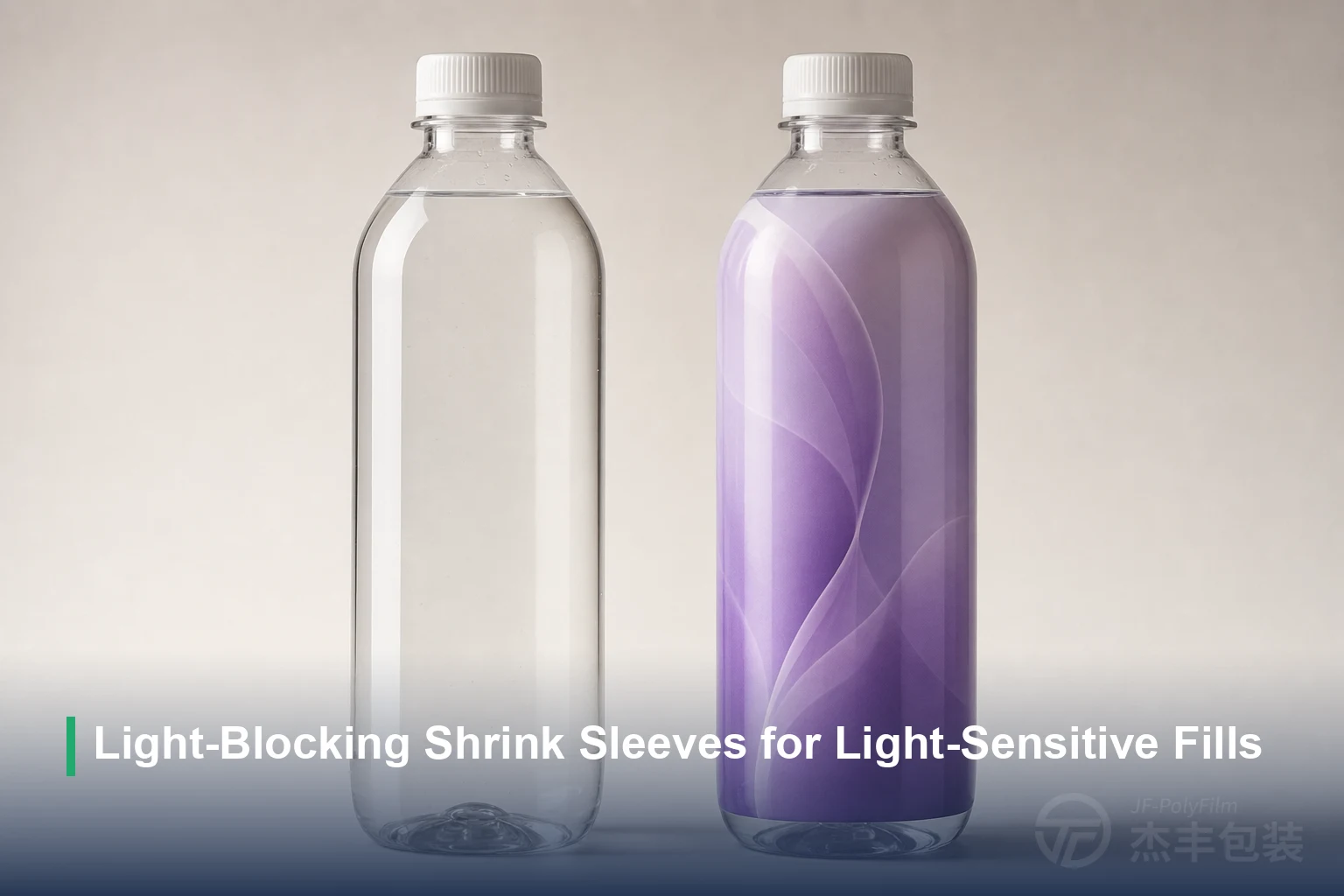
Light-Blocking Shrink Sleeves for Light-Sensitive Fills
Beer, dairy, supplements, and some medicines degrade under light. Which fills need protection, and how a full-body opaque PETG sleeve wraps the whole container to keep light off the contents.
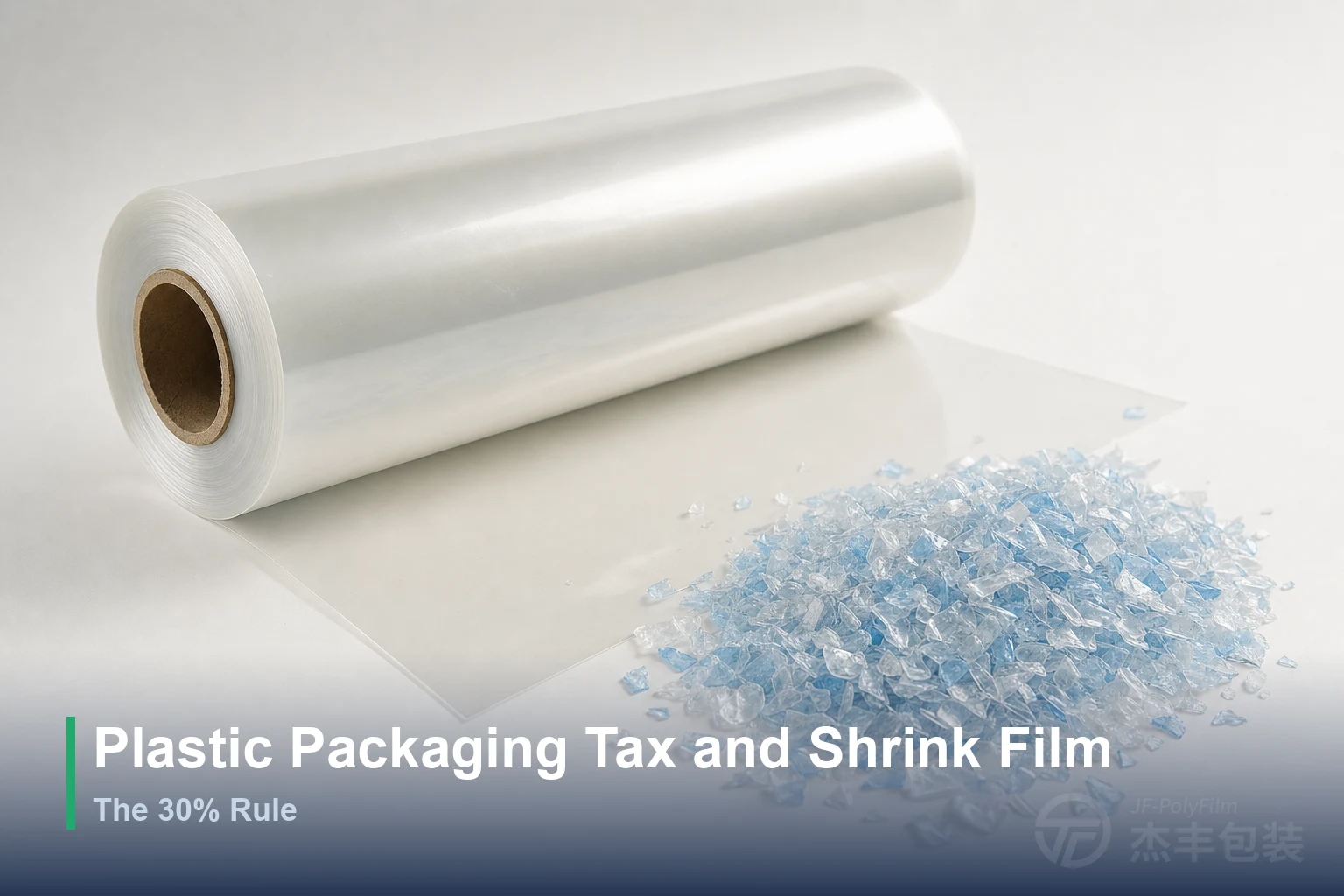
Plastic Packaging Tax and Shrink Film: The 30% Rule
How plastic packaging taxes in the UK, Spain, Italy and the EU treat shrink sleeves, why the 30% recycled-content threshold is the number worth remembering, and how RPET film helps a sleeve cross it.
Need Expert Advice on Shrink Film?
Our technical team can help you choose the right film for your application.
Contact Us