
Tamper-Evident Shrink Bands for Bottles: A Selection and Sizing Guide
How to choose, size, and apply tamper-evident shrink bands for bottle seals — material options, the lay-flat formula, closure fit, heat application, and the procurement specs that matter at volume.
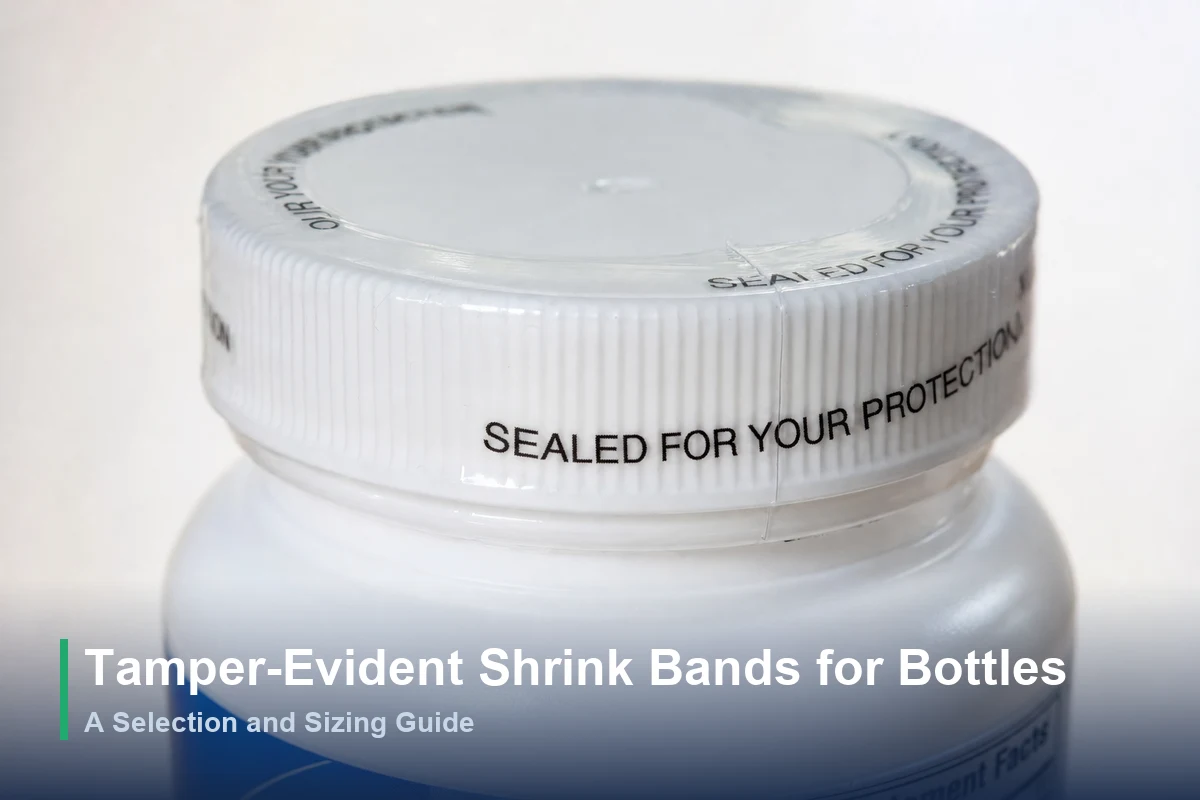
A tamper-evident shrink band is a short tube of heat-shrinkable film slipped over the junction of a cap and bottle neck; brief heat draws it tight into a one-piece seal that tears along a perforation on first opening and cannot be put back. Because it spans both the closure and the neck, a broken band reads at a glance as a container that has been entered.
This guide follows the band through the decisions a buyer actually makes, in order: how the seal proves a breach, which film to specify, how to size it, which bottles and caps accept it, how it is applied, and which procurement details matter once the order runs into the thousands.
Key takeaways
- A band must cover the cap and the neck together and tear along one vertical perforation; covering the cap alone is not a tamper seal.
- Bands are specified by lay-flat width — the tube measured flat across — rather than by cap or bottle diameter, so the two figures are never interchangeable.
- A correctly specified band overhangs the closure by roughly five millimetres top and bottom so the film catches the neck rather than riding on the cap.
- PVC is still the majority of band volume, but higher-shrink, PET-compatible films such as PETG and OPS are gaining share, led by regions with strict recycling and material-compliance standards.
- PETG film for bands carries verified transverse shrink of 75 percent or more and machine-direction shrink held to 3.0 percent or less, with a recommended shrink tunnel of 95–100°C.
How a Tamper-Evident Shrink Band Works
A band proves a breach by being destroyed when the container is opened. The tube spans the cap-to-neck junction, and a single vertical perforation runs its full height; lifting or twisting the cap tears the film along that line so the cap can come off. Once torn, shrunk film does not return to a tube and the edges no longer line up, so the band cannot be resealed or re-shrunk to look untouched. A damaged band is therefore read as a sign of entry, which is the whole point of the format.
The perforation is cut one of two ways. A vertical perforation runs top to bottom and is torn straight up to remove the cap. A horizontal perforation runs once around the band below the cap, so twisting the closure shears the upper section free while the lower ring stays on the neck. Both leave a visible, irreversible mark; the choice follows the closure and how the consumer expects to open it. For the seal to count as tamper evidence at all, the band has to grip both the cap and the neck — a band that shrinks onto the cap alone slides off and proves nothing.
Choosing the Material: PETG, PVC, PLA and OPS
Four films cover almost all tamper bands: PVC, PETG, PLA, and OPS. They differ most in shrink behaviour, optical clarity, print compatibility, and how they behave at end of life, and those four axes decide which one a given bottle should carry.
PVC is still the low-cost default and remains the majority of band volume in use, because it shrinks readily at modest heat and costs less than the alternatives. Its weakness shows downstream: PVC is classed as a contaminant in the PET recycling stream, and the gradual shift toward higher-shrink, PET-compatible films is most visible in markets with strict recycling and material-compliance standards. PETG and OPS are the films taking that share. PETG draws down hard around contoured necks and prints in full colour, while OPS shrinks at a lower temperature and stays soft enough for squeezable containers — its real niche rather than a fallback. PLA, a bio-based film, appears where a compostable claim drives the specification, though its lower heat tolerance narrows the shrink window and its compostable claim depends on access to industrial composting, which is why it stays a niche choice.
| Film | Shrink behaviour | Optical clarity | End-of-life note |
|---|---|---|---|
| PVC | High shrink at low heat input | Good gloss | Contaminant in the PET recycling stream |
| PETG | Very high shrink, holds contoured necks | High clarity and gloss | Recyclable; PET-family, no chlorine on incineration |
| OPS | Moderate shrink at a lower temperature; suits soft, squeezable containers | Good clarity | Sorted separately from PET |
| PLA | Moderate shrink; narrower heat window | Good clarity | Bio-based; compostable only with industrial composting access |
For a worked example, PETG band stock typically holds transverse shrink at 75 percent or more with machine-direction shrink kept to 3.0 percent or less, which is the combination that lets a band collapse tightly onto a narrow neck without distorting in height. A full performance comparison of the two leading films — grade-by-grade clarity, shrink curves, and printing — sits in the PETG vs PVC shrink film breakdown rather than here.
Sizing a Shrink Band: Lay-Flat, the Three-Number Spec and Overhang
Sizing decides whether the band seals or fails, and it turns on a measurement most buyers get wrong on the first attempt: lay-flat width is the band laid flat and measured across, not the diameter of the cap or bottle. For a non-standard finish, the formula is the finish circumference in millimetres divided by two, plus about two millimetres of relief. That relief lets the band slip over the closure before heat draws it down.
Bands are commonly called out with a three-number spec written as diameter × circumference × height — for example 26 × 50 × 26 mm — where the circumference is the cap’s outer wrap, slightly larger than the bottle, and the height is the band’s length up the neck. The two systems are the same measurement read two ways: lay-flat is that circumference figure folded flat, so a 50 mm circumference is a 25 mm lay-flat, which lets a buyer move between a supplier’s three-number callout and a tape reading off a real bottle. Height is set so the band overhangs the closure by roughly five millimetres at the top and bottom; that overhang is what lets the film catch the neck rather than balancing on the cap.
| Sizing input | What it means | Rule of thumb |
|---|---|---|
| Lay-flat width | Band measured flat across | Finish circumference ÷ 2 + ~2 mm |
| Three-number spec | Diameter × circumference × height | e.g. 26 × 50 × 26 mm |
| Overhang | Film extending past the closure | ~5 mm top and bottom |
Getting the width wrong fails in both directions. A band cut too small tears along its own perforation while it is still being slipped on, before any heat reaches it; a band cut too large will not draw down to the bottle shape and finishes loose and wrinkled. A workable band sits in a narrow window around the container’s finish, which is why the lay-flat figure is verified against a sample rather than assumed.
Matching Bands to Bottle and Closure Types
A band only seals when the container gives it something to grip. Most bottle necks carry a moulded ring just below the closure — the satellite ring — and a correctly sized band shrinks down over that ring so it locks in place and cannot slide off. The band should sit across roughly the lower half of the cap and the upper half of the neck, bridging the two so the perforation has to break before the cap can move.
What blocks a band is geometry, not the type of dispenser. Straight-walled Boston round and cylinder bottles give the film little defined neck to seat against, and one-piece hinged or snap fitments leave no clean ring for the tube to grip. Where the neck offers nothing to lock onto, packers reach for another approach — a full-body sleeve, an induction liner, or a printed seal across the dispensing opening. Trigger, pump, and sprayer bottles are a different case: they are a standard banded format, but the band has to bridge the wide gap between the dispensing head and the neck, so they run on dedicated, wider-tolerance neck-banders rather than on settings tuned for a plain cap.
Bands themselves come in a few forms. A flat-cut band is simply tube stock cut to length, with or without perforation, and is the standard neck seal. A preform band is shaped to fit a particular bottle profile, including square and oval containers a round tube would not hug. A printed band carries a safety message such as a sealed-for-protection line, and a full-body sleeve extends from the cap down the whole bottle and can be printed across its entire face. Where the decision is specifically between a neck band and a full-height sleeve — anchoring, decoration, and cost — that is a comparison in its own right; the short version is that a neck band proves a breach while leaving an existing label alone, and a full-body sleeve ties the tamper indicator to the graphics.
Applying the Band: Heat Gun vs Shrink Tunnel
Once a band is sized, heat does the rest, and the heat source scales with the run. For prototypes, short runs, and sampling, a handheld heat gun is enough: the band is slipped on by hand and the nozzle is swept evenly around it so the film draws down without scorching one side. The method is slow and operator-dependent, which is why it rarely leaves the sampling stage. Mid-volume runs usually step up to a semi-automatic or tabletop bander paired with a small shrink tunnel, the rung most buyers grow through before committing to a full conveyor line.
Production volume moves to a shrink tunnel, where bottles travel on a conveyor through a chamber of steam or hot air and every band shrinks under the same controlled profile. For PETG band stock, a tunnel set around 95–100°C is the recommended window; steam tunnels run roughly 90–100°C, while hot-air tunnels hold a higher surface temperature with the film itself reaching close to 95°C. Holding to that temperature-and-dwell window is what keeps the seal consistent across thousands of units. When a band wrinkles, finishes loose, or shows dog-ears, the cause is usually temperature, dwell, or band size rather than the film itself; that diagnostic ground is covered in solving PETG shrink film problems. For bands that also carry decoration, the press and ink choices behind a fully printed band are set out in PET shrink sleeve printing methods.
Procurement Specs That Matter for Bottle Seals
At sampling quantities a band is judged by whether it shrinks; at order quantities it is judged by whether every roll behaves like the last one, and that is where the specification sheet earns its place. Before a purchase order, the neutral checklist any supplier should be made to answer is short:
- Thickness and shrink rate — stated as a verified transverse and machine-direction pair, not a single number; band film usually runs in the 30–60 micron range.
- Lot traceability — a lot number on the roll label tying back to width, length, and production date, so a downstream defect can be traced to its batch.
- Packing and minimum order — how rolls are palletised and what the minimum order quantity is, since both set the cost of a first run.
- Storage life — how long the stock holds and under what conditions before shrink behaviour drifts.
Measured against that list, the films described here are sampled across at least five metres per batch and ship with a certificate of analysis, and most rolls run splice-free so the band feeds without an interruption mid-run; the PETG band stock holds for around twelve months when kept at 10–30°C away from light and moisture. Confirming a supplier can hold those figures run after run is its own step, and three things make it concrete: a current quality-system certificate such as ISO 9001 or a recent third-party audit, the material’s GRS, REACH, and RoHS documentation, and a pre-shipment inspection with a certificate of analysis per lot. The fuller supplier-vetting workflow is a topic in its own right.
Recyclability and Compliance for Pharma and Food Bottles
For pharmacy and food bottles the band is part of a compliance and recycling story, not just a seal. The recycling consequence is concrete: the Association of Plastic Recyclers classes PVC as a contaminant in the PET stream because PVC and PET have nearly the same density and cannot be separated by sink-float sorting, and PVC releases hydrochloric acid when heated — as little as 50 ppm of PVC in a PET bale is enough to degrade the recovered resin. A PET bottle carries resin identification code 1, so a band drawn from the PET family keeps that single-resin stream clean where a PVC band breaks it.
On materials compliance, the relevant references are material standards such as EU 10/2011, recycled-content certification under GRS, and chemical compliance under REACH, which describe what the film is made of and how its recycled content is verified. PETG band stock is fully recyclable and releases no chlorine on incineration; the stock described here ships with GRS, REACH, and RoHS documentation that puts that recycling and compliance story on paper. For a pharmacy or supplement bottle, specifying a PET-family band aligns the tamper seal with both the bottle’s own recycling code and the material standards a regulated category is audited against. The deeper sorting and single-stream mechanics behind that choice are set out in PET shrink sleeve recyclability.
Across all six decisions — proving a breach, choosing the film, sizing the band, matching the closure, applying the heat, and writing the spec — a tamper-evident band is a small component that has to be right in material, size, fit, and spec at once. Films like the clear PETG shrink film referenced throughout this guide are specified to hold all of that together at volume.
Frequently Asked Questions
Can a standard PVC band be swapped for PETG on the same line?
How is lay-flat width measured for a non-standard bottle finish?
Why can a tamper band not be resealed once it is opened?
Should a supplement or pharmacy bottle use a neck band or a full-body sleeve?
Which closures and bottle shapes do not accept a neck band?
Related Articles
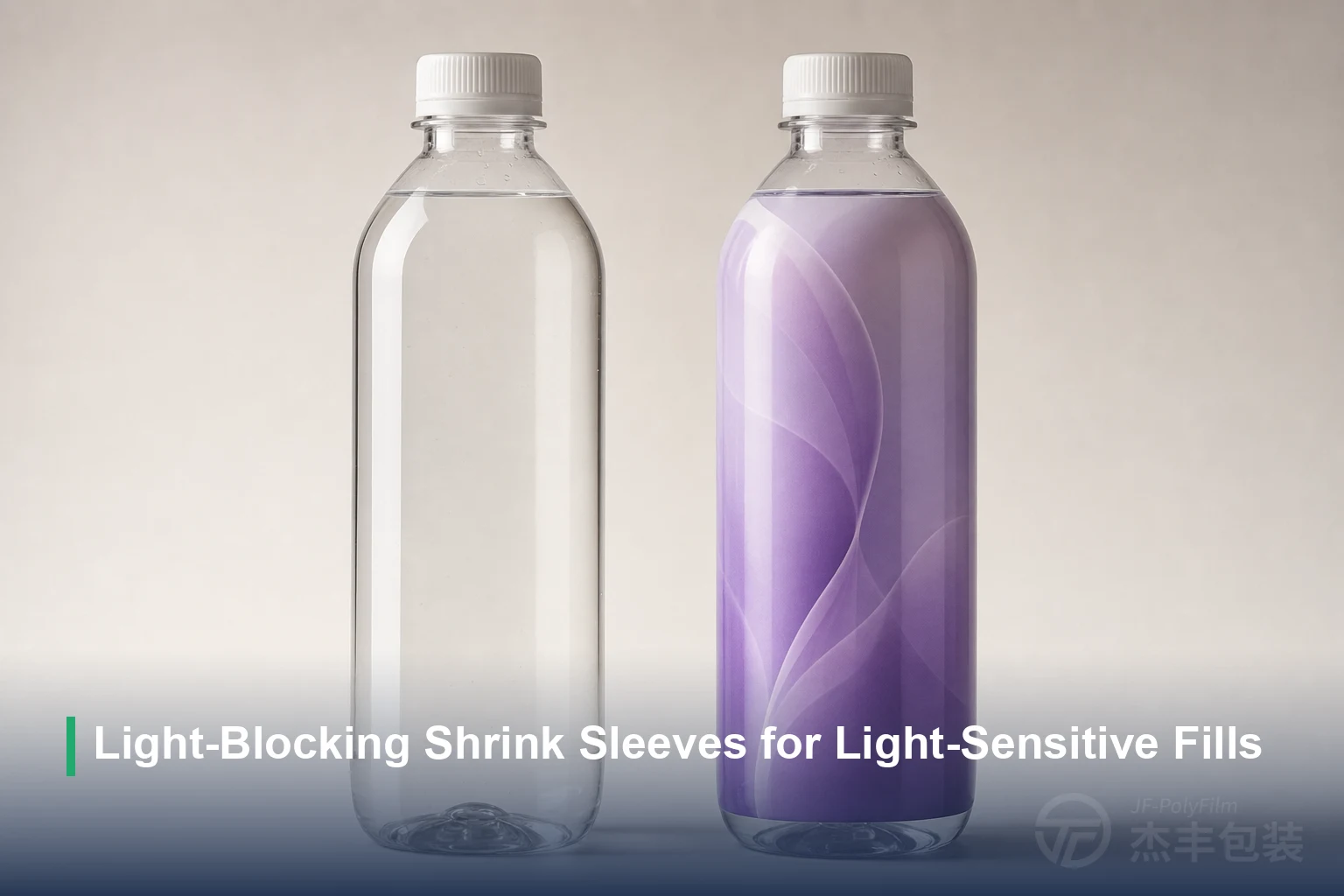
Light-Blocking Shrink Sleeves for Light-Sensitive Fills
Beer, dairy, supplements, and some medicines degrade under light. Which fills need protection, and how a full-body opaque PETG sleeve wraps the whole container to keep light off the contents.
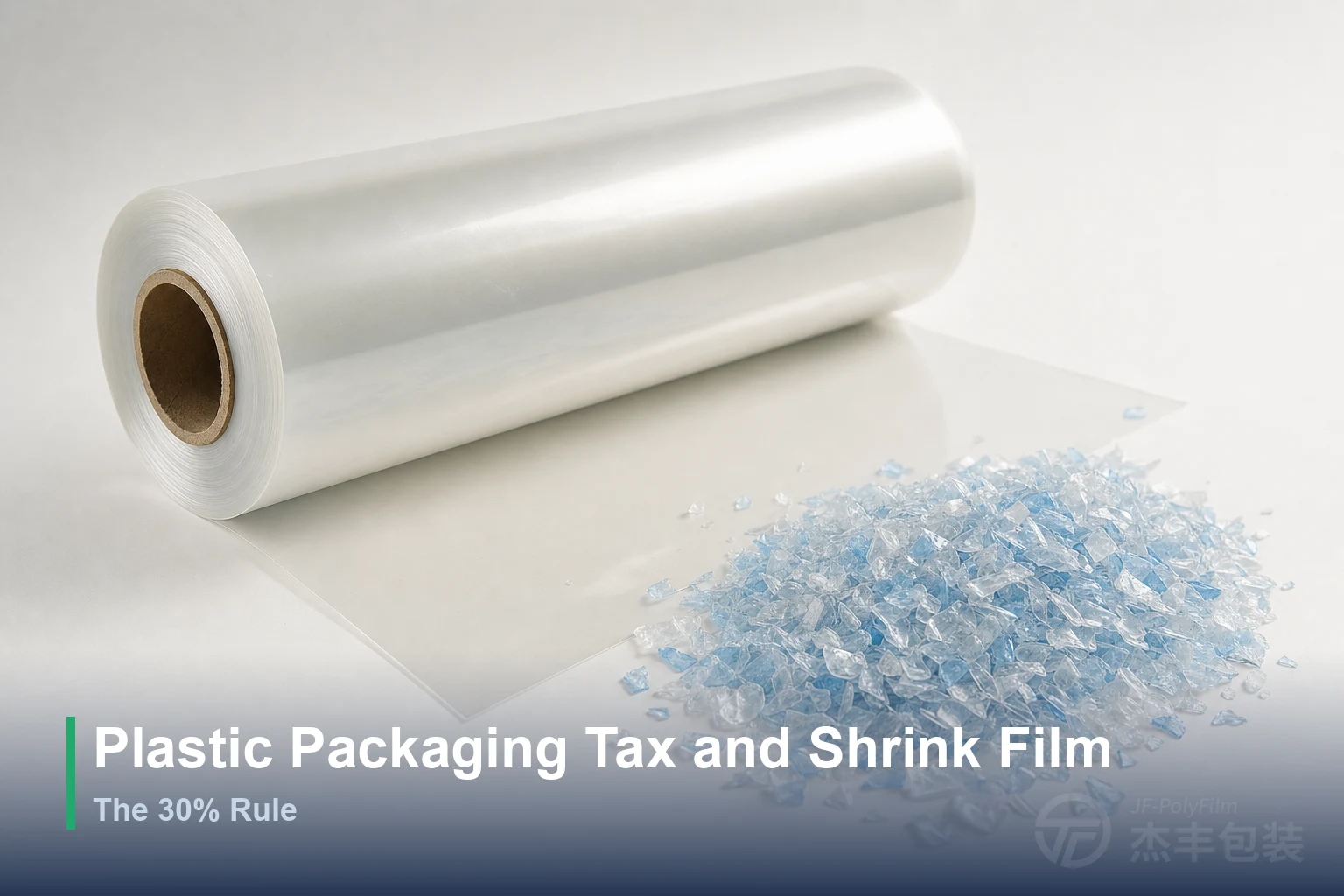
Plastic Packaging Tax and Shrink Film: The 30% Rule
How plastic packaging taxes in the UK, Spain, Italy and the EU treat shrink sleeves, why the 30% recycled-content threshold is the number worth remembering, and how RPET film helps a sleeve cross it.
Need Expert Advice on Shrink Film?
Our technical team can help you choose the right film for your application.
Contact Us