
PETG vs OPS Shrink Film: Polyester vs Polystyrene
How PETG and OPS shrink sleeve films compare on polymer family, softness, shrink temperature, clarity, and recycling stream — and which container each one fits.
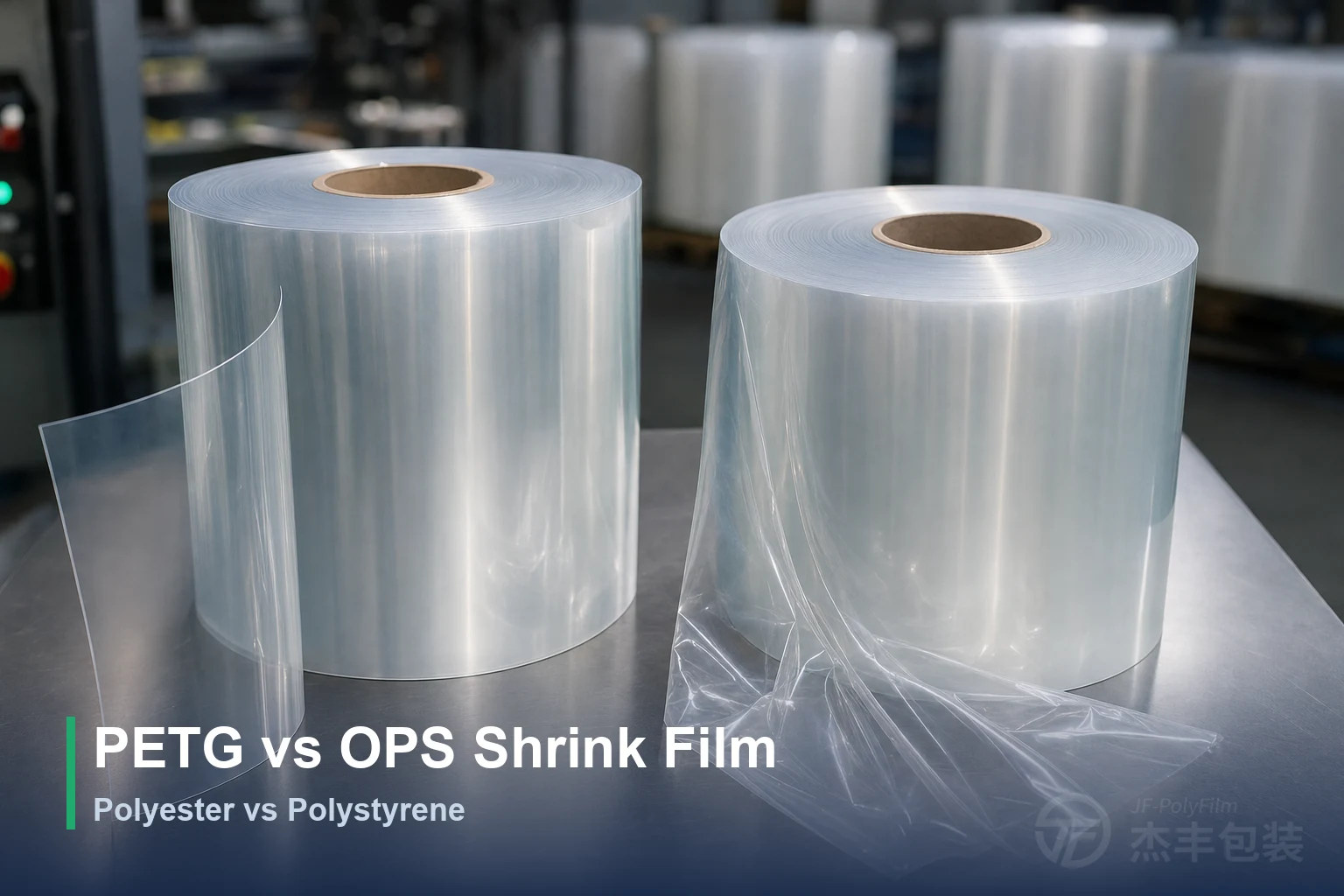
PETG and OPS are the two clear shrink-sleeve films most often weighed against each other, yet they come from different polymer families. PETG is a glycol-modified copolyester in the PET family; OPS is oriented polystyrene, a styrenic film with no PET lineage at all. That family split — not any single line on a spec sheet — is what decides which container each film belongs on, and it runs from the way the sleeve feels in the hand all the way through to which recycling stream it ends up in.
Key takeaways
- PETG reaches the highest transverse shrink of the common sleeve films, commonly specified at ≥75%, and holds deep, full-body contours; OPS shrinks cleanly on straight-wall and squeezable shapes but does not match that draw on compound curves.
- OPS activates at a lower tunnel temperature and pulls in with lower shrink force, which suits heat-sensitive contents and lower-energy lines; PETG draws over a wider, more forgiving window near 95-100°C.
- OPS is soft and springs back after squeezing without creasing, making it the natural film for squeezable and soft-wall containers; PETG is stiffer, tougher, and more resistant to scuffing and cracking through converting and shipping.
- OPS is polystyrene and carries resin code RIC 6, a stream separate from the RIC 1 PET bottles a sleeve usually rides with; PETG is a polyester, and its CPET grade recovers with the bottle in the PET stream.
- OPS density sits near 1.04-1.05 g/cm³ against PETG’s ~1.28-1.33; OPS is generally the more economical, higher-yield film, while PETG is the premium performer.
Two polymer families, not two grades of one film
The first thing to understand about PETG and OPS is that they are not two versions of the same material — they are different polymers. PETG is a copolyester built on the same PET chemistry as a beverage bottle, modified with glycol so it stays amorphous and shrinks rather than crystallizing. OPS is oriented polystyrene: polystyrene extruded into film and stretched to raise clarity, stiffness, and strength. One is a polyester, the other a styrenic, and almost every practical difference below traces back to that.
The distinction is not academic. Because OPS is polystyrene, it carries resin identification code 6 and stays outside the RIC 1 PET stream entirely, while a PETG sleeve remains a polyester relative of the bottle it decorates. The styrene backbone also explains the material’s signature behavior — its softness, its low shrink temperature, and its brittleness all follow from being a polystyrene rather than a polyester. Read that one fact correctly and the rest of the comparison falls into place.
PETG vs OPS at a glance
PETG and OPS diverge across a handful of properties that decide most sleeve jobs. The comparison below stays at the material level, and cost appears only as a direction, not a number — real pricing shifts with region, gauge, and order size. The OPS shrink figures are shown as a range because published values for the film do not agree.
| Property | PETG | OPS |
|---|---|---|
| Polymer family | Glycol-modified PET copolyester (polyester) | Oriented polystyrene (styrenic) |
| Recycling code | Polyester; CPET grade recovers in RIC 1 PET stream | RIC 6 (PS), separate stream |
| Stiffness / feel | Rigid, firm | Soft, flexible, springs back under squeeze |
| Total shrink (TD) | Highest, commonly ≥75%, holds complex contours | Moderate-to-high; best on straight-wall shapes |
| Machine-direction shrink | Low, typically ≤3% | Very low |
| Shrink onset / tunnel | Higher onset, wide window, ~95-100°C for full draw | Lower onset, low-energy tunnel, low shrink force |
| Toughness | Tough, scuff- and crack-resistant | Brittle; cracks under impact and cold |
| Clarity / gloss | Glass-clear, high gloss, premium finish | Clear, generally less premium than PETG |
| Density | ~1.28-1.33 g/cm³ | ~1.04-1.05 g/cm³ |
| Chemical resistance | Better | Poorer |
| Cost positioning | Premium / high-performance | Economical / high-yield |
Everything supplied here belongs in the PETG column of that table, not the OPS one: our clear PETG runs TD ≥75% with MD ≤3.0%, and the crystallizable CPET grade TD 74±2% for packages that must recover in the bottle stream.
Soft and squeezable, or rigid and firm
Softness is where OPS earns its keep, and it is a genuine advantage rather than a consolation. OPS film is comparatively soft and flexible, and it recovers elastically after it is deformed — squeeze the container, and the sleeve springs back to shape without the crease, whitening, or memory fold a stiffer film would take. That makes OPS the natural choice for squeezable and soft-wall containers, the kind a consumer compresses in the hand, where a rigid sleeve would kink and hold the mark.
PETG behaves in the opposite register. It is the firmer, more rigid film, which is exactly what a hard-walled bottle or a structural full-body sleeve wants: the film holds its form, resists denting, and reads as a solid, quality surface rather than a flexible skin. The routing that follows is clean. Squeezable tubes, soft dosing bottles, and flexible containers lean toward OPS; rigid bottles, jars, and containers where the sleeve should feel substantial lean toward PETG. Neither answer is “better” in the abstract — the container’s own stiffness sets which film matches it.
Low-temperature shrink and the energy it saves
OPS pulls in at a lower temperature than PETG, and for the right package that is a real operating advantage. Its shrink onset sits low, so it draws down in a cooler, lower-energy tunnel and with lower shrink force — gentler on the container and on the printed artwork, and less demanding on heat-sensitive contents that a hotter tunnel might disturb. Its machine-direction shrink is very low as well, so on a straight-wall bottle without a bottom taper the sleeve stays flat and square rather than climbing or curling at the edges.
PETG asks for more heat, needing a hotter, more even tunnel — commonly near 95-100°C for full draw — but gives back a wider, more gradual shrink window that tolerates line-speed swings and reaches a higher total contraction. The two films therefore suit different lines: OPS where energy budget, gentle heat, or a heat-sensitive product is the constraint, PETG where the shape demands maximum draw and the tunnel can supply the heat to get it. Why a film contracts around a container at all is a separate question, covered in how PETG shrink film works.
Brittleness and durability: the styrene trade-off
The same styrene chemistry that makes OPS soft in thin film also makes the polymer inherently brittle, and that is its main structural weakness. Polystyrene fractures rather than yields under a sharp impact, and it grows more fragile as temperature drops, so an OPS sleeve is more prone to cracking, splitting, or chipping at the seam — especially on a cold line, in cold-chain distribution, or under rough handling. Orientation during manufacture toughens the film and offsets some of this, but it does not change the underlying character of the resin. OPS is also the poorer performer on chemical resistance, more readily attacked by certain solvents and aggressive contents than a polyester film.
PETG is the tougher, more forgiving material here. It resists impact and scuffing, tolerates the flexing and abrasion of converting and shipping without cracking, and stands up better to chemical exposure. For a sleeve that has to survive a fast filling line, a long distribution chain, or a cold environment, that durability is part of what the premium buys — the label that arrives intact and stays intact.
Clarity, gloss and the shelf impression
Both films are transparent, but they do not read the same on shelf. Oriented polystyrene is genuinely clear — orientation lowers its haze well below a film like polypropylene — and for many everyday packages its optics are perfectly adequate. Where the design leans on the film itself for a premium impression, though, PETG is the higher-end surface: it finishes glass-clear with a high-gloss face that keeps printed graphics crisp and supports a transparent “no-label” look, and high-clarity PETG is generally regarded as the more premium of the two clear films.
That gap only matters where it is visible. On an opaque or heavily printed sleeve the film surface barely shows, and OPS’s clarity is beside the point; the decision moves back to softness, shrink, and cost. It is on transparent designs and high-end finishes — cosmetics, premium personal care, anything where the film is part of the brand impression — that PETG’s optical edge becomes load-bearing and worth paying for.
Two recycling streams: RIC 6 versus the PET family
The clearest end-of-life difference follows straight from the polymer family. OPS is polystyrene and carries resin identification code 6, a stream entirely separate from the RIC 1 PET bottles a shrink sleeve usually rides with — so an OPS sleeve and the PET container under it belong to two different recycling routes from the start. A PETG sleeve does not have that problem in the same way: it is a polyester, chemically related to the bottle rather than foreign to it.
Neither film floats free of PET flake on density alone, and the mechanics of float-sink sortation and wash-off release are a topic in their own right — set out in the PET shrink sleeve recyclability guide rather than repeated here. What matters for this comparison is the destination. An OPS sleeve reaching a PET reclaimer behaves like any foreign styrenic: a contaminant the bottle stream is not built to absorb, in the same category recyclers police other non-polyester films toward. European PET recyclers, through bodies such as Petcore, have gone as far as urging bottlers to drop OPS shrink sleeves for exactly this reason. PETG sits on the other side of that line — a polyester the PET melt can tolerate even as off-spec material — and its crystallizable CPET grade, specified at TD 74±2% with a 230°C melting point well above bottle-recycling dryer temperatures, recovers together with the container in the RIC 1 stream. Two films, two streams: that is the substance of it.
Cost positioning and where each film fits
On cost, OPS is generally the more economical film and the higher-yield one — a lighter material at around 1.04-1.05 g/cm³ against PETG’s ~1.28-1.33, so a given weight of resin covers more sleeves. PETG sits as the premium option, and the premium is not arbitrary: it buys the highest shrink, the best clarity and gloss, the toughest and most chemical-resistant film, and a place in the PET polyester family. Exact figures move with region, gauge, and volume and belong on a quotation rather than in an article, but the qualitative positioning is stable — OPS competes on value, PETG on performance.
That turns into a straightforward routing. A squeezable or soft-wall container, a simple straight-wall bottle, a heat-sensitive product or a lower-energy line, or a cost-driven program where adequate optics are enough — these point to OPS, and it is the honest answer for them. A deep or full-body contour that needs maximum shrink, a premium transparent finish, a package that must survive rough or cold handling, or a program committed to keeping the sleeve inside the PET recycling family — these point to PETG. The same routing logic against the other sleeve materials — PVC, PLA, POF, and bottle-resin PET — is set out in the companion comparisons.
As a film manufacturer running three production lines dedicated to polyester shrink film, our reading is deliberately narrow: we make PETG, CPET, and RPET, not OPS, so the recommendation is to match the film to the container rather than to the supplier. Where the package calls for a polyester sleeve, the clear PETG shrink film supplied here runs at TD ≥75% with MD ≤3.0%, in gauges from 30-60 μm and widths to 2000 mm, against GRS, REACH, and RoHS documentation and a 1-3 tonne MOQ — and where a squeezable or heat-sensitive package genuinely fits OPS, that is worth knowing before the artwork is committed.
Frequently Asked Questions
Is OPS shrink film the same as a PET bottle or a PETG sleeve?
Which shrinks at a lower temperature, OPS or PETG?
Why does OPS suit squeeze bottles better than PETG?
Can OPS and PETG sleeves be recycled with PET bottles?
Is OPS cheaper than PETG?
Related Articles
How to Store Shrink Film: Rolls, Shelf Life, Handling
What the 10–30°C, 12-month storage window actually protects, how to stand rolls so they don't flat-spot, and why film has to acclimate before it reaches the line.
Shrink Film Test Methods: How Specs Are Measured
Every figure on a shrink film datasheet or COA traces back to a standard method. See which ASTM and ISO tests measure shrinkage, tensile, haze, and gauge, and how to read the report.
Need Expert Advice on Shrink Film?
Our technical team can help you choose the right film for your application.
Contact Us