
How Does PETG Shrink Film Work? The Heat-Shrink Mechanism
The molecular reason a PETG sleeve grips a bottle: how stretching freezes shrink memory into the film, why the glass transition switches it on, and how the shrink curve runs.
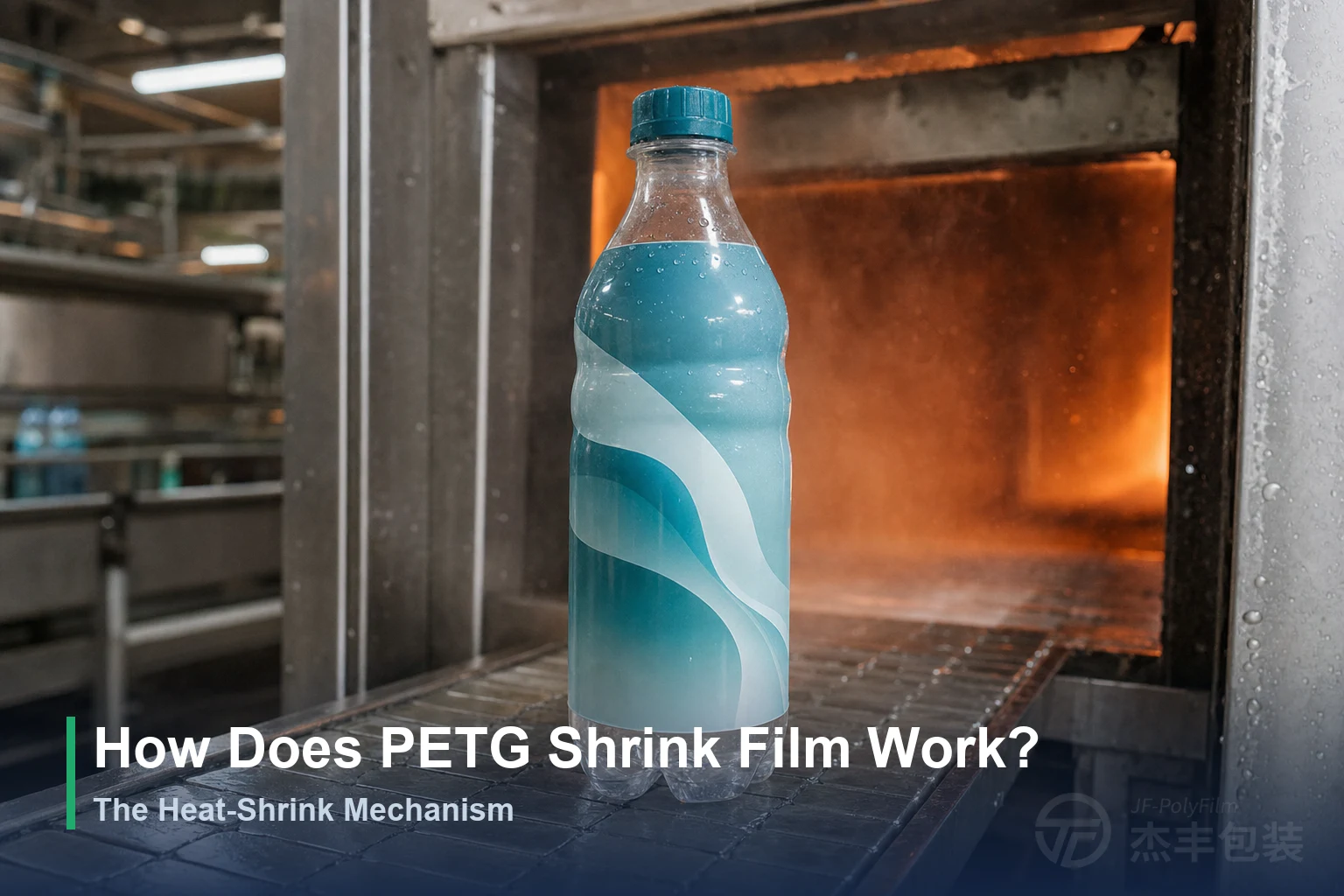
PETG shrink film works by storing a memory of how it was made. During manufacturing the film is stretched and rapidly cooled, freezing its molecular chains in a high-tension, extended state; reheating past a set temperature releases that tension so the chains recoil and pull the film tight around a container.
Key takeaways
- The pull comes from entropy, not from heat softening the film: stretching lowers the chains’ entropy, and reheating lets them spring back toward a disordered, higher-entropy coil — the shrink is that recovery.
- The glass transition, for PETG near 80°C and reported broadly across 75-85°C, is a two-way switch: below it the film is dimensionally locked for storage and shipping; above it, shrinkage turns on.
- Shrink-film grades are often tuned so contraction begins near 65-70°C and then climbs a smooth, controllable curve rather than snapping tight all at once.
- Contraction is directional by design: transverse (around the bottle) shrink reaches roughly 75-80%, while machine-direction (vertical) shrink stays very low, so the label grips the girth without shortening or pulling the print out of register.
- A steam tunnel drives the film to about 95-100°C for the few seconds it takes the chains to relax and the sleeve to seat.
The molecular mechanism: frozen orientation and entropic recovery
The film shrinks because stretching stored energy in its molecular structure, and heat lets that energy discharge. A shrink film is not simply melted smaller in the tunnel; it recovers a shape its chains were forced out of during manufacturing, and the driving force behind that recovery is entropy.
Left relaxed above its transition temperature, a polymer’s long chains sit as random coils — the most disordered, and therefore the highest-entropy and most stable, arrangement available to them. When the softened film is stretched during orientation, those coils are pulled straight and lined up along the stretch direction. Straightening a coil sharply cuts the number of shapes it can take, so its entropy falls and the material is driven into a strained, non-equilibrium state that “wants” to return to disorder. A rapid quench — cooling below the transition temperature before the chains can retract — freezes them in place and locks the strain in. The film now looks and feels stable on the reel, yet it is thermodynamically loaded, holding its stretched geometry only because the cold has immobilized the chain segments.
Reheating springs the trap. Once the film crosses back above the transition temperature, the chain segments regain mobility, the frozen-in stress relaxes, and the chains retract toward the coiled state they were driven away from. That retraction, summed across the whole film, is the visible shrink. Because the force comes from the chains’ drive back toward higher entropy — the same rubber-elastic recovery that snaps a stretched rubber band back — the film contracts with real force rather than just losing size, which is what lets a sleeve clamp firmly onto a bottle instead of hanging loose over it. The retracting chains rarely reach their fully relaxed coil before the film cools and re-locks, so a residual contractive stress lingers and keeps the seated sleeve under gentle tension against the wall — the reason a shrunk sleeve stays snug as it cools instead of easing off. How far the film travels in that recovery depends on how heavily it was oriented to begin with, which is what lets one base resin be engineered into films of very different shrink levels.
The glass transition: one temperature doing two jobs
The temperature that unlocks shrinkage is the glass transition, or Tg — for PETG generally near 80°C, and reported across roughly 75-85°C depending on grade — and it governs the film in both directions at once: below it the film holds still, above it the film moves. Storage stability and tunnel activation are not two separate properties but two faces of this single threshold.
Below Tg the copolyester sits in a glassy state. Its chain segments are effectively frozen, so the frozen-in orientation cannot release and the film stays dimensionally stable — the same reason a sleeve on the reel, or a shipment crossing an ocean, does not creep or self-shrink at ambient warehouse temperatures. Cross above Tg and the material passes into a rubbery state; the segments gain mobility, and only then can the stored strain relax and the film contract. Shrink-film grades are usually tuned toward the lower end of that window so contraction begins a little above room temperature — often around 65-70°C — which opens a wide, forgiving gap between everyday handling and the shrink tunnel. That gap is what makes the material practical: it stays inert through printing, seaming, storage, and application, then activates cleanly once the tunnel deliberately pushes it past the transition.
| Temperature vs. Tg | Molecular state | What the film does |
|---|---|---|
| Well below Tg (ambient storage, transit) | Glassy — chain segments frozen | Dimensionally stable; orientation stays locked, no creep or self-shrink |
| Approaching Tg (onset near 65-70°C) | Segments begin to regain mobility | Shrinkage starts; the film begins to draw in |
| Above Tg, in the tunnel (film at ~95-100°C) | Rubbery — segments fully mobile | Stored strain relaxes fast; the sleeve seats to the contour |
The shrink curve: onset, steep rise, and plateau
Shrinkage does not arrive all at once at a single temperature; it follows a curve with three stages — an onset where contraction begins, a steep zone where most of the shrink happens quickly, and a plateau where the film nears its maximum and levels off. The relationship between temperature and percent shrink is non-linear, and the shape of that curve, not just its endpoint, decides how cleanly a sleeve forms.
PETG’s curve is characteristically smooth and gradual with a relatively low onset, which means the film draws in progressively as it heats rather than collapsing the instant it reaches temperature. A gentle, controlled curve lets a sleeve follow a complex profile in sequence: it tightens on the shoulder, then the waist, then the base, conforming to each diameter as the film reaches it. A curve that rises too steeply — a near-instant snap shrink — gives the film no time to settle evenly against the surface, so where one zone contracts before an adjacent one, the film can gather, distort, or pull unevenly across a compound curve, because the material has locked in before it has seated.
That is a matter of the curve’s physics. The process settings behind uneven heating, and the defects that follow from it, are treated separately in solving PETG shrink film problems. How much total shrink a given container actually needs, and how the 65%, 75%, and 80% figures map onto bottle shapes, is a selection question worked through in how to choose a PETG shrink rate. The point here is only that a smooth, progressive curve is what makes controlled, even contraction possible in the first place.
Direction is engineered in: gripping around, not down
A sleeve has to clamp around a container’s circumference without shortening from top to bottom, and that split behavior is written into the film during manufacturing rather than left to chance: the film is oriented far more across its width than along its length. Reading a sleeve specification, this is why two shrink figures appear, not one.
Most sleeve film is stretched mainly in the transverse direction (TD) — across the web, which becomes the circumference of the finished sleeve — on a tenter frame. On that line, clips grip both edges of the softened film and travel along rails that gradually diverge, drawing the film sideways as it moves forward. That sideways draw is where the chains get oriented, so the transverse direction ends up carrying almost all of the frozen-in strain and therefore almost all of the shrink. The machine direction (MD), running along the length of the web, receives comparatively little draw, holds little stored strain, and so contracts only slightly.
The result is a film that pulls hard around the bottle and barely at all up its height. Transverse shrink is engineered high — reaching roughly 75-80% at the top of PETG’s range — so the sleeve can tighten into necks, shoulders, and waists whose diameters are smaller than the body. Machine-direction shrink is kept very low so the label does not ride up, foreshorten, or drag the printed artwork out of register. JFPolyFilm’s clear and white PETG grades, run on our own production lines, measure TD ≥75% with MD held to 3.0% or below — the numerical signature of a film that grips the girth while leaving the height alone.
Why PETG shrinks so smoothly
PETG suits shrink sleeves because it stays amorphous — glycol modification disrupts the regularity of the PET chain so it resists crystallizing — and an amorphous film gives a wide processing window and a smooth, forgiving shrink curve rather than a brittle, snappy one. That single structural fact sits underneath most of its handling advantages.
Standard PET tends to crystallize, and crystalline regions leave a film stiffer and more prone to embrittlement as it is worked. PETG is a copolyester in which part of the chain’s building blocks are replaced by a bulkier glycol unit, breaking up the chain’s regularity so the segments cannot pack into crystals easily. The film therefore holds its amorphous structure, and because it does not crystallize as it contracts, it shrinks uniformly and tolerates a broad band of tunnel temperatures without turning brittle or uneven. That width is what makes the material production-friendly: it absorbs the normal drift in tunnel temperature and line speed instead of failing at the edges of a narrow window.
The same mechanism separates PETG from the alternatives at a glance: PVC carries a narrow processing window and can release corrosive gases such as hydrogen chloride if overheated, oriented polystyrene is temperature-sensitive and brittle, and PLA is more brittle and narrow-windowed still. The full material-by-material comparison — shrink ceilings, cost position, and recycling behavior — belongs to a dedicated comparison rather than this mechanism piece, and is laid out in PETG vs PVC shrink film. What matters mechanically is that PETG’s amorphous structure is the root of both its smooth curve and its wide window.
The mechanism journey: from resin to a gripped bottle
Every stage of making and applying a sleeve maps onto the physics above: the resin is cast into film, oriented to program in the shrink memory, printed and seamed into a tube, slid over the container, and finally heated to release the memory and conform. Traced end to end, the sequence shows exactly where the shrink behavior is written in and where it is called up.
| Stage | What physically happens | Why it matters |
|---|---|---|
| Cast into film | Molten PETG is cast and cooled into an unstretched, amorphous sheet with no stored orientation | The base film carries no shrink memory yet; shrink is added deliberately, later |
| Orient (stretch) | The film is drawn — mainly across its width on a tenter — then quenched, freezing chain orientation and strain into it | This step programs the shrink rate and the TD/MD split; it is where the film “learns” to grip |
| Print and seam into a tube | The printed film is bonded along one edge into a tube; it must accept ink cold, without heat that would trigger early shrink | Calls for a film with stable, printable surface behavior — covered in the printing guide |
| Apply over the container | The tube is cut to length and slid loosely over the container before any heat | The sleeve sits larger than the container so it has room to draw in |
| Shrink in the tunnel | Steam or hot air pushes the film past Tg to about 95-100°C for a few seconds; stored strain relaxes and the film recoils | The film seats to necks, shoulders, and waists — the payoff of every earlier step |
Read as one chain of cause and effect, a shrink sleeve is a piece of engineered memory: orientation writes the shrink behavior into the film during manufacturing, the glass transition keeps that behavior dormant through storage and printing, and the tunnel finally calls it up on the line. The printing and seaming steps that turn oriented film into a tube are detailed in PET shrink sleeve printing methods, and the way a sleeve is defined and where it fits among label formats is set out in what is a shrink sleeve label. For a container with a known shape and shrink target, JFPolyFilm’s clear PETG shrink film can be matched to the grade whose curve and TD ceiling seat cleanly on it.
Frequently Asked Questions
Why does PETG shrink film shrink when it is heated?
Why doesn't shrink film shrink on its own during storage or shipping?
Why does a sleeve tighten around the bottle but not shrink up and down?
What temperature does PETG shrink film need to activate?
Why does PETG shrink more evenly than PVC or OPS?
Related Articles
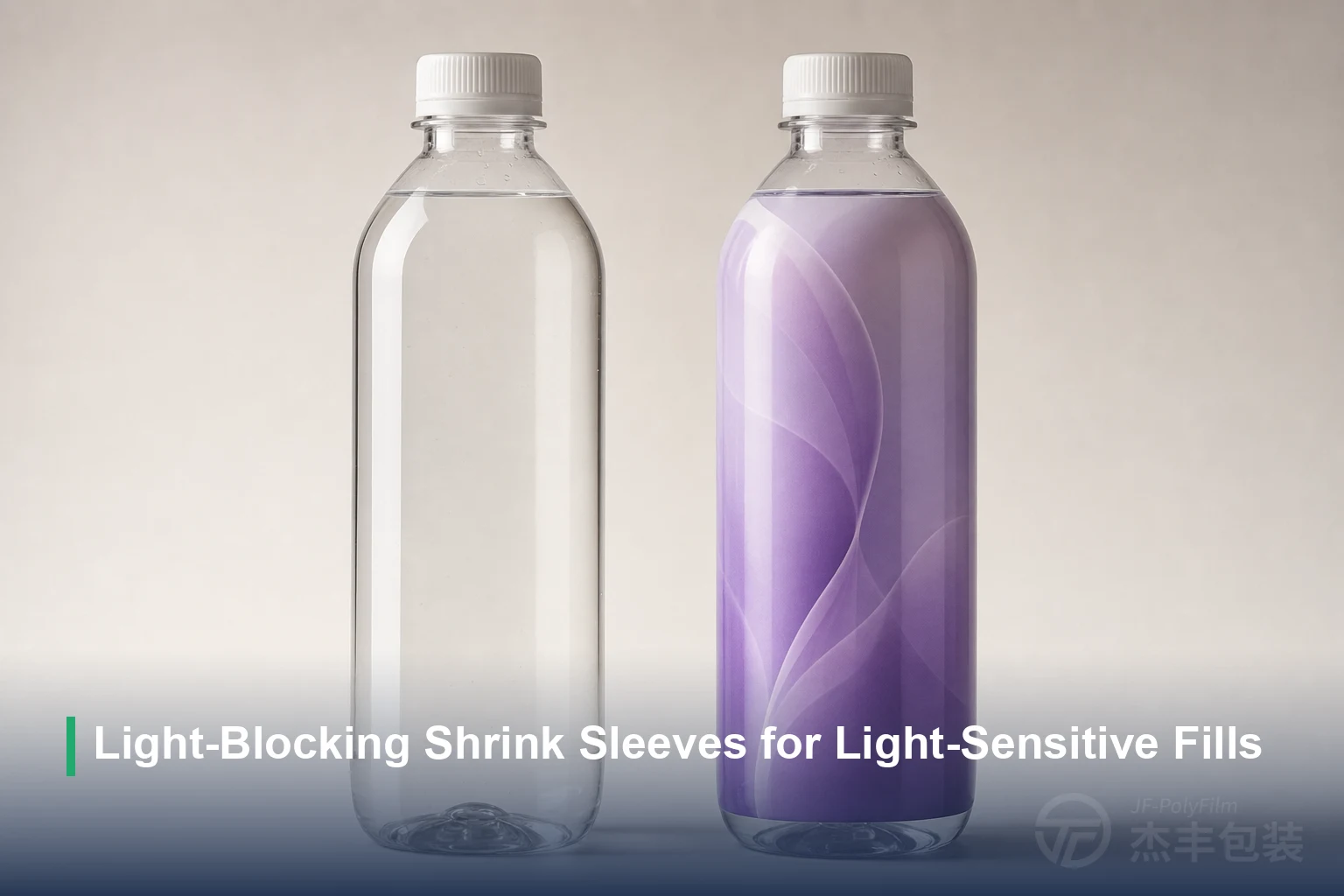
Light-Blocking Shrink Sleeves for Light-Sensitive Fills
Beer, dairy, supplements, and some medicines degrade under light. Which fills need protection, and how a full-body opaque PETG sleeve wraps the whole container to keep light off the contents.
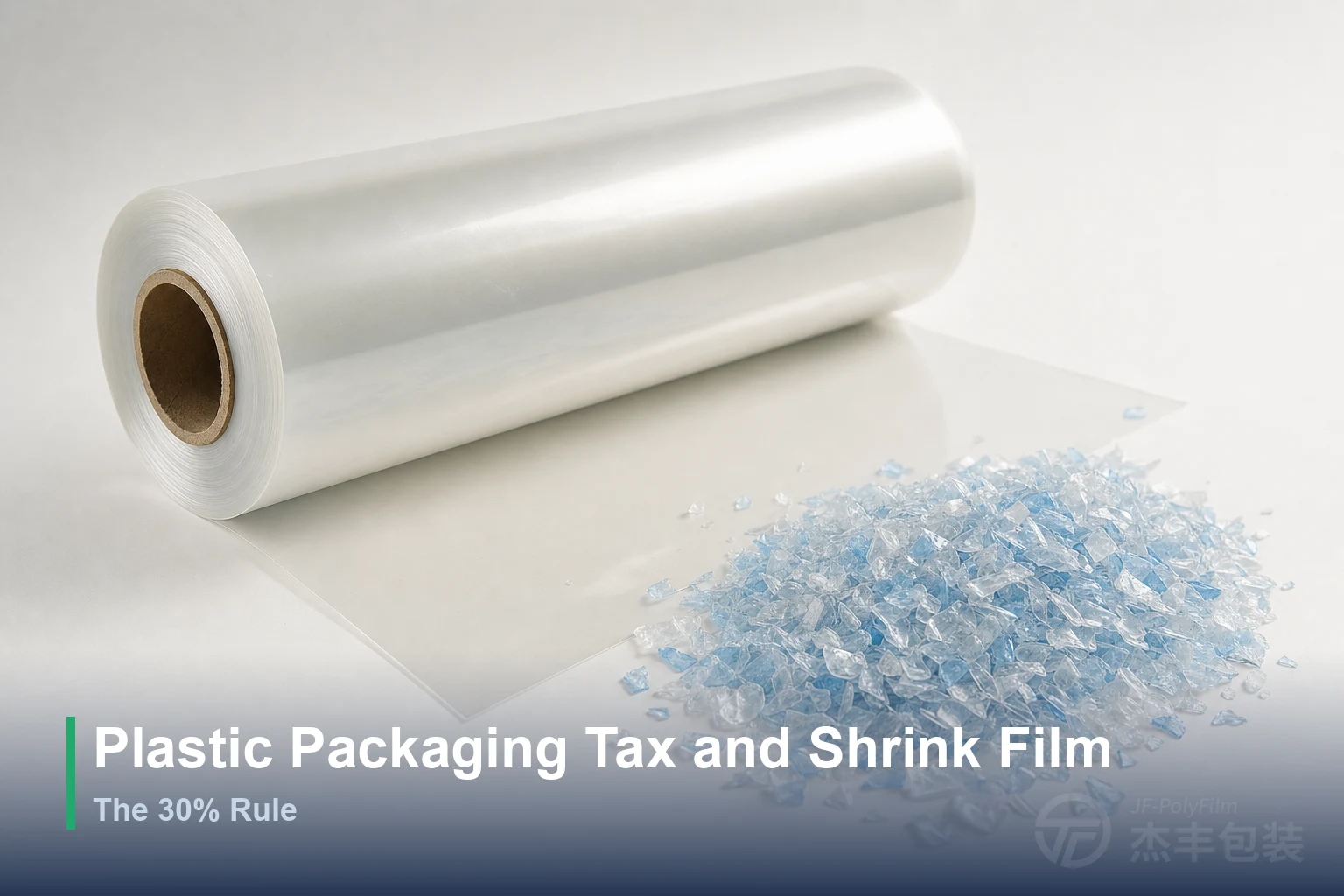
Plastic Packaging Tax and Shrink Film: The 30% Rule
How plastic packaging taxes in the UK, Spain, Italy and the EU treat shrink sleeves, why the 30% recycled-content threshold is the number worth remembering, and how RPET film helps a sleeve cross it.
Need Expert Advice on Shrink Film?
Our technical team can help you choose the right film for your application.
Contact Us