
Plastic Packaging Tax and Shrink Film: The 30% Rule
How plastic packaging taxes in the UK, Spain, Italy and the EU treat shrink sleeves, why the 30% recycled-content threshold is the number worth remembering, and how RPET film helps a sleeve cross it.
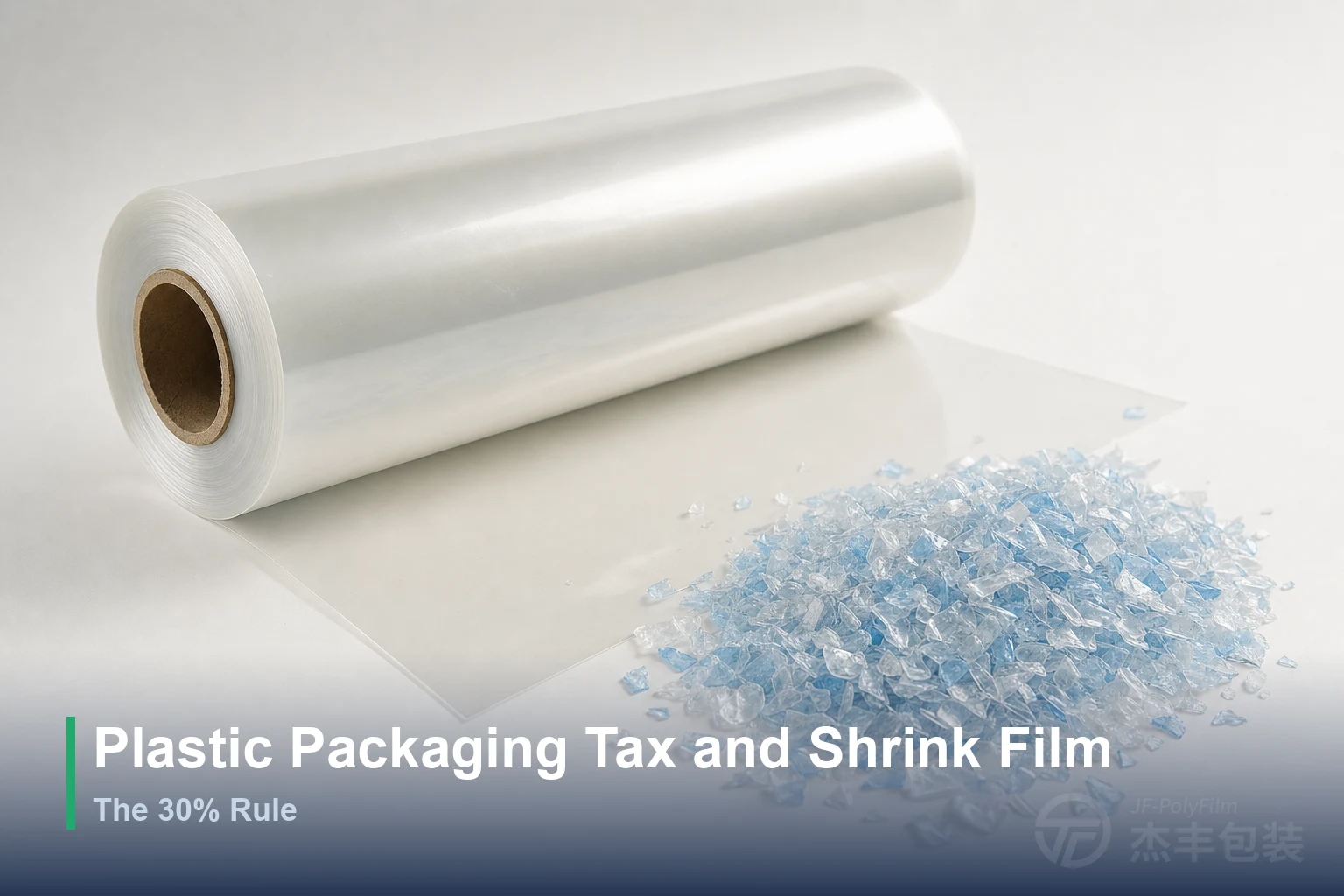
A shrink sleeve is a plastic packaging component, and in a growing number of European markets that means it carries a tax bill by weight — unless the film holds enough recycled content to cross a threshold. The single most useful number for a sleeve buyer to carry is 30%: the recycled-content line the UK draws between a taxed sleeve and an exempt one.
This is a procurement and regulation story, not a chemistry one. How a recycled percentage is engineered into film, and how the physics of separation decides whether a sleeve recovers with its bottle, are covered elsewhere; here the subject is narrower — how four European plastic packaging taxes treat the sleeve as a taxable object, and what recycled content does to that treatment. It is also worth saying plainly at the top: tax rates move, and this is not tax advice. The stable, executable figure to design around is the threshold, and everything below builds outward from it.
Key takeaways
- Four European measures put a price on non-recycled plastic packaging: the UK Plastic Packaging Tax, Spain’s tax on non-reusable plastic packaging, Italy’s deferred plastic tax, and the EU plastic own resource — and a shrink sleeve is a plastic packaging component inside their scope.
- The UK draws a hard line at 30% recycled content by weight: a sleeve at or above 30% is exempt from the tax, one below it is charged per tonne. That threshold is the number to design around because it has held stable while the rate is adjusted every April.
- The UK explicitly lists applying a shrink film label to a bottle as a taxable packaging activity, and the recycled content is judged on the sleeve component itself, by weight — not on the whole packaged product.
- A standard RPET or PCR-containing PETG sleeve film typically carries 30–50% post-consumer content, which clears the UK 30% line and lowers the taxable weight under Spain’s per-kilogram model.
- Recycled content only counts when it is documented: a Global Recycled Standard chain of custody with a transaction certificate per shipment is what turns a recycled percentage into a figure a tax authority will accept.
Why the sleeve is taxed as a component in its own right
The sleeve is taxed because it is a plastic packaging component in its own right, assessed on its own weight rather than as part of the bottle it decorates. UK guidance lists heating a shrink film label onto a bottle among the manufacturing activities that create a taxable finished component, and where a component is built from more than one material but plastic is the largest part by weight, the whole component is treated as plastic packaging. Spain’s tax reaches semi-finished plastic items and the plastic elements used to close, present, or market a product, which is exactly what a sleeve is.
That component-level view is the part buyers most often miss, and it is where the film supplier’s role becomes concrete. Because the recycled content is measured on the sleeve film itself and not averaged across the finished pack, the recycled percentage of the plain film supplied for that layer directly sets its tax classification. A brand can run recycled-content bottles and still owe tax on a virgin sleeve, or the reverse. Each component is scored separately, so the sleeve is a decision a buyer controls independently — and one a manufacturer of the film can answer directly, by supplying the recycled grade the classification turns on.
The four European taxes a sleeve can meet
Four measures matter for anyone selling packaged goods into Europe, and they work on three different logics — a threshold, a per-kilogram deduction, a deferred charge, and an indirect one. The table sets them side by side; the paragraphs that follow add the detail a spec sheet needs, with the caution that every rate is adjusted over time and the latest official figure should always be confirmed.
| Tax (in force) | How it charges | Recycled-content treatment | What it means for a sleeve |
|---|---|---|---|
| UK Plastic Packaging Tax (since 2022) | Per tonne on packaging below the recycled threshold | Hard line: ≥30% recycled by weight is exempt; below 30% is taxed | A sleeve under 30% recycled adds a per-tonne charge; at or above, the component is exempt |
| Spain, tax on non-reusable plastic packaging (since 2023) | Per kilogram on non-recycled plastic, no threshold | Every certified recycled kilogram is deducted from the taxable weight | Each recycled kilogram in the film lowers the taxable weight of the sleeve layer; fully recycled is exempt |
| Italy plastic tax (legislated, not in force) | Planned per-kg charge on single-use plastic items | Recycled and bio-based plastics planned for exemption | No charge applies today; the plan has been deferred repeatedly, currently to 2027 |
| EU plastic own resource (since 2021) | Per kilogram on non-recycled packaging waste, paid by member states | Recycled packaging waste is excluded from the member-state base | No direct charge on the sleeve; it is the reason national sleeve taxes exist |
The UK Plastic Packaging Tax has run since April 2022 and charges packaging whose recycled content is below 30% by weight. Any business manufacturing or importing 10 tonnes or more of finished plastic packaging over a rolling 12 months must register, whether or not its components clear the threshold. The rate is raised each April in line with inflation, which is precisely why the rate is the wrong number to memorise and the threshold is the right one; confirm the current official per-tonne figure for the year in question.
Spain’s tax on non-reusable plastic packaging has applied since January 2023 as a per-kilogram charge, but only on the non-recycled plastic in a package. There is no exemption threshold; instead the recycled fraction is subtracted from the taxable weight kilogram by kilogram, so a higher recycled share means a lower bill and a fully recycled film owes nothing. The recycled content has to be certified for the deduction to hold.
Italy’s plastic tax is legislated but has never taken effect. Introduced in 2020 as a planned per-kilogram charge, it has been postponed repeatedly and is currently deferred to 2027, with recycled and bio-based plastics slated for exemption if it ever begins. The right way to read it is as a spec-planning signal, not a present cost — a reason to keep the recycled option qualified rather than a charge to budget for now.
The EU plastic own resource is different in kind. Since 2021 each member state pays a per-kilogram levy on the non-recycled plastic packaging waste it generates into the EU budget; a proposal to raise that rate is on the table but not adopted. It is not levied on companies. Its relevance to a sleeve buyer is that it gives every member state a standing incentive to reduce non-recycled plastic, which is the upstream driver behind the national taxes a business actually pays.
Why 30% is the number to design around
Of everything above, the 30% UK threshold is the figure worth committing to a spec, because it is both stable and executable in a way the rates are not. Rates change on a schedule — the UK adjusts every April, the EU levy has a rise pending, Italy’s has slipped by years — so a number quoted today can mislead a buyer reading next year. The 30% line has held since the tax started, and it converts cleanly into a design target: get the recycled content of the sleeve film at or above 30% by weight and that component drops out of the charge entirely.
Spain works on a different logic worth understanding alongside it. There is no cliff-edge threshold; recycled content is rewarded linearly, each certified kilogram trimming the taxable weight, so the incentive runs all the way to 100%. The two models point the same direction from opposite structures: in the UK, recycled content is a pass/fail gate at 30%; in Spain, it is a sliding scale with no floor. A sleeve specified to clear the UK line already carries meaningful recycled content into the Spanish calculation, which is why one recycled grade can serve both markets. For the regulation-driven mandates that sit beside these taxes — the recyclability and recycled-content rules of the PPWR — the timeline and clauses are a separate subject, set out in what PPWR means for shrink sleeves; the point here is only that the tax lever and the mandate lever are distinct, and recycled content happens to answer both.
How recycled content changes the tax treatment
Recycled content is the one property of the film that moves a sleeve across these tax lines, which is the practical reason a brand specifies it beyond any sustainability pledge. An RPET sleeve film, or a PETG film blended with post-consumer recycled (PCR) material, carries a verified recycled percentage while it prints and shrinks like standard PETG. Push that percentage to 30% or above and the sleeve component clears the UK threshold; feed it into the Spanish calculation and every recycled kilogram comes off the taxable weight.
A standard RPET grade typically carries 30–50% PCR, which lands it above the UK 30% line by design and puts a substantial deduction into the Spanish base. How that recycled fraction is engineered into the resin, and how it holds the same shrink and print performance as virgin film, is the subject of the RPET shrink film explainer rather than this article; what matters here is the alignment — the recycled content that answers the sustainability case is the same recycled content that answers the tax one. The honest framing is qualitative: a compliant recycled grade lowers or removes this layer’s tax burden and keeps the component on the right side of the threshold. What it does not do is turn into a savings figure anyone should quote in advance, because the charge depends on volumes, market, and rates that shift.
One boundary keeps the claim clean. Recycled content is what the film is made from; it does not change how the sleeve behaves at end of life, which is a separate question of resin chemistry and separation covered in how CPET recycles in the RIC 1 stream. A recycled-content sleeve can still be hard to recover, and a recyclable sleeve can be made from virgin resin. For the taxes discussed here, only the recycled input counts.
Proving the recycled content counts
A recycled percentage earns its tax treatment only when it is documented, because it cannot be measured on the finished film. Once recycled and virgin PET are blended and oriented, the recycled chains are the same molecule as the virgin ones, so verification has to travel back through the supply chain rather than forward through a test of the roll. That is what a chain-of-custody certification does. Under the Global Recycled Standard, certified mass in is reconciled against certified product out, and a transaction certificate — issued per shipment — ties the specific delivery a buyer receives to the recycled claim behind it. Spain’s tax law additionally recognises certification to the EN 15343 traceability standard for the same purpose.
The distinction between holding a certification and proving a shipment is where recycled claims most often come apart at audit, and it is worth setting out in full when qualifying a supplier — the mechanics of scope versus transaction certificates are covered in the guide to verifying shrink film certifications. For the tax question the rule compresses to one line: without accepted documentation, a tax authority counts the recycled share as zero, so the paperwork is not administrative overhead but the thing that makes the threshold real.
How a buyer should read the tax exposure
The workable response is to treat the sleeve’s recycled content as a market-access variable, not an afterthought. Map the destination markets against the four measures — a live UK charge, a live Spanish one, a deferred Italian plan, an indirect EU driver — and the exposure resolves into a short checklist: know whether the sleeve sells into a market that taxes non-recycled plastic, know the threshold or deduction that applies, specify the film’s recycled content to clear or reduce it, and require the certification that documents the claim per shipment. Because rates and dates move, and because the classification of a specific component depends on the whole component and each market’s own rules, professional tax advice belongs in the loop for the numbers; the film specification is the part a buyer controls directly.
The recycled grade is where a film manufacturer meets this problem directly. JFPolyFilm’s RPET shrink film is produced with 30–50% post-consumer content under a live GRS certification, and a transaction certificate travels with each shipment to tie the delivered rolls to that recycled claim. Its shrink and print behaviour matches virgin PETG — transverse shrink at TD ≥75%, machine-direction shrink held to MD ≤3.0%, across 30–60 μm — so moving to the recycled grade changes the tax classification of the sleeve layer without changing how it runs on the line. At that recycled share the component sits above the UK 30% line and trims the taxable weight under the Spanish deduction, with paperwork that holds up at audit. Where that contribution ends deserves stating as plainly as where it begins: the film settles the recycled input for one layer, but it does not decide whether the finished pack is taxed — that turns on total packaging weight, each destination market, and rules that belong with a tax professional. JFPolyFilm supplies the film and the certification behind it, the recycled part of the answer, and leaves the tax position itself for the buyer and their adviser to confirm; no honest supplier should put a figure on the saving before the volumes and rates that decide it are known.
A bottle line selling into the UK or Spanish market can begin by qualifying RPET shrink film against the recycled-content figure its specification needs. Tell JFPolyFilm which markets the pack sells into and the recycled percentage to hit, and the reply comes back with the matching grade and the GRS paperwork that evidences it.
Frequently Asked Questions
Does the UK Plastic Packaging Tax apply to shrink sleeves?
What recycled content exempts a sleeve from the UK tax?
Does recycled content help in Spain the same way it does in the UK?
Is the EU plastic levy a tax on our packaging?
How do we prove the recycled content actually counts toward the threshold?
Related Articles
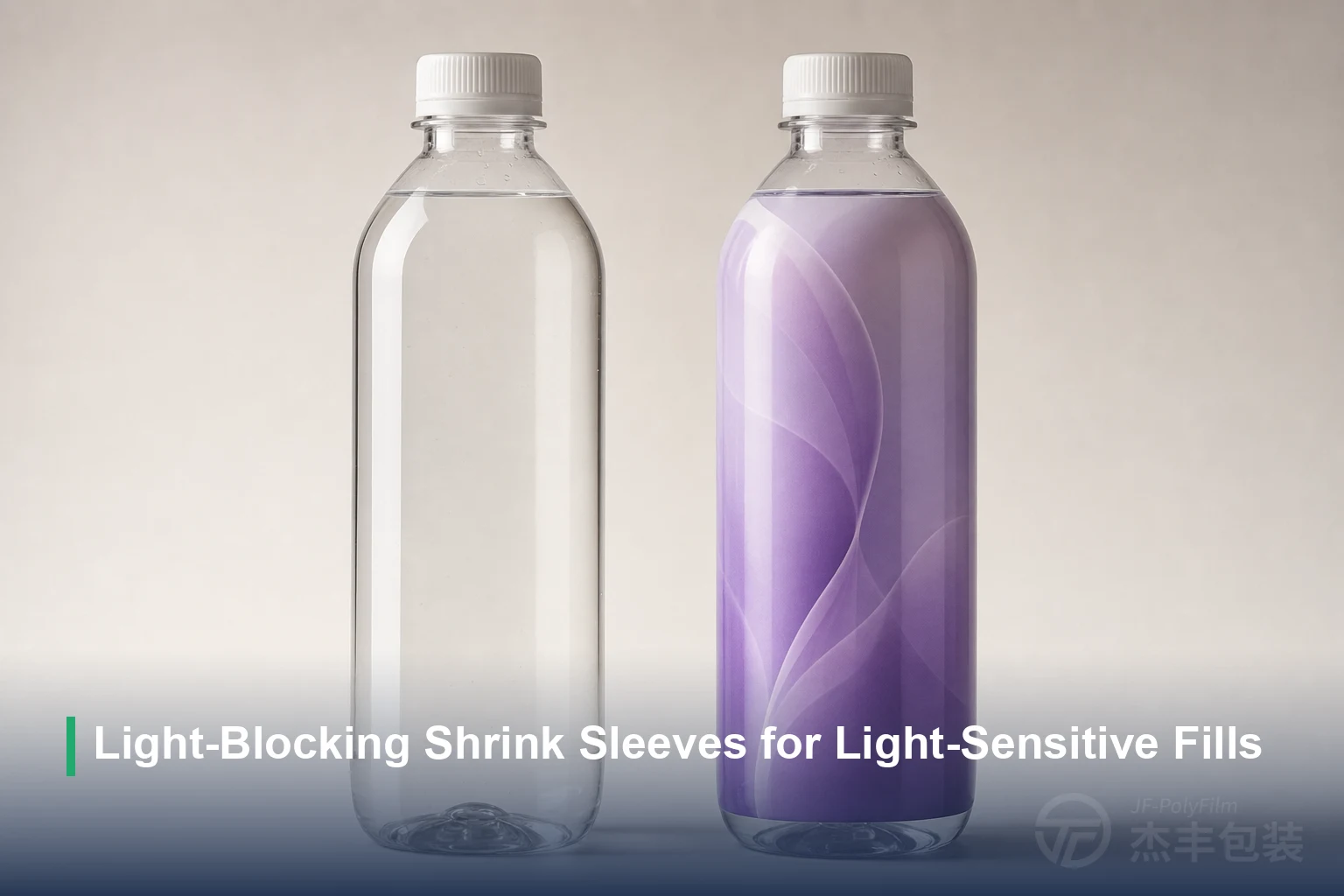
Light-Blocking Shrink Sleeves for Light-Sensitive Fills
Beer, dairy, supplements, and some medicines degrade under light. Which fills need protection, and how a full-body opaque PETG sleeve wraps the whole container to keep light off the contents.
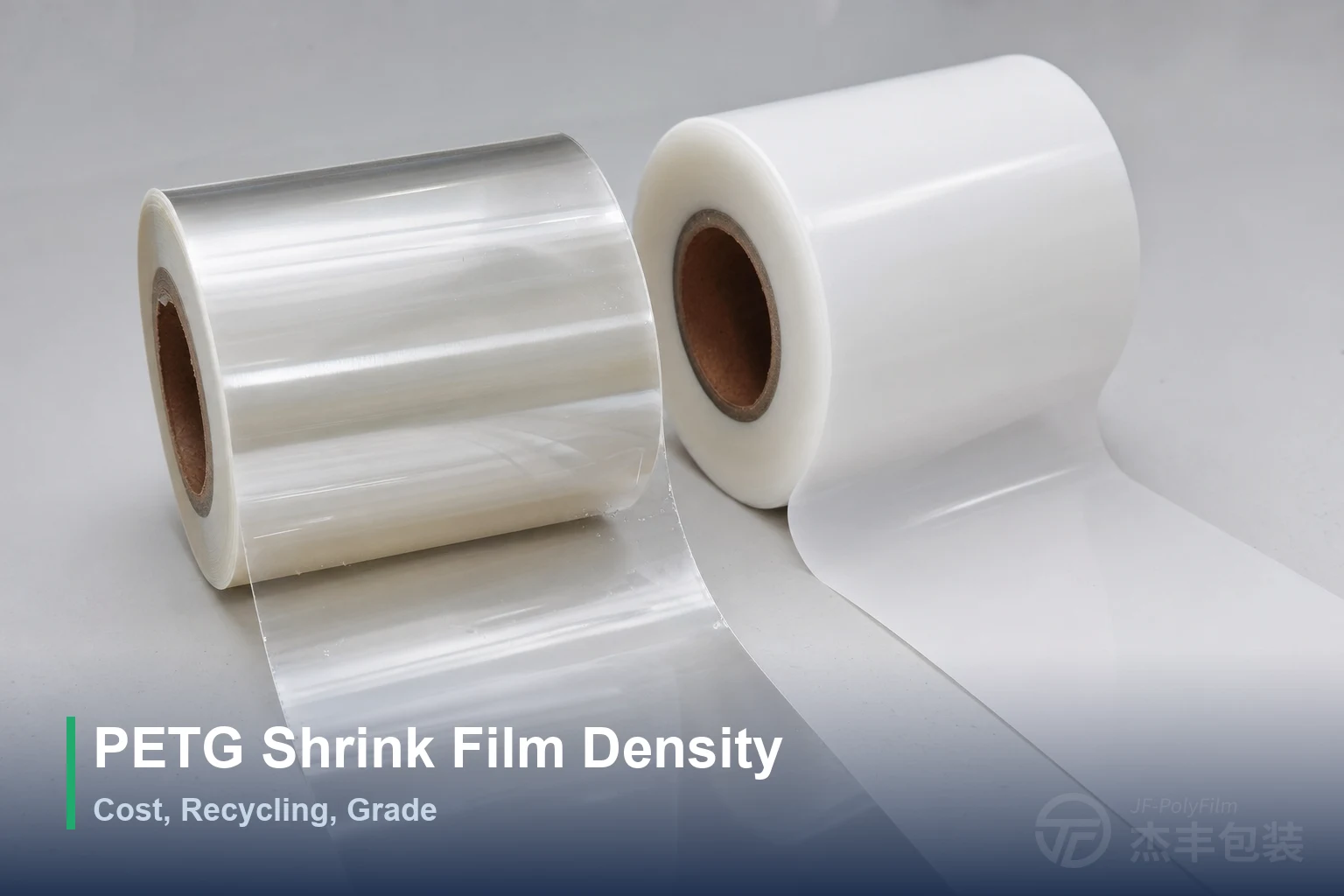
PETG Shrink Film Density: Cost, Recycling, Grade
Density drives three things a buyer feels: how much film a kilogram yields, whether a sleeve floats or sinks in recycling, and how clear and white grades split.
Need Expert Advice on Shrink Film?
Our technical team can help you choose the right film for your application.
Contact Us