
PETG Shrink Film Density: Cost, Recycling, Grade
Density drives three things a buyer feels: how much film a kilogram yields, whether a sleeve floats or sinks in recycling, and how clear and white grades split.
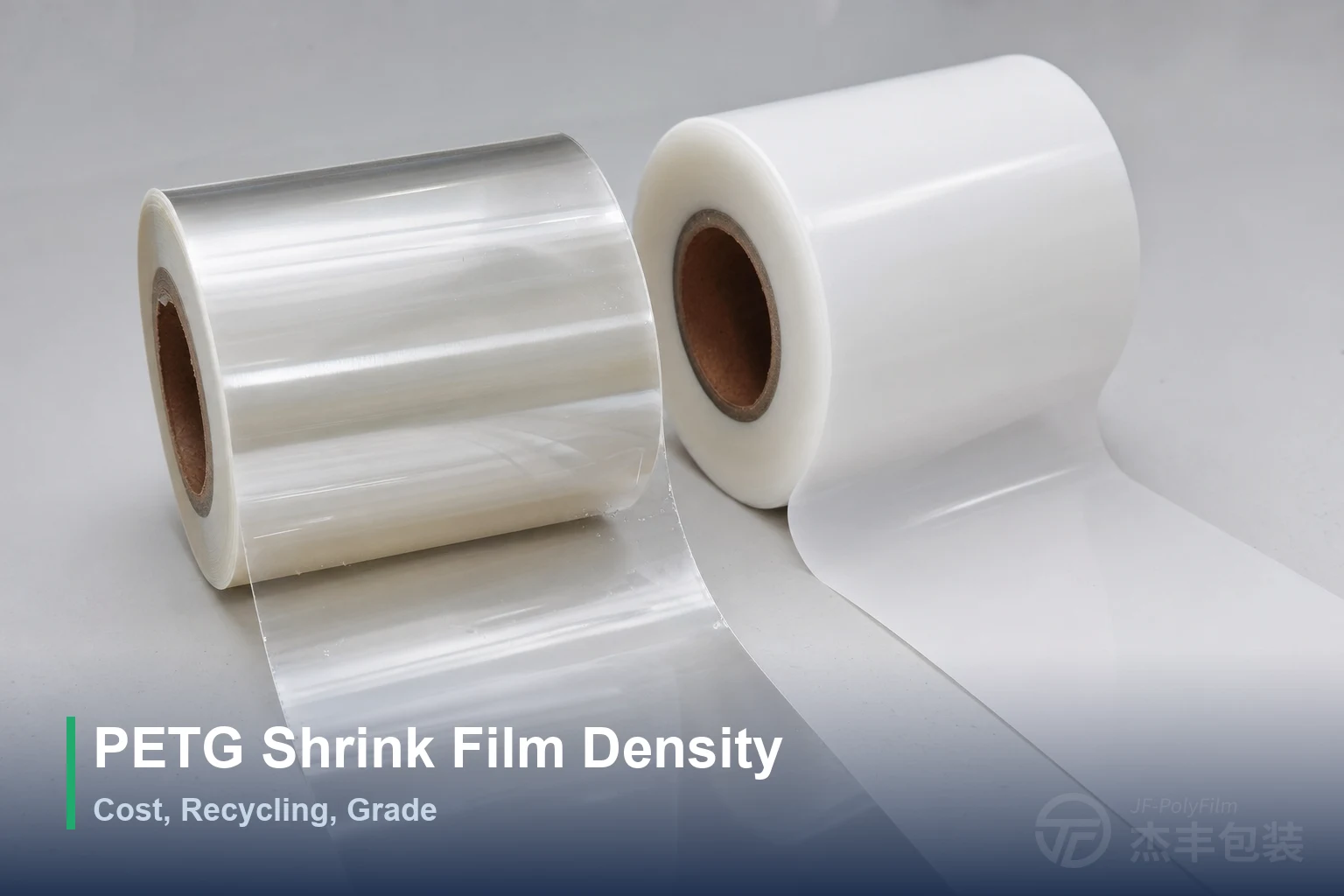
PETG shrink film density is easy to skim past on a datasheet, yet for a clear grade it sits near 1.28 to 1.33 g/cm³ — typically about 1.32 — and that one number quietly governs how much film a kilogram yields, whether a sleeve floats or sinks in recycling, and how a white grade is built.
Key takeaways
- Clear PETG shrink film runs about 1.28 to 1.33 g/cm³, typically 1.32 — essentially the density of the base copolyester resin, since a clear grade is a solid, unfilled film.
- Areal weight is density multiplied by thickness, so a lower density yields more sleeve area per kilogram — the basis of what is sold as a high-yield film.
- White PETG splits in two: a micro-voided grade runs lighter than clear (a fully voided film can fall below 1.0 g/cm³), while a solid grade filled with titanium dioxide (about 4.2 g/cm³) runs heavier, around 1.35 to 1.45 or more.
- Water, at 1.0 g/cm³, is the float/sink line in recycling: clear and pigmented PETG sink alongside PET bottle flake (about 1.37 to 1.40), while a below-1.0 micro-voided sleeve floats free of it.
- Density is not opacity. A white film’s opacity comes mainly from light scattering off internal voids, with pigment a second, optional route that moves density the other way.
What sets a shrink film’s density
Density is mass divided by volume, and for a shrink film it is decided by two things: the chemistry of the polymer and whatever has been added to or removed from the solid web. A clear PETG shrink film is the simplest case — a solid, unfilled, amorphous sheet — so its density tracks the base copolyester resin almost exactly, landing in the 1.28 to 1.33 g/cm³ band and clustering around 1.32 in a typical grade. There is no filler bulking it up and no void space lightening it, so what you measure is close to the resin itself.
That figure is a static material property, and it is worth separating from the property buyers more often ask about. Density describes how heavy the film is; it says nothing about how far the film draws in when heated. A film can be dense and high-shrink, or light and high-shrink — the two live on different axes, and the pull-in comes from molecular orientation frozen into the web, explained in how PETG shrink film works. Density earns its own article because it drives a different set of outcomes: what a kilogram is worth in coverage, where the sleeve lands at end of life, and how a white grade reaches its opacity. Each of those traces straight back to the number.
One neighbouring material makes a useful yardstick: a PVC shrink film runs slightly heavier than clear PETG, around 1.30 to 1.40 g/cm³, so a like-for-like PVC sleeve carries a touch more mass for the same coverage — a single point of comparison, not the whole material trade, which turns on far more than weight.
Density at a glance: five reference points
The clearest way to read density is against water and against the PET bottle flake a sleeve may share a recycling stream with. Five reference points frame every decision below — the density band, whether it puts the film above or below the 1.0 g/cm³ waterline, and what that changes.
| Material and state | Density (g/cm³) | Vs. water (1.0) | Float or sink | What it changes |
|---|---|---|---|---|
| Clear PETG shrink film (solid, amorphous) | 1.28–1.33 (typ. 1.32) | Above | Sinks | Baseline yield; sinks with PET flake in recycling |
| White PETG, micro-voided | Lower than clear; fully voided < 1.0 | Can be below | Floats when < 1.0 | Higher yield; can separate from the PET stream |
| White PETG, solid TiO₂ pigment | ~1.35–1.45+ | Above | Sinks | Lower yield; sinks with PET flake |
| PET bottle flake (crystalline / oriented) | ~1.37–1.40 (often cited ~1.38) | Above | Sinks | The reference stream a sleeve joins or leaves |
| Water | 1.00 | — | The line itself | The float/sink threshold in recycling |
Clear-film figures are JFPolyFilm’s published grade values; white-film bands describe general micro-voided and pigmented constructions. PET bottle flake reads higher than an amorphous PET sheet (about 1.33 to 1.34) because crystallinity and orientation from blow-moulding pack the polymer tighter — which is why the bottle stream sits near 1.38 rather than at the resin’s amorphous figure.
Density and yield: reading a sleeve by weight
Density decides how much film a kilogram becomes, and that is where it first touches the purchase order. A film’s areal weight — its grams per square metre — is simply its density multiplied by its thickness: a 1.32 g/cm³ clear grade at 45 µm weighs 59.4 g/m², which means one kilogram covers a little under 17 m² of film. Drop the density and the same kilogram covers more; raise it and it covers less. Thickness is the other multiplier in that product, chosen on its own terms and worked through in how to choose shrink film thickness, but density is the factor most buyers overlook because it is invisible on the roll.
The per-sleeve view follows directly. The weight of a single sleeve is roughly its density times its thickness times its unwound area — the flattened dimensions the sleeve is cut to. Two films at the same thickness and the same layflat will hand you a different number of sleeves per kilogram if their densities differ, because the lighter one puts less mass into each sleeve. This is the bridge between the two ways a shrink film is counted: it is bought by the kilogram but costed by the sleeve, and density is the conversion sitting silently between them. A high-yield film is nothing more exotic than a lower-density film delivering more sleeve area for the same weight of resin.
That is why a lower density is not a defect to be corrected but, in the right grade, a feature to be specified — the whole point of a micro-voided white, covered below. When the two counting methods have to be reconciled against a real order, the film’s measured density on its Certificate of Analysis is the figure to anchor to rather than a generic catalogue nominal, a habit worth carrying into any supplier and COA check.
Density and recycling: float, sink, and where a sleeve lands
Density also decides which recycling company the sleeve ends up keeping. Rigid PET bottles are recycled through a wet process that separates plastics by whether they float or sink in water, and the dividing line is water’s own density, 1.0 g/cm³: anything lighter rises and is skimmed off, anything heavier sinks and stays in the PET fraction. A sleeve’s density, relative to that line, sets which side of the separation it reports to.
A clear PETG sleeve, at roughly 1.32, sits above the line and sinks — landing in the same fraction as the PET bottle flake it was wrapped around, which sinks at about 1.37 to 1.40. That the flake reads heavier than the sleeve is a matter of state, not a different material: an unoriented, amorphous PET sheet — the resin before it is drawn into a bottle — measures only about 1.33 to 1.34 g/cm³, barely above the clear copolyester film, but the stretch and heat of blow-moulding crystallise and orient the bottle wall, packing the same polymer tighter until the recovered flake settles near 1.37 to 1.40. So the sleeve sinks alongside a flake that is denser than either the sleeve itself or the resin that flake began as. A solid pigmented white behaves the same way, only heavier. Whether a sinking sleeve is welcome in that fraction, and on what conditions, is a compatibility question with its own physics; the density point is narrower and firm — a sleeve above 1.0 travels with the bottle rather than away from it, and the full sorting and compatibility story is taken up in CPET and RIC 1 recycling explained.
The more useful lever is the film that goes the other way. A sufficiently micro-voided white grade falls below 1.0 g/cm³ and floats, so in the same water bath it rises clear of the sinking bottle flake and is skimmed off — a clean, purely physical separation of the label from the container. That floatability is the material basis for a genuinely sortable full-body sleeve: rather than trusting downstream steps to tell the sleeve from the bottle, the density gap does it at the water line. It is one of the few cases where a film’s density is not just a consequence to manage but a property engineered on purpose, and it is why density belongs in a sustainability conversation, not only a cost one.
Clear versus white: two densities, two routes
White PETG is where the single density figure finally breaks apart, and the reason is that opacity can be built two opposite ways. A white film is not one grade with one weight — it is two constructions pulling density in different directions, and treating them as interchangeable is where density mistakes usually start.
The first route is micro-voiding, also called cavitation: the film is filled with countless microscopic air pockets that scatter incoming light, so the sheet reads opaque without a heavy pigment load. Because those voids are, in effect, engineered-in air, they lower the film’s specific gravity below that of the clear grade — and a fully voided construction can fall under 1.0 g/cm³, the floatable, high-yield white already described. This is the mainstream way a full-body white sleeve is made, and its opacity comes chiefly from the voids scattering light, not from a pigment.
The second route is a solid white pigment, most often titanium dioxide, dispersed through an otherwise solid film. Titanium dioxide is dense — around 4.2 g/cm³, several times the polyester matrix — so even a modest loading pulls the overall density up, landing a solid pigmented white around 1.35 to 1.45 g/cm³ or higher depending on how much is added. Here the density moves above clear, not below it.
The two are often combined — voids for the bulk of the opacity, a measure of pigment for whiteness and tone — but the direction each pushes density is fixed and opposite: voids lighten, pigment weighs down. This is why a white sleeve’s density is a band rather than a value, and why opacity should never be pinned on pigment alone. The full optics-and-printing choice between the two families, and when to reach for each, is a selection question in its own right, laid out in clear vs white PETG shrink film; here the point is narrower — the same word, white, covers a film lighter than clear and one heavier than clear, and only the construction tells you which.
What density tells a buyer
Read on its own, a density figure looks like trivia on a datasheet. Read against the three things it controls, it is one of the more informative numbers a shrink film carries. It sets the yield behind the per-sleeve cost, so it belongs in any comparison of what a kilogram is actually worth in coverage. It fixes the film’s fate at the water line, so it belongs in any recyclability claim. And it reveals how a white grade was built — voided and light, or pigmented and heavy — so it belongs in any read of what “white” really means on a given roll.
None of that turns density into a quality score. A lighter film is not better than a heavier one; each is right for a different job, and the number simply tells you which construction is in your hands. Where density earns its place is upstream of the datasheet, as a target set when a grade is formulated rather than a figure noticed after the fact — the coverage of a high-yield voided white, the sink-with-the-bottle behaviour of a clear sleeve, and the opacity of a pigmented one are all decisions made in the density before the film is ever run. That makes it a specification to state, not a surprise to inherit. Describe what the pack has to accomplish — carry the most area per kilogram, part cleanly from the bottle at the water line, or stand opaque over the product — and the density target falls out of the answer, whether the job settles on JFPolyFilm’s clear PETG or the white construction built around it.
Frequently Asked Questions
What is the density of PETG shrink film?
Does PETG shrink film float or sink in water?
Why does white PETG shrink film have a different density than clear?
How does film density affect the cost of a shrink sleeve?
Is a denser shrink film a better shrink film?
Related Articles
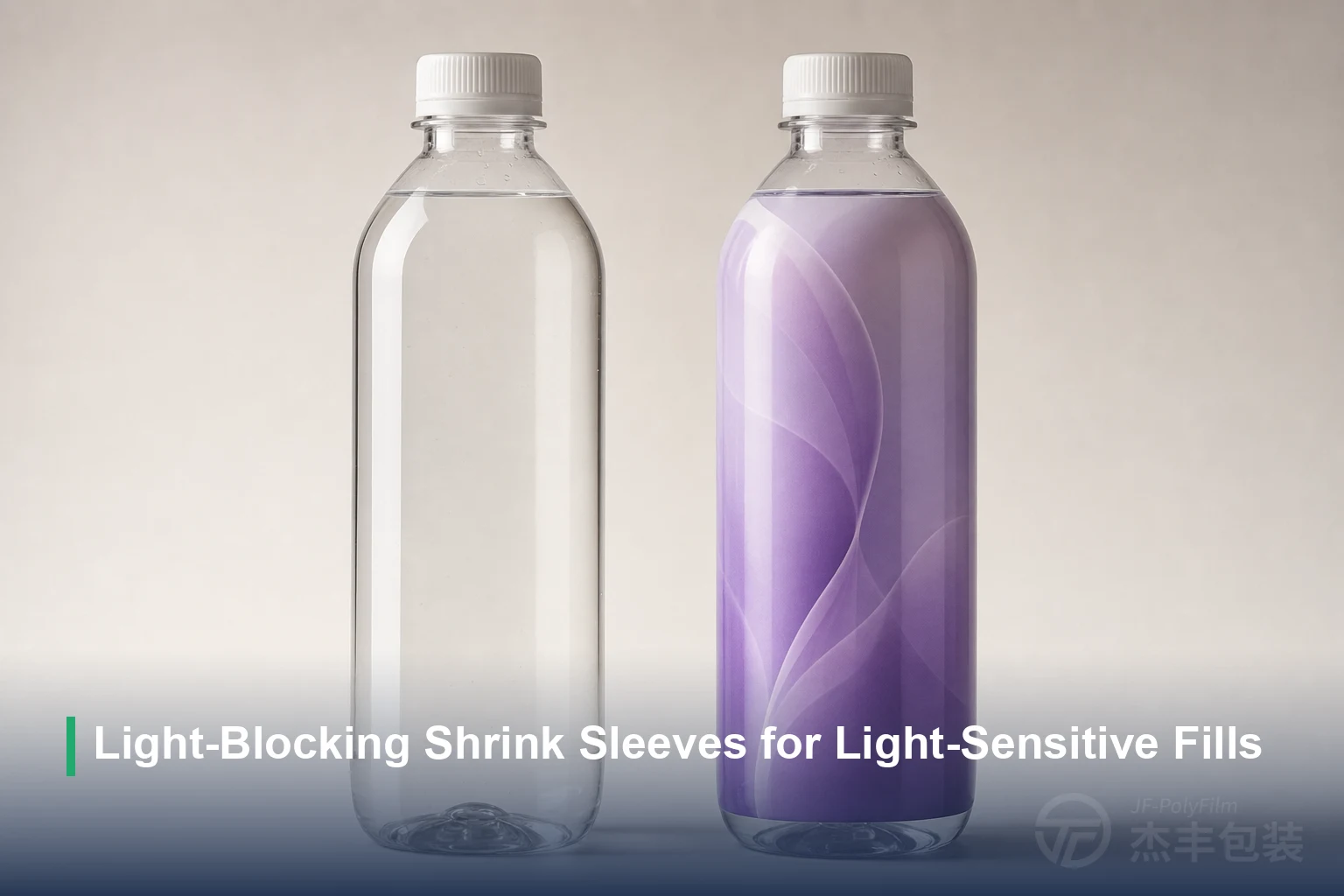
Light-Blocking Shrink Sleeves for Light-Sensitive Fills
Beer, dairy, supplements, and some medicines degrade under light. Which fills need protection, and how a full-body opaque PETG sleeve wraps the whole container to keep light off the contents.
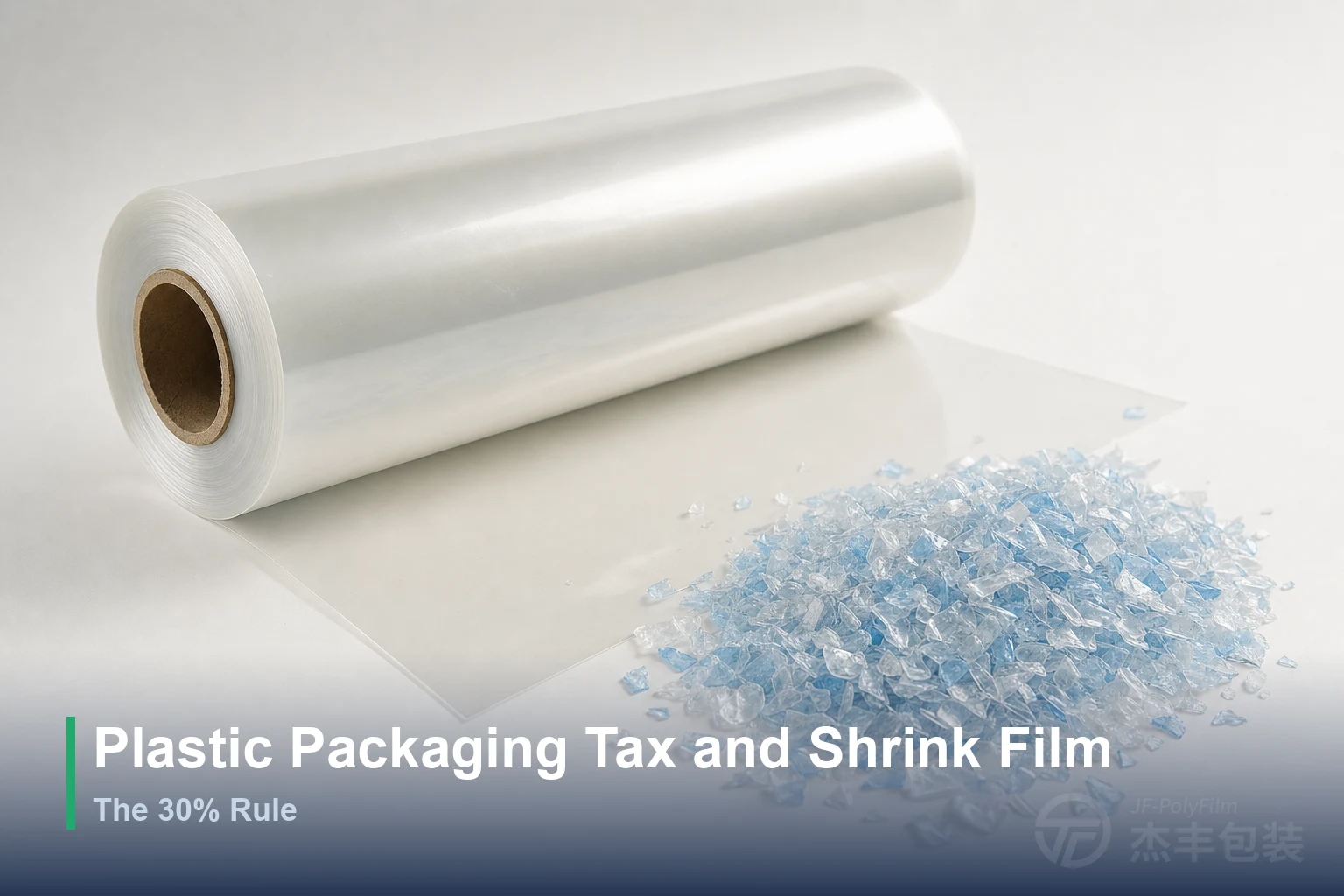
Plastic Packaging Tax and Shrink Film: The 30% Rule
How plastic packaging taxes in the UK, Spain, Italy and the EU treat shrink sleeves, why the 30% recycled-content threshold is the number worth remembering, and how RPET film helps a sleeve cross it.
Need Expert Advice on Shrink Film?
Our technical team can help you choose the right film for your application.
Contact Us