
Light-Blocking Shrink Sleeves for Light-Sensitive Fills
Beer, dairy, supplements, and some medicines degrade under light. Which fills need protection, and how a full-body opaque PETG sleeve wraps the whole container to keep light off the contents.
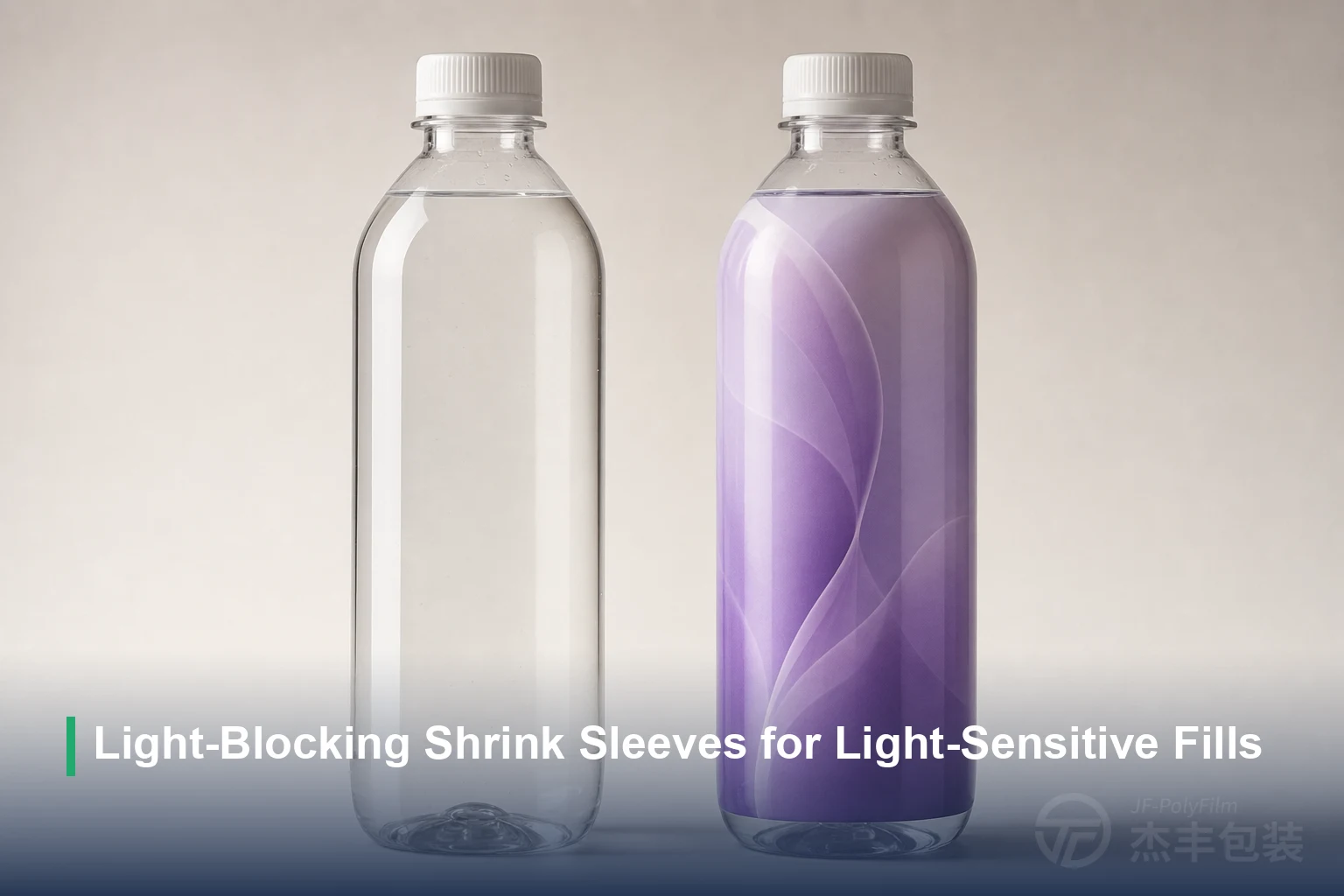
A light-blocking shrink sleeve is a full-body opaque label, usually white PETG, that wraps the whole container and, being opaque rather than see-through, keeps most of the visible light and UV that would harm the fill off the contents. The same sleeve carries the brand graphics, so it shields what is behind it while doing the labelling job.
That second job matters for a narrow but important set of products. Most fills are indifferent to a lit shelf, but a handful react to light in ways that ruin flavour, strip nutrients, or weaken an active ingredient — and for those, the choice between a see-through pack and an opaque one is a functional decision, not a design preference.
Key takeaways
- Light-sensitive fills — beer, dairy, supplements, and some medicines — degrade under light through reactions that clear packaging does nothing to slow.
- The damage is driven by specific wavelengths: beer skunks under roughly 350–500 nm blue and near-UV light, and many photosensitive medicines break down under about 300–500 nm.
- An opaque full-body sleeve blocks light because it is not see-through; a clear film and a partial label both leave the fill exposed.
- Coverage is the sleeve’s structural advantage: a full-body sleeve wraps 360 degrees around the container, while a wrap or waist label shields only the band it sits on.
- An opaque sleeve reduces light-induced degradation — one stress among several — and is not a preservative or a shelf-life guarantee.
Which fills degrade under light
Only a defined group of products needs light protection, and knowing whether a fill belongs to it is the first question, ahead of any decision about the film. The common thread is a molecule inside the pack that absorbs light and starts a reaction — a spoiled flavour, a lost vitamin, a weakened dose. Beer, cultured dairy, vitamins and supplements, and a range of photosensitive medicines all share that vulnerability, each for its own chemistry.
| Light-sensitive fill | What light does | Off-target result | Light-avoidance approach |
|---|---|---|---|
| Beer | Blue and near-UV light (~350–500 nm) excites riboflavin, which passes energy to hop-derived iso-alpha-acids | ”Light-struck” skunky flavour from a thiol compound | Brown glass traditionally; an opaque sleeve covers what glass tint alone cannot |
| Dairy and dairy drinks | Riboflavin drives photo-oxidation while riboflavin, vitamin A, and vitamin C break down | Off-flavours and vitamin loss, detectable within hours under retail lighting | Opaque cartons or bottles, or an opaque full-body sleeve |
| Supplements and vitamins | Vitamins A, B2, B6, B12, folic acid, and D degrade under UV and visible light | Loss of potency over time | Amber or opaque bottles; opaque sleeves on otherwise clear containers |
| Photosensitive medicines | Near-UV and blue-violet light (~300–500 nm) drives photodegradation | Loss of the active compound | Amber glass and opaque or light-resistant containers |
The list is worth reading as a screening tool. If a fill contains riboflavin, hop compounds, light-sensitive vitamins, or a photosensitive active, it has a reason to sit behind an opaque wall; if it does not, a clear sleeve costs it nothing. Beer is the clearest case, and the dairy and supplement programmes each carry their own considerations, with the dairy side covered in depth in shrink sleeves for yogurt and dairy.
The container the fill already sits in shapes the answer too. A light-sensitive product in clear glass or a translucent bottle is fully exposed on a lit shelf, and that is where an opaque sleeve earns its place. The same fill in amber glass or an already-opaque bottle arrives with some protection built into the container, so the sleeve’s light job is smaller — though a full-body opaque sleeve still closes the gaps a tinted bottle leaves, since even amber glass passes a share of the visible light that reaches the contents. Reading the container alongside the fill keeps the decision honest: the question is not whether a product could use an opaque sleeve, but whether light actually reaches the fill in the pack it ships in.
How light spoils these fills
The reactions behind the table run on the same basic idea: a light-absorbing molecule catches a photon and hands the energy off to something that then breaks. In beer, riboflavin — vitamin B2 — is the light absorber. When blue or near-UV light hits it, it becomes reactive and passes energy to the bitter iso-alpha-acids that come from hops. A side chain on those acids splits, forms a free radical, and ends up building a sulphur compound closely related to the one in skunk spray, which is why light-struck beer smells the way it does. The trigger is not UV alone; visible blue light, the kind ordinary glass lets through, is enough on its own.
Dairy follows the same photosensitiser at work. Riboflavin in milk absorbs light and sets off oxidation, and in the process riboflavin itself, along with vitamins A and C, breaks down — the fill loses nutrition and gains an off-flavour, often within a few hours under a lit retail cabinet. Vitamins and supplements degrade more directly: riboflavin, folic acid, vitamins A, B6, B12, and D all lose stability under light, and riboflavin can accelerate the breakdown of its neighbours. Many photosensitive medicines follow the same pattern in the roughly 300–500 nm band, which is why amber and opaque containers are the long-standing answer across those categories. In every case the useful move is the same: keep the reacting wavelengths away from the contents.
What makes these reactions a packaging problem rather than a rare edge case is how little light they need. The off-flavour compound in light-struck beer is detectable at extremely low concentrations, so the exposure that ordinary shelf and cabinet lighting delivers over hours or days is enough to register, well before a bottle sees direct sun. Dairy shows the same speed, with off-notes appearing within hours under retail lights. The damage is also cumulative: every hour the fill spends lit adds to it, and nothing reverses once the reaction has run. That is why the answer across all four categories is to limit the exposure at the pack rather than to rely on fast turnover or careful storage alone — the container is the one variable that travels with the product from the line to the shelf.
Visible light and UV: what has to be stopped
Blocking light means blocking two different things, and a film that stops only one leaves the fill exposed. PETG, like the PET polyester family it belongs to, naturally absorbs shorter-wave UV below roughly 315 nm but stays largely transparent to longer UVA and to visible light. That means a plain clear film screens out a little short-wave UV and no more — it does nothing about the visible blue light near 400–500 nm that skunks beer and oxidises dairy, because that light passes straight through a transparent sleeve.
Two things close that gap. Visible light is blocked by opacity: a film that is not see-through simply does not let it through, which is what an opaque white grade delivers across the whole visible range. UV is handled separately, by the film absorbing shorter wavelengths itself and, where more is needed, by adding a UV absorber to the film, which pushes the block further toward 400 nm. The practical read is that stopping the visible blue light matters as much as stopping UV for these fills, and only an opaque body does that — a point clear film cannot meet no matter how it is treated. Quantifying the exact share of light held back is best done with a transmittance measurement on the specific grade rather than a headline figure, since it varies with the film and its construction.
Coverage: why a full-body sleeve beats a partial label
For light protection, how much of the container is covered decides as much as how opaque the film is, and this is where a full-body sleeve pulls ahead of every other label format. A clear label is designed to show the contents, so it blocks essentially nothing. A partial label — a waist band, a wrap around the middle — shields only the strip it sits on and leaves the shoulder, neck, and base open to the shelf lights. A full-body shrink sleeve, by contrast, draws down around the entire container, top to bottom and all the way around, so there is almost no uncovered surface for light to reach.
That 360-degree wrap is a structural property of the format, not a feature added on top. Because the sleeve shrinks to the contour of the bottle, it seals against curves, shoulders, and tapers that a flat label cannot follow, closing the gaps where light would otherwise slip in. For a light-sensitive fill in a clear or lightly tinted bottle, that full coverage is the difference between a token gesture and a genuine barrier — the opaque body puts a continuous wall between the shelf lighting and the contents, rather than a patch across one part of it.
The surfaces a partial label leaves bare are not incidental ones. On most bottles the fill rises into the shoulder and neck, so a waist or wrap band that stops at the mid-section leaves the contents lit exactly where the liquid sits highest, while a clear base admits light from underneath; the uncovered strip sits over product, not over empty headspace. A full-body sleeve closes all of those zones in one wrap, which is why coverage and opacity have to be judged together: a highly opaque film over only part of the container still leaves a lit path to the fill, and a fully wrapped sleeve of moderate opacity keeps far more light off the contents than a darker film that reaches only halfway.
The coverage also changes what a brand has to do to the container. The traditional routes to light protection all sit in the pack itself: switch to amber or darker glass, mould an opaque bottle, or add an outer carton. Each works, and each also constrains the design — amber glass fixes the colour of the bottle, an opaque moulded container hides the fill whether or not the brand wants that, and a carton adds a second component and its own cost. A full-body opaque sleeve moves the light protection into the label instead, which lets a product keep a standard clear or flint bottle and gain the shielding from the graphic that was going on it anyway. For a light-sensitive fill that still wants a distinctive container, that is the practical draw: the barrier travels with the branding rather than dictating the bottle.
Specifying an opaque PETG sleeve
An opaque PETG sleeve gives a light-sensitive product both jobs in one component: the printed brand face on the outside and the light protection built into the film itself. JFPolyFilm’s white PETG is made for exactly this — an opaque grade that draws down onto contoured bottles with the same high transverse shrink as a clear film, so nothing about the fit is traded away to gain the coverage. Where the opacity comes from is a material question rather than a light-protection one: an opaque white film scatters light internally, through micro-voids or a white pigment such as titanium dioxide or a combination, and the mechanics of that, along with how density falls out of it, are set out in PETG shrink film density and the clear versus white grade guide. This article stays on the application: the sleeve is opaque, so it blocks light.
It is worth being precise about what that buys. An opaque sleeve reduces the light-induced reactions described above and nothing else. It is a decorative label that also happens to keep light out — not a preservative, and no claim about shelf life belongs on it. Light is one stress among several; oxygen, heat, storage time, and the seal all act independently, and a sleeve touches none of them. Read that way, the value is concrete and honest: for a fill that degrades under light, a full-body opaque sleeve removes the light, and it does so while carrying the same graphics any sleeve would. For a product that is indifferent to light, the case disappears, and a clear sleeve does the display job better. The fill decides, and the deciding question is simply whether light is one of the things it needs kept away.
Frequently Asked Questions
Which products need a light-blocking shrink sleeve?
Does a light-blocking sleeve stop UV as well as visible light?
Is a full-body opaque sleeve better than a partial label for keeping light out?
Does a light-blocking sleeve keep the product fresh or extend shelf life?
Where does the light-blocking come from — the pigment?
Related Articles
Plastic Packaging Tax and Shrink Film: The 30% Rule
How plastic packaging taxes in the UK, Spain, Italy and the EU treat shrink sleeves, why the 30% recycled-content threshold is the number worth remembering, and how RPET film helps a sleeve cross it.
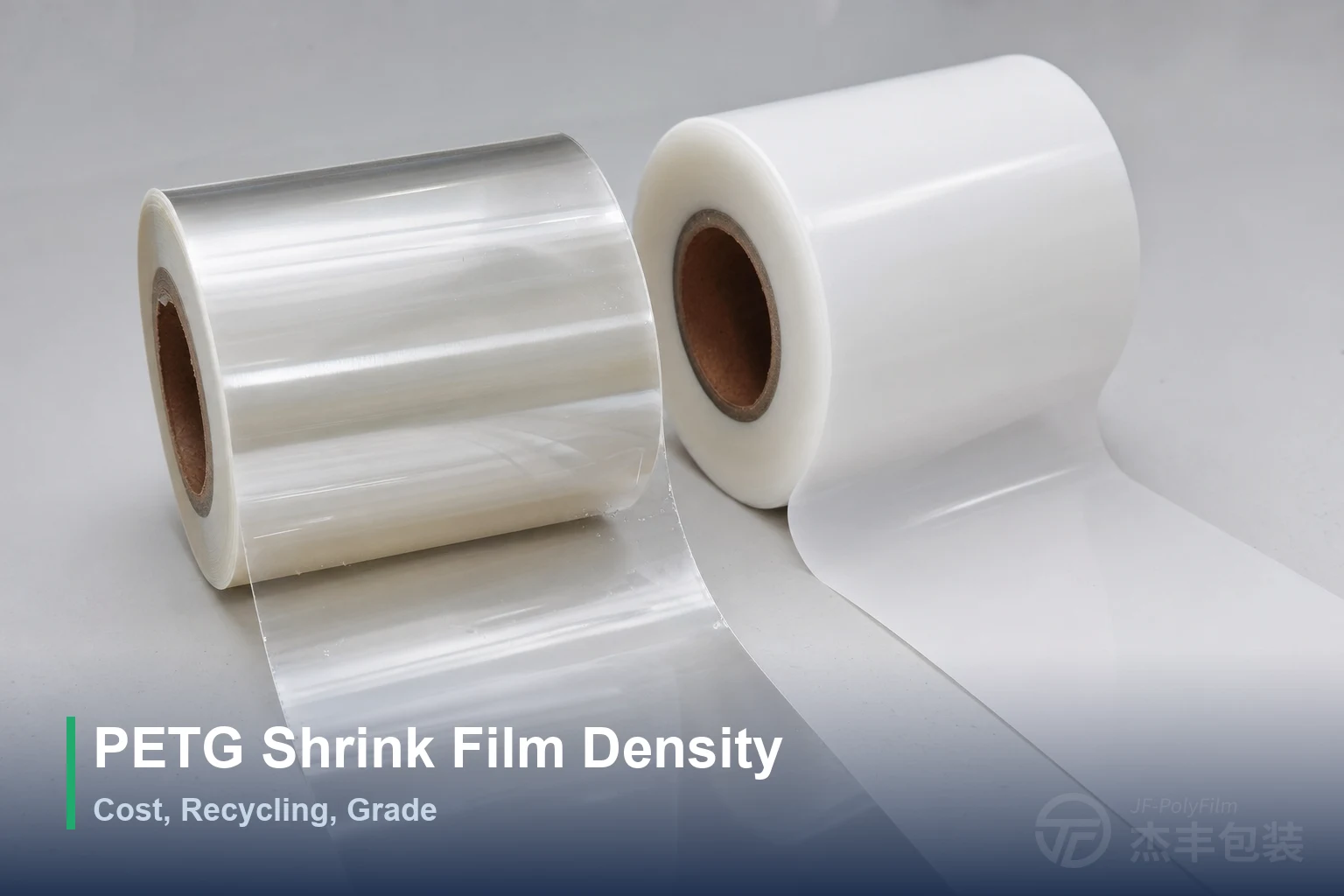
PETG Shrink Film Density: Cost, Recycling, Grade
Density drives three things a buyer feels: how much film a kilogram yields, whether a sleeve floats or sinks in recycling, and how clear and white grades split.
Need Expert Advice on Shrink Film?
Our technical team can help you choose the right film for your application.
Contact Us