
How to Choose PETG Shrink Rate: 65%, 75% or 80%
Size a PETG shrink sleeve by bottle shape: measure the curve, calculate the shrink you need, and route it to the 65%, 75%, or 80% tier without over-buying.
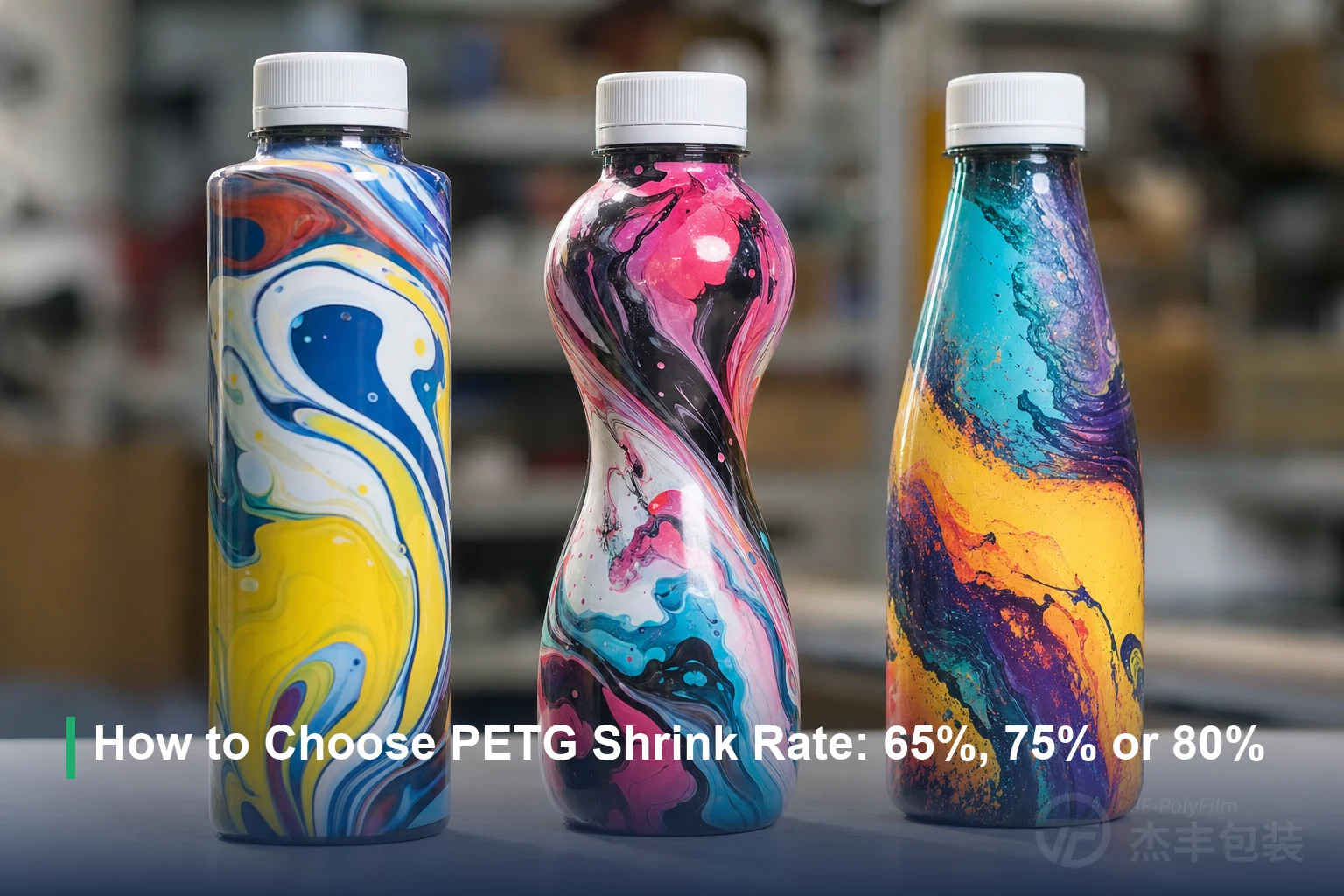
PETG shrink rate is the maximum percentage a printed sleeve can contract sideways in the heat tunnel, and the right figure — 65%, 75%, or 80% — is set by how deeply the bottle curves, not by which number reads strongest on a datasheet.
Key takeaways
- The shrink a job needs comes from the bottle, not the datasheet: required transverse shrink ≈ (1 − narrowest diameter ÷ widest diameter) × 100, measured at the bottle’s tightest local point rather than its average, plus a 1–2% layflat margin.
- The 65/75/80 figures are transverse-direction ceilings — the most the film can draw — so match the tier to the deepest contour, not to the biggest number on offer.
- 65% suits near-straight cups and cylinders, 75% covers most standard bottles, and 80% is reserved for deep-curved, waisted, or high-taper containers — the decision-routing table below maps each shape to its tier and grade.
- Above roughly 75% transverse shrink, PETG is effectively the only base film; PVC tops out near 40–60%, oriented polystyrene around 60–70%, and general-purpose films around 55%.
- JFPolyFilm’s clear and white PETG run transverse shrink of 75% or above with machine direction held to 3.0% or below, verified by five-meter batch sampling and a Certificate of Analysis on every shipment.
What the shrink rate actually measures: TD, not MD
Every 65/75/80 figure refers to one axis alone — the transverse direction (TD), the sideways draw that pulls a sleeve in around the container — never the vertical machine direction. Shrinkage is directional, and the two axes do opposite jobs, so reading the wrong one leads straight to the wrong grade.
The transverse direction is the working axis. As a shrink sleeve passes through the tunnel, TD is what tightens the printed film against the bottle wall, drawing it down onto shoulders, waists, and tapers. A film’s headline shrink rate is its maximum TD contraction, so a grade rated at 75% can pull its circumference in by roughly three-quarters where a contour demands it.
The machine direction (MD) runs vertically, and here the goal is the reverse — as little movement as possible. If a sleeve shortens top to bottom, it lifts off the base and drags the artwork out of registration, so MD is deliberately held low. JFPolyFilm’s clear and white PETG grades keep MD to 3.0% or below while delivering TD of 75% or above; the CPET grade runs MD to 5.0%. Because only the TD figure governs whether a film can follow a curve, the tier is chosen on that one number, with MD treated as a control limit rather than a selection input.
How to calculate the shrink rate a bottle needs
The shrink a container needs is a measurement, not a guess: the required TD comes from two diameters — the narrowest the sleeve must hug and the widest it slips over — as (1 − narrow ÷ wide) × 100. Round-bodied bottles can use diameters directly; irregular or oval cross-sections use circumference at each point instead. Adding a 1–2% layflat margin, and specifying a film rated a little above the result, leaves headroom for line variation.
Two worked examples show how far apart real containers land.
- Near-straight water bottle. The sleeve rests over a 66 mm shoulder and must draw down to a 60 mm label base: (1 − 60 ÷ 66) × 100 ≈ 9%. Even after the clearance needed to slip over the shoulder, the deepest local draw stays modest: a 9% requirement sits far below the 65% ceiling — the lowest tier offered — and because that ceiling is a maximum the film can reach rather than a target it must hit, the sleeve fits with room to spare. A still-water bottle is the archetype here.
- Deep-waisted contour bottle. The sleeve clears a 76 mm shoulder and must tighten into a 34 mm waist: (1 − 34 ÷ 76) × 100 ≈ 55%. Adding the clearance to pass the shoulder and the layflat margin, the film at the waist works near the top of its range, which pushes the choice to a 75% or 80% grade.
The reason the two numbers diverge so sharply is that a sleeve does not shrink evenly. It contracts most where the container is narrowest — necks, shoulders, and waists — and least across the widest belly. The calculation therefore fixes on the single tightest point the film must reach, because that local draw, not the average, decides whether the sleeve lies flat or puckers.
Two factors argue for a film rated slightly above the calculated figure rather than exactly on it. Heavy ink coverage slightly suppresses shrink, since a dense printed area resists contraction more than bare film, so a graphics-rich sleeve reaches a little less than its rated draw at a given temperature. Line variation adds the second reason: tunnel temperature, dwell time, and bottle-to-bottle geometry all drift within tolerance, and a small ceiling margin absorbs that drift instead of leaving marginal fits to chance. Together these push the required draw up to the next tier when the calculated figure lands close to a boundary.
Matching the required draw to a tier: 65%, 75%, or 80%
Once the required draw is calculated, it routes to a tier by a simple rule: pick the lowest ceiling that comfortably clears the deepest local contour. The three PETG tiers span a clear division of container shapes, and each pairs with the grade a real bottle would ship on.
| Tier (max TD) | Local draw it clears | Typical container shape | Example application | Grade fit |
|---|---|---|---|---|
| 65% | Up to ~55% (single to low double digits typical) | Near-straight cups, cylinders, straight-wall bottles | Wide-mouth cups, still water, straight jars | Clear or white PETG at the lower band |
| 75% | ~55–65% — standard bottle contours | Most beverage and household bottles, gentle tapers | Standard PET bottles, gentle-shouldered containers | Clear/white PETG (TD ≥75%), CPET (74±2%) |
| 80% | ~65% and above — deep curves, waists, sharp tapers | Deep-waisted, contoured, or complex asymmetric bottles | Craft-beer contours, hourglass or gripped bottles, ornate cosmetics | Highest-band PETG grades |
A wide-mouth cup or a straight jar — the shape behind a dairy or yogurt cup — asks little of the film and sits comfortably in the 65% tier. Most everyday bottles with moderate shoulders fall into the 75% band, the reason it covers the broadest slice of applications. Only genuinely deep contours — the waisted and gripped shapes common to craft beer and ornate cosmetic bottles — call for the 80% ceiling. Reading the tier from the shape routes each container to the lowest ceiling that still clears its deepest point.
Why a higher shrink rate is not always better
Reaching for the highest tier by default is the most common mistake, because past the point where the sleeve meets the surface, extra shrink capacity has nowhere useful to go. On a near-straight bottle, an 80% film keeps contracting after the sleeve has already closed onto the wall, and the surplus gathers into puckers and wrinkles instead of a smooth wrap.
That over-shrink also distorts the print. Because contraction concentrates at the narrowest points, graphics in high-draw zones compress hardest, and a film pulling further than the contour needs exaggerates the effect — text tightens, logos skew, and a straight rule bows. Artwork is pre-distorted in prepress to compensate for expected shrink, so a film that draws well past the contour throws off that compensation; the interaction between shrink and printed image is covered in PET shrink sleeve printing methods. When over-shrink shows up as flowering, curl, or registration drift on the line, the fix belongs to process tuning rather than the spec, walked through in solving PETG shrink film problems. A higher tier is also a more demanding specification, so an 80% film on a near-straight bottle pays for contraction capacity the shape can never use. Choosing a tier no higher than the contour needs is the cleaner route on both counts: it holds the graphic and keeps the spec matched to what the container actually demands.
Why too low a shrink rate leaves the sleeve loose
Choosing a tier below the container’s deepest local draw fails in the mirror image of over-shrinking: the film reaches its ceiling before the narrowest point is fully covered, so the sleeve stays loose at the waist or shoulder, its edges lift, and the label never seats flat against the wall. Under-specifying is the quieter failure, because a film that looks close enough on the datasheet can still fall short on the bottle.
Two things push a film short of the draw a contour needs. The first is too little headroom: a 65% film asked to cover a local draw in the low 60s has nothing left once heavy ink coverage and normal line variation shave a few points off its rated ceiling. As a working rule, the rated ceiling should sit several points — roughly five to ten — above the calculated local draw, so the layflat margin, ink suppression, and line drift all have room before the film runs out of contraction. The second is temperature. A shrink curve plots how far a film has contracted at each tunnel temperature, and a heat-sensitive fill that caps how hot the tunnel can run can stop a film before it reaches full draw. PETG begins to shrink at a lower temperature than crystalline PET — which barely moves below about 60°C — and climbs a comparatively gentle curve, so it conforms to a deep contour progressively rather than snapping tight at one temperature. JFPolyFilm’s PETG grades reach full draw within a tunnel window that runs best between 95 and 100°C, whether a boiling-water bath, a hot-air tunnel, or a steam tunnel.
A film whose curve needs more heat than the fill tolerates never seats, which is why the curve matters as much as the ceiling. Reading both — how far a film draws and the temperature at which it gets there — keeps a tier matched to the bottle and to what it holds.
Where 65/75/80 sit across shrink films
Before a tier is chosen, the target shrink also narrows the material itself, because the 65/75/80 band belongs almost entirely to PET-family films. Ranked by achievable TD, PETG and PET sit at the top, oriented polystyrene in the middle, PVC across a broad mid-band, and polyolefin films far below — so the required percentage often settles the base material before any grade comparison begins.
| Material | Typical max TD shrink | Where it fits |
|---|---|---|
| PETG / PET | ~75–80% | High-shrink sleeves for deep and complex contours |
| OPS (oriented polystyrene) | ~60–70% | Moderate-contour sleeves |
| PVC | ~40–60% | Simple to moderate bottle shapes |
| General-purpose baseline | ~55% | Standard, low-contour containers |
| OPP (oriented polypropylene) | under 20% | Light tamper bands, low-shrink wraps |
The practical consequence is that anything needing more than about 75% TD is effectively a PETG job — no lower-shrink material reaches the 80% tier at all. That is why the deepest-contour containers concentrate on PETG, while the choice between PETG and a lower-shrink film for simpler shapes is a separate material-layer question, weighed in PETG vs PVC shrink film. One route sits outside this ranking: a bidirectional PETG film (TD ≥70%, MD 35±5%) shrinks on both axes so a printed label peels off cleanly in a bottle wash, a different end-of-life design detailed on the biaxial shrink film product page rather than a fourth shrink tier.
Verifying a supplier’s stated shrink rate
A datasheet number is a ceiling, not a guarantee, so the last step before committing to a tier is confirming the film actually shrinks to spec. Two checks separate a figure that fits on paper from one proven on the line, and each maps to a document or a sample a serious supplier can produce on request.
The first is the test standard and a batch Certificate of Analysis. Stated shrink figures come from controlled methods — ASTM D2732 measures free linear shrinkage in a heated oil bath, and GB/T 13519 does the same in the Chinese market, while ISO 14616 covers the related shrinkage-stress side of film behaviour — so asking which standard produced the number, and at what temperature and dwell time, distinguishes a measured value from a marketing round-up. JFPolyFilm samples each production batch at five meters or more, runs the full property set including shrinkage rate, thickness, haze, and tensile strength, and attaches a COA to the shipment, so the tier arrives measured against its spec rather than assumed to meet it.
The second is a draw-down sample on the real container. The only conclusive proof a tier fits is a shrink trial at the target tunnel temperature on the actual bottle, so requesting short rolls or sheets before volume turns the calculated answer into a tested one. A film that seats cleanly on the intended contour, at a tunnel temperature the fill can tolerate, has confirmed both the TD ceiling and the shape of its curve at once — the two variables the tier decision rests on.
From the chosen rate to a quotable specification
With the tier confirmed, the last move is turning it into a specification a supplier can quote — a layflat width set from the container’s widest point and its margin, tied to the grade and film properties the job needs. The result is a spec anchored to the bottle rather than to a datasheet maximum.
A single tier can still ship in more than one grade — clear, white, CPET, or RPET all reach the high-shrink band while differing on optics and recycling path, compared separately by grade. The supply envelope holds across them: 30–60 μm thickness, widths to 2000 mm, a minimum order around one tonne, storage at 10–30°C, a 12-month shelf life in original packaging, and direct printing without corona pre-treatment. Sharing the target container, its measured widest and narrowest diameters, and the intended tunnel type lets JFPolyFilm’s clear PETG be matched to the exact tier a job needs.
Frequently Asked Questions
What shrink rate do I need for my bottle?
Should I just buy the highest shrink rate available?
What is the difference between TD and MD shrinkage?
How much can PETG shrink compared with PVC or OPS?
How can I check that a stated shrink rate is real?
Related Articles
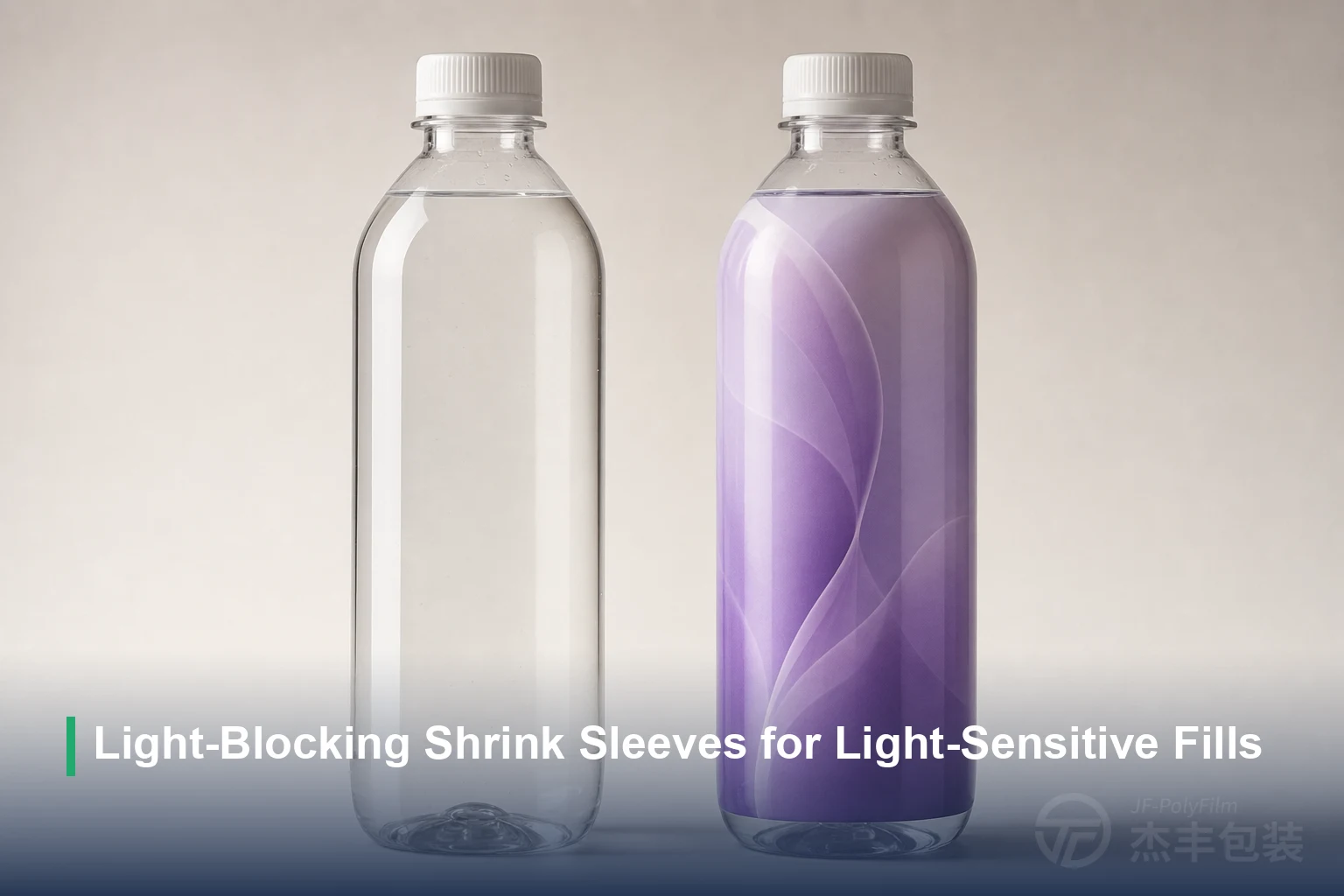
Light-Blocking Shrink Sleeves for Light-Sensitive Fills
Beer, dairy, supplements, and some medicines degrade under light. Which fills need protection, and how a full-body opaque PETG sleeve wraps the whole container to keep light off the contents.
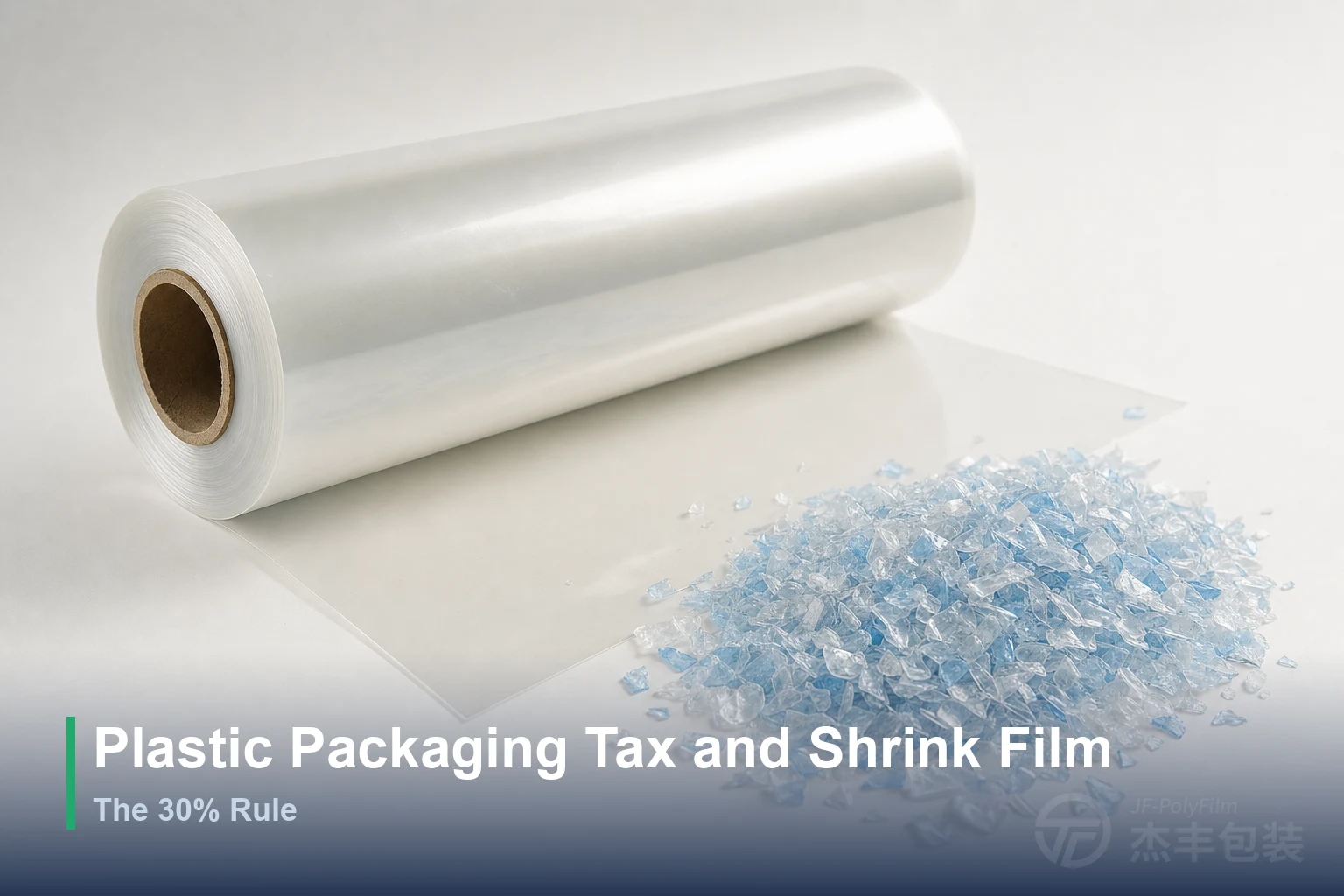
Plastic Packaging Tax and Shrink Film: The 30% Rule
How plastic packaging taxes in the UK, Spain, Italy and the EU treat shrink sleeves, why the 30% recycled-content threshold is the number worth remembering, and how RPET film helps a sleeve cross it.
Need Expert Advice on Shrink Film?
Our technical team can help you choose the right film for your application.
Contact Us