
PET vs PETG Shrink Film: Bottle Resin vs Sleeve Film
Why PET is the benchmark bottle resin but the wrong material for a shrink sleeve — and how PETG's amorphous structure makes it the film that grips the bottle.
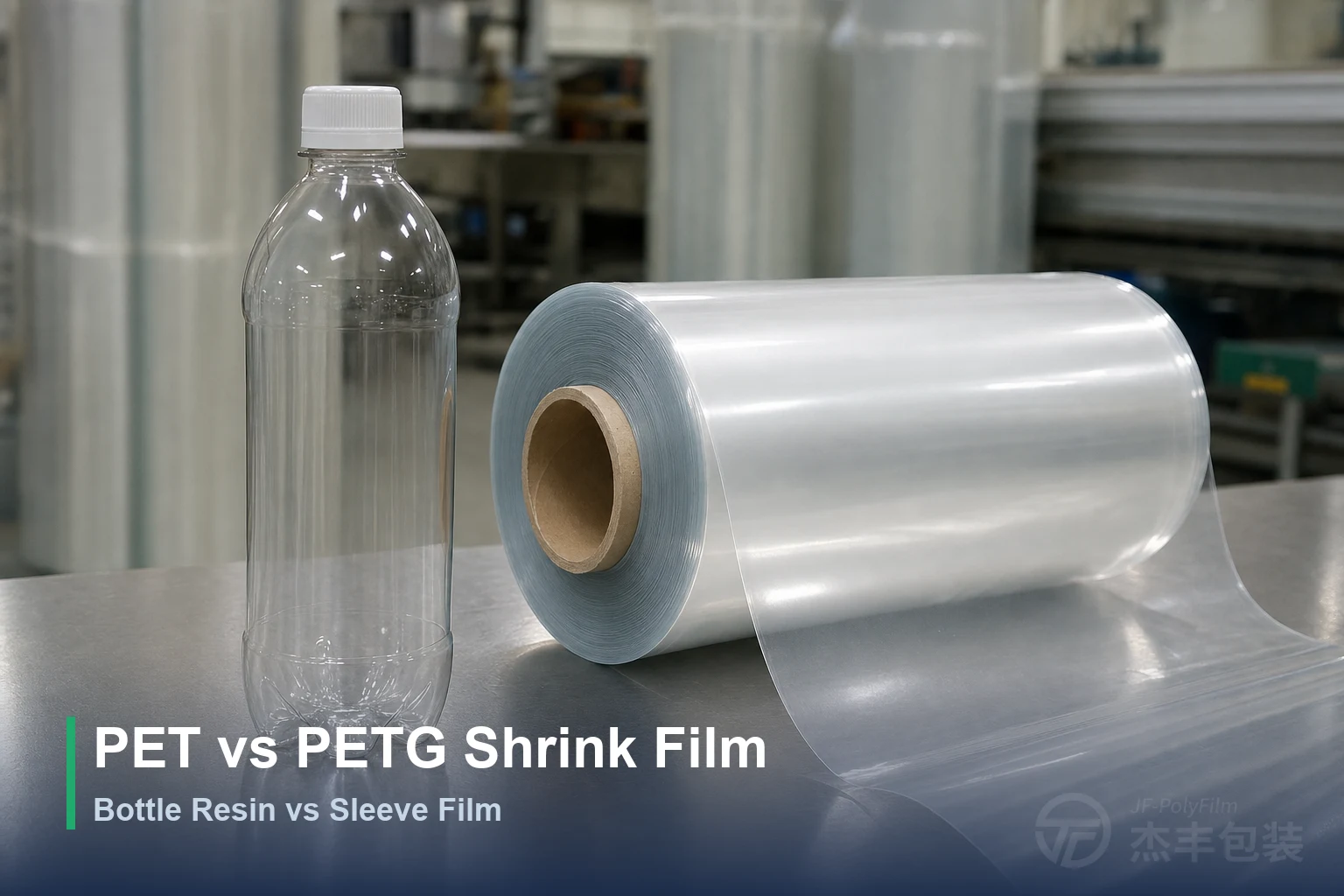
PET and PETG differ by the job each material is built for: PET is the semi-crystalline polyester that bottles are blown from, while PETG is the amorphous copolyester that shrink sleeves are made from. The property that makes PET an excellent bottle — its readiness to crystallize — is the same one that rules it out as a shrink film. They are relatives in the polyester family, but they belong to opposite ends of a package: one is the container, the other is the film that wraps it.
Key takeaways
- PET earns its place as the benchmark bottle resin through semi-crystallinity: stretch blow molding drives strain-induced crystallization that raises strength, rigidity, and gas barrier while keeping the wall clear, with a bottle density near 1.38 g/cm³.
- That same crystallizing tendency is a liability in a shrink film — reheated during orientation and again in the tunnel, homopolymer PET tends to crystallize, embrittle, and haze, and crystallization actually suppresses the transverse shrink a sleeve depends on.
- PETG stays amorphous because CHDM modification breaks up the chain’s regularity, and that is what delivers the high, smooth, controlled transverse shrink of roughly 75-80% and the wide processing window a sleeve needs.
- PETG’s glass transition sits near 80°C and its shrink tunnel runs about 95-100°C, a forgiving window that seats the sleeve on shoulders and compound curves without hazing, splitting, or shrinking unevenly.
- PET and PETG both sit in the PET polyester family and both sink in water (PETG ~1.28-1.33 g/cm³, PET bottle ~1.38), so neither is automatically recyclable — whether a sleeve separates from or travels with the bottle is a design decision.
Why crystallinity makes PET an excellent bottle resin
PET earns its status as the benchmark bottle resin precisely because it is semi-crystalline: its regular molecular chains can pack into ordered crystalline regions, and modern stretch blow molding harnesses that tendency to build strength, rigidity, gas barrier, and dimensional stability into the wall, all while keeping the bottle clear. Crystallinity is not a side effect here; it is the point.
A PET bottle starts as an amorphous injection-molded preform and is then stretched and blown into shape. That biaxial draw pulls the molecular chains into alignment and triggers strain-induced crystallization — the chains order themselves into crystallites so small that they reinforce the wall without scattering light. The result is a container that is strong, stiff, and dimensionally stable yet still highly transparent and glossy, so transparency and mechanical performance are gained together rather than traded against each other. The same ordered structure gives PET a useful barrier to carbon dioxide and oxygen, which is why it holds carbonation and extends shelf life for soft drinks and water. PET also carries Resin Identification Code 1 and sits at the center of the most established plastic recycling stream, with a bottle density near 1.38 g/cm³ that sends the flake to the bottom of a wash tank. Every one of those virtues traces back to the same root: a chain regular enough to crystallize on command.
Why the same PET is the wrong material for a shrink film
The very tendency that serves a bottle — PET’s readiness to crystallize — turns into a liability the moment the same resin is asked to shrink. An oriented homopolymer PET film reheated in a shrink tunnel tends to crystallize as it contracts, and crystallization leaves it brittle, hazy, and uneven instead of tight and clear. The same molecular behavior earns opposite verdicts depending on the job: an advantage in a blown bottle, a defect in a shrink sleeve.
The damage runs deeper than appearance, and it lands squarely on the one property a sleeve is bought for. When a semi-crystalline PET film is stretched to program shrink and then reheated, its aligned chains order into crystallites rather than recoiling freely, and those crystalline regions pin the structure in place — so the same crystallization that reinforces a bottle wall now cancels the contraction a sleeve is supposed to deliver. The more heavily such a film is oriented in an attempt to store more shrink, the more it crystallizes on the way, so the effort defeats itself: a homopolymer PET film oriented near its glass transition can be driven right up to tunnel temperature and still barely draw in. A film that should clamp hard around the girth instead reaches only a low, poorly controlled contraction, well short of what a waisted or shouldered container needs, and what little it gives arrives unevenly. The same limit explains why recovered PET bottle flake cannot simply be blown back into shrink film: that flake is already crystalline, and the more crystalline the feedstock, the less contraction is left in it to release.
Crystallization also narrows and steepens the processing window. Because ordered regions form quickly once the film is hot enough, the material wants to release over a tight temperature band rather than draw down gradually, and a steep, all-at-once curve leaves no margin for a sleeve to seat in sequence around a compound shape. The film gathers, wrinkles, or throws white stress lines where one zone contracts before its neighbor has settled, and any drift in tunnel heat or line speed tips it from under-shrunk to distorted. A material that excels at holding a single rigid shape is, for exactly that reason, poorly suited to changing shape cleanly on demand — the crystallinity that is an asset in the container is a defect in the wrap.
That verdict applies to bottle-grade PET taken as it comes, not to the whole family. PET chemistry can still be engineered into a shrink film — but only by controlling that crystallization rather than letting it run: PETG does it by preventing crystallization outright, while a crystallizable CPET does it by deferring crystallization until the heat of the recycling line. A shrink film, in other words, has to be engineered out of the family rather than simply cut from bottle resin.
Why PETG is engineered to shrink
PETG is engineered to do the one thing PET cannot: stay amorphous. It is a copolyester in which cyclohexanedimethanol (CHDM) replaces part of the glycol, disrupting the regularity of the chain so the material cannot pack into crystals — and that permanent amorphous structure is precisely what a shrink film needs. Where PET’s crystallinity fights the shrink, PETG’s lack of crystallinity enables it.
Every requirement a sleeve places on a film maps onto that single structural fact. Because the chains never crystallize, PETG contracts smoothly and clearly instead of embrittling and hazing, and it reaches the high, controlled transverse shrink a sleeve demands — roughly 75-80% at the top of its range, enough to seat cleanly into necks, shoulders, and waists whose diameters are smaller than the body. The stored orientation is free to relax fully on reheat, so the contraction that a crystallizing film loses is exactly the contraction an amorphous one keeps. The amorphous structure also opens a wide, forgiving window: with a glass transition near 80°C and a tunnel running about 95-100°C, the film draws down progressively as it heats rather than collapsing at a single point, which is what lets it follow a compound curve in sequence — tightening on the shoulder, then the waist, then the base — and absorb the normal drift in tunnel temperature and line speed instead of failing at the edges of a narrow band. It stays tough rather than brittle through that draw, so it resists cracking and splitting where a crystalline film would fracture, and it prints and finishes with high clarity and gloss. On our own production lines, JFPolyFilm’s clear and white PETG grades run transverse shrink of 75% or higher with machine-direction shrink held at or below 3.0%, so the sleeve grips the girth without riding up or dragging the print out of register.
Those properties earn their keep before the shrink step as much as during it, because a sleeve passes through several converting operations on the way to the bottle. It is printed, then seamed along one edge into a continuous tube and slit into individual sleeves, all long before any heat is applied — and each of those steps leans on the same amorphous structure. The toughness that resists cracking in the tunnel also keeps the film from splitting or chipping at the edges as it is folded, seamed, and cut; the clarity that survives the shrink keeps printed graphics sharp and saturated rather than veiled behind haze; and a PETG film with high enough surface energy — ours among them — accepts ink directly, without the corona pre-treatment a less receptive surface would demand. From printing and tube-making through to the final draw-down, the material has to carry the whole converting line, not only its last few seconds.
How that stored shrink memory is written into the film during orientation and released in the tunnel is a mechanism in its own right, worked through in how PETG shrink film works.
PET vs PETG: the material split at a glance
Read side by side, the contrast is not that one material is better than the other but that each is optimized for an opposite demand — PET to hold a rigid shape, PETG to change shape on cue. The table below lines up the properties that decide where each belongs.
| Property | PET (bottle resin) | PETG (shrink film) |
|---|---|---|
| Molecular structure | Semi-crystalline; regular chains that crystallize | Amorphous; CHDM disrupts regularity, no crystallization |
| Typical role | Bottles and rigid containers | Full-body and neck shrink sleeves |
| Shrink behavior | Low and poorly controlled; crystallizes on reheat | High and smooth, transverse shrink ~75-80% |
| Processing window | Narrow and steep | Wide and forgiving (Tg ~80°C, tunnel ~95-100°C) |
| Clarity after forming | High (fine strain-induced crystallites) | High; stays clear because it does not crystallize |
| Toughness when worked | Stiffer, more prone to embrittlement as film | Tough, resists cracking through the shrink |
| Density | ~1.38 g/cm³ (bottle) | ~1.28-1.33 g/cm³, typically ~1.32 |
| Recycling family | RIC 1, most established stream | PET polyester family; recyclability set by sleeve design |
What the family tie means when the bottle is recycled
PET and PETG are relatives — both sit in the PET polyester family and both sink in water, with a PETG sleeve near 1.28-1.33 g/cm³ and a PET bottle near 1.38 — so neither is automatically recyclable, and whether a sleeve helps or hinders bottle recovery comes down to how it is designed to behave. Because the sleeve does not separate from the bottle on density alone, a mismatched full-body label can ride into the recovered resin as a contaminant rather than parting from it cleanly.
That is a design problem with known answers rather than a dead end, and it is treated on its own terms elsewhere. How a sleeve actually moves through a recycling line — and the three design routes that keep a label out of the contamination pile — is worked through in are PET shrink sleeves recyclable. A sleeve built from crystallizable PET shares the bottle’s own chemistry and can be recovered in the same RIC 1 stream, the same-stream route covered in CPET and the RIC 1 recycling stream. And the regulatory side — how design-for-recycling rules now decide whether a sleeve is allowed on the market at all — is set out in what PPWR means for shrink sleeves.
The bottom line: PET is the container, PETG is the film
The split holds all the way down: PET is the material of the container itself, and PETG is the material of the film that wraps it, because the crystallinity that makes one a strong, clear bottle is exactly what disqualifies it as a sleeve, while the amorphous structure that makes the other shrink smoothly is what a bottle wall does not want. Choosing between them is really choosing which job you are solving.
For a shrink sleeve, that means the answer is PETG rather than bottle-grade PET — and, where recovery with the bottle is the priority, the same-family options a manufacturer engineers around it: crystallizable CPET for the RIC 1 stream, GRS-certified RPET for recycled content, and bidirectional film for wash-off glass reuse. As the mill that produces these grades on three of its own production lines, JFPolyFilm can match a container’s shape and shrink target to the right film; clear PETG shrink film is the starting grade for high-clarity full-body sleeves.
Frequently Asked Questions
Is PETG the same as PET?
Why isn't PET used to make shrink sleeves?
What are the densities of PET and PETG?
What shrink rate can PETG reach?
Does a PETG sleeve prevent a PET bottle from being recycled?
Related Articles
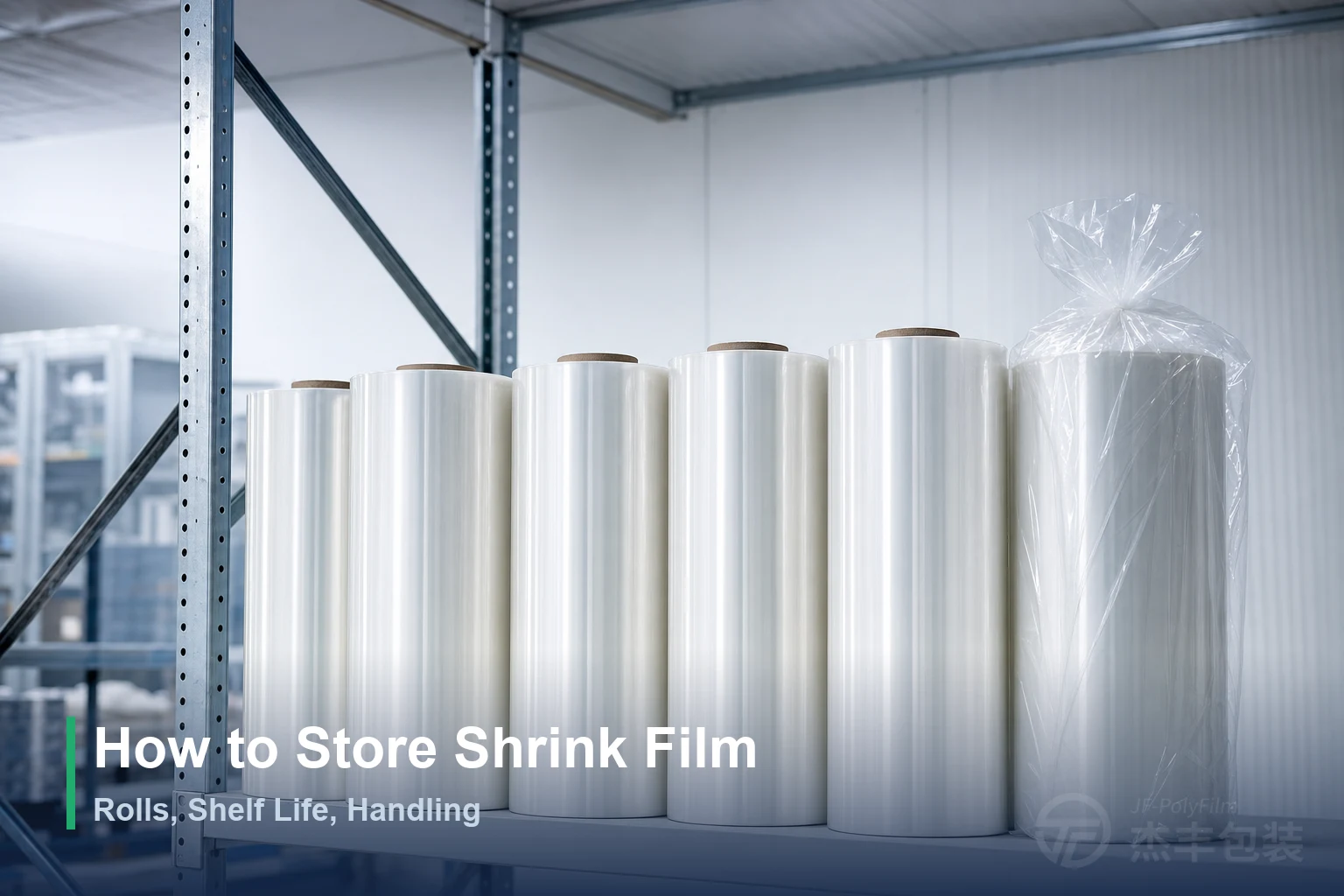
How to Store Shrink Film: Rolls, Shelf Life, Handling
What the 10–30°C, 12-month storage window actually protects, how to stand rolls so they don't flat-spot, and why film has to acclimate before it reaches the line.
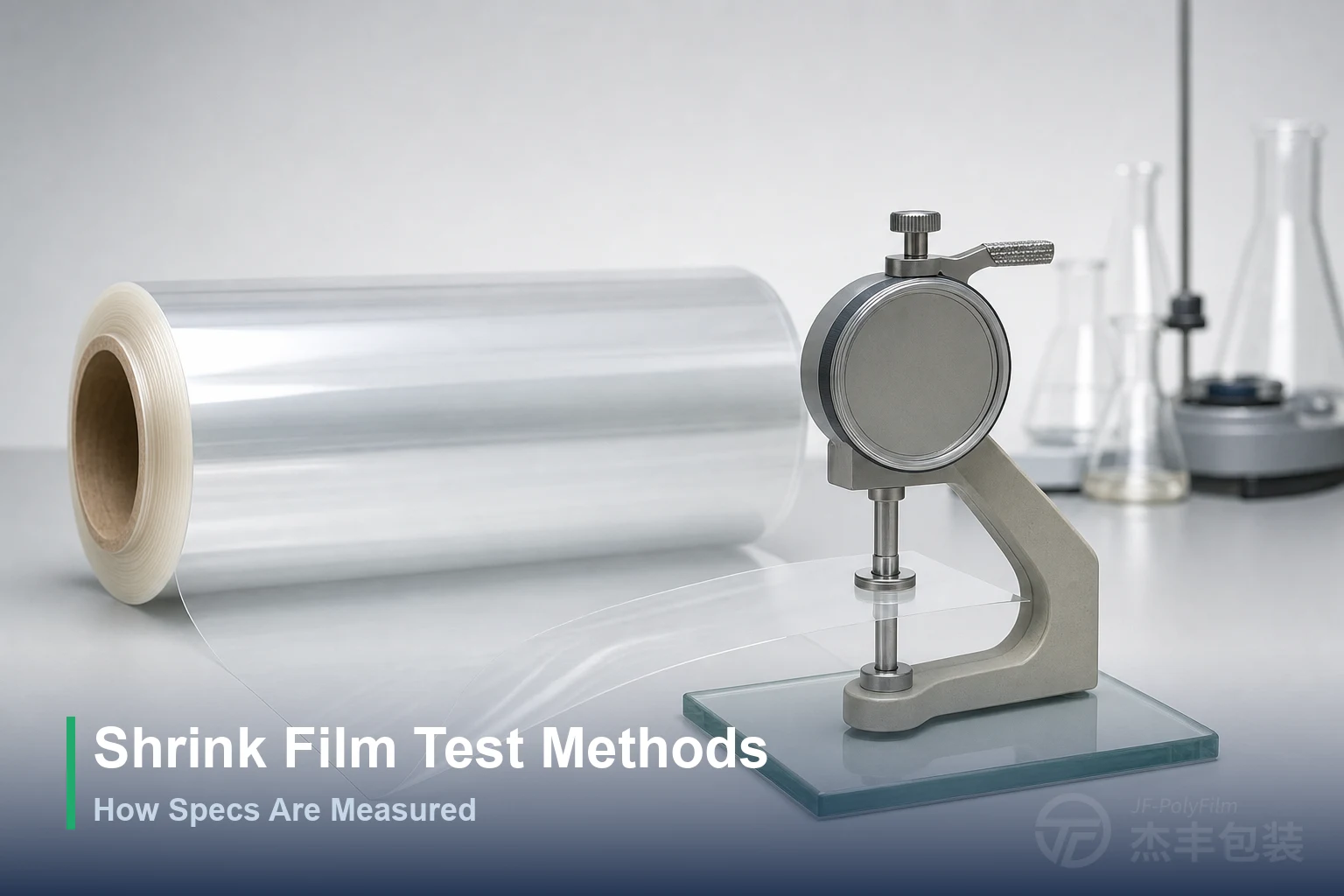
Shrink Film Test Methods: How Specs Are Measured
Every figure on a shrink film datasheet or COA traces back to a standard method. See which ASTM and ISO tests measure shrinkage, tensile, haze, and gauge, and how to read the report.
Need Expert Advice on Shrink Film?
Our technical team can help you choose the right film for your application.
Contact Us