
Shrink Bands vs Shrink Sleeves: Neck Seal or Full Wrap
Choosing between a tamper-only neck band and a full-body shrink sleeve — what each format covers, the film and converting behind them, and when one film does both jobs.
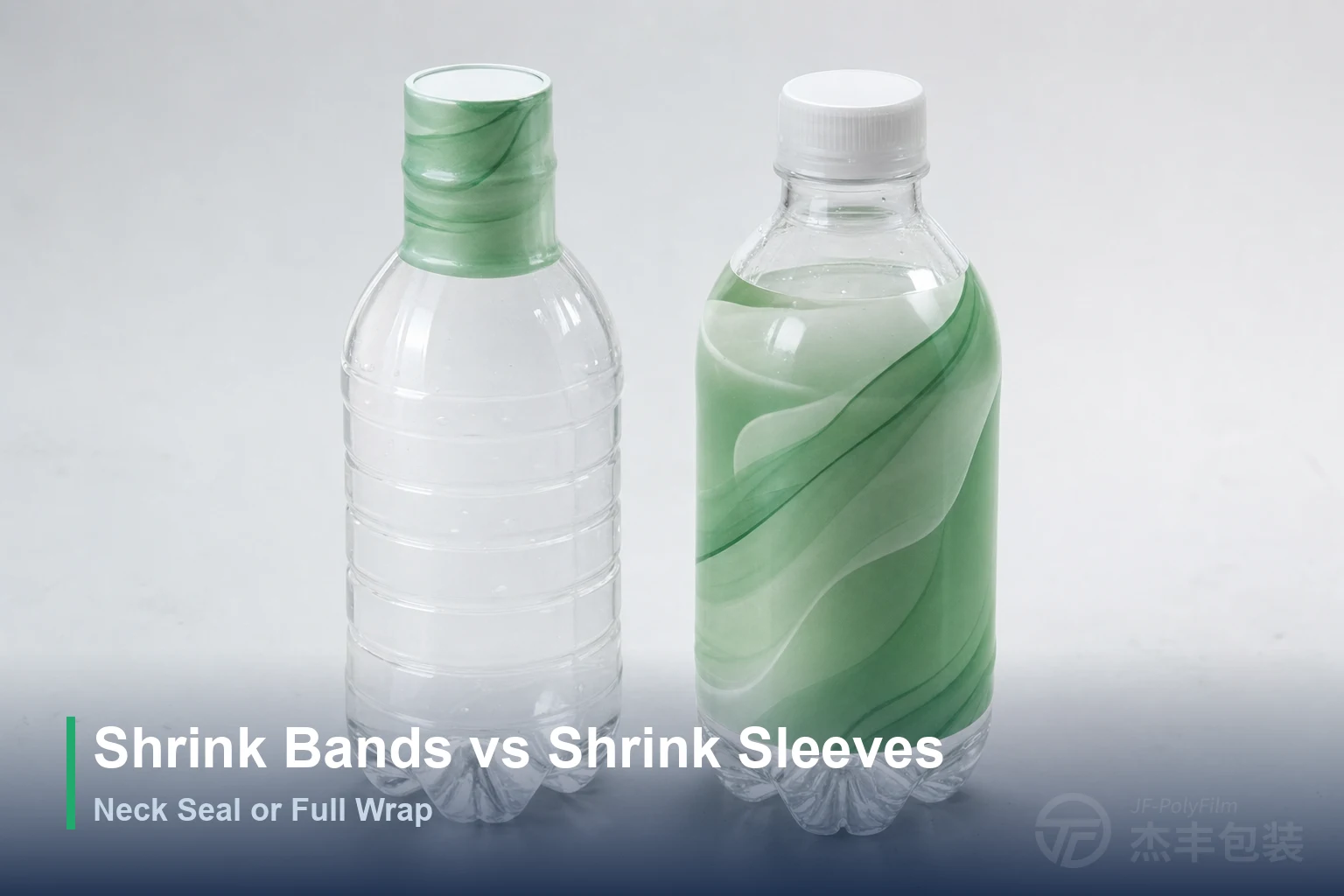
A shrink band and a full-body shrink sleeve are the same heat-shrink film cut to two sizes — a short ring over the cap-and-neck joint that proves tampering, versus a full wrap that carries 360° graphics down the whole container. The choice between them is a packaging decision, not a material one, and it turns on a single question: does the pack need a seal, a brand face, or both.
Key takeaways
- A band’s job is tamper evidence at the closure; a full-body sleeve’s job is 360° branding, and a sleeve can also prove tampering when it is extended up over the cap.
- A band covers only the cap-and-neck junction and leaves the container’s existing label in place; a sleeve replaces the label and carries the entire design.
- Because a band commits a fraction of the film a full sleeve needs, it is the more economical route wherever decoration is already handled somewhere else on the pack.
- Both formats can be cut from the same PETG stock, though neck bands have traditionally been mostly PVC; PETG holds transverse shrink of 75% or more for a tight draw over necks and contours and is a growing share of band volume where recyclability matters.
- The two run on different converting and application setups — a banding line and tunnel for the ring, full-body sleeving with a steam or hot-air tunnel for the wrap.
What each format covers
The split between the two formats is coverage: a band seals a small zone, a sleeve dresses the whole bottle. Everything that follows — cost, print area, the machine that applies it — falls out of that one difference.
A shrink band is a short tube of film that sits over the cap-and-neck junction. Its main task is tamper evidence: once it is heated tight across the closure, opening the pack has to break it, and the broken film is the visible signal that the container was already entered. The mechanics of how a band tears, and how to match one to a specific closure, are their own subject, set out in the tamper-evident shrink bands guide; the point here is scope. A band touches only the top of the pack and deliberately leaves the body’s existing label untouched.
Leaving the label alone is not a limitation of the band; for an established product it is the reason to choose one. A brand with a settled label and a recognised look does not want to redesign and reprint the whole container just to satisfy a tamper requirement, and a band lets it add the seal at the closure while everything below stays exactly as the shelf already knows it.
A full-body shrink sleeve is a full-height tube that runs from the shoulder to the base of the container. Its purpose is decoration — a seamless 360° surface for the design, the colour scheme, and the product and regulatory copy — and it becomes the label rather than adding to one. How a sleeve is formed as a tube and shrunk onto a shape is covered in what a shrink sleeve label is. A sleeve is not automatically tamper-evident, but it can be: extend it up over the cap and add a horizontal tear line, and the same film that carries the brand also seals the closure.
Shrink band vs full-body sleeve: the comparison
Seven dimensions separate the two formats, and coverage drives every one of them. Everything in the table below is about format and coverage — the resin, grade, and gauge behind either cut are decided on their own terms, not from this comparison.
| Dimension | Shrink band | Full-body sleeve |
|---|---|---|
| Coverage | Cap-and-neck junction only | Shoulder to base, full height |
| Primary job | Tamper evidence (can carry a small logo) | 360° brand graphics; can add tamper evidence over the cap |
| Film used | A fraction of the container — leaner | The whole container — more film per unit |
| Existing label | Left in place | Replaced; the sleeve becomes the label |
| Application | Cut to short rings, banded over the cap, shrunk in a tunnel | Formed into full-height tubes, sleeved over the body, shrunk in a steam or hot-air tunnel |
| Print real estate | Narrow strip — logo, symbol, code, safety line | Full face — complex full-colour design plus product and regulatory copy |
| Container fit | Needs a defined neck to grip | Conforms to tapered, waisted, and irregular shapes |
Read down the table and the two formats sort themselves by job rather than compete. A band is the answer when the closure is the only thing that needs new film. A sleeve is the answer when the container itself is the canvas. The middle of the table — how much film each uses and how it is applied — is where the real operating difference sits, so it is worth pulling apart.
Film use and converting: where the difference sits
A band is the leaner format because it commits far less film and usually leaves the rest of the pack alone. That is where its cost advantage comes from: it wraps a small ring at the closure instead of the full body, and a bottle that already carries a decorated label keeps that label, so the band buys tamper evidence without a second print run across the whole container. A full-body sleeve works the other way — it dresses the entire surface, which is more film and a larger printed area, and in exchange it delivers the complete brand face in one piece.
The two are also applied differently downstream. Bands are cut into short tubes and placed over the closure, then drawn tight with heat — a handheld heat gun for prototypes and short runs, a tunnel for volume. Full-body sleeves are formed into full-height tubes, positioned over the container by a sleeving applicator, and shrunk in a steam or hot-air tunnel that has to bring the whole wrap down evenly. The heat task is not the same size: a band collapses a small ring at the neck, while a sleeve has to shrink an even draw across the shoulder, body, and base of the container at once, which is why full-body work leans on steam tunnels for uniform coverage. What the container offers each format differs too — a band has to seat on a defined neck to lock in place, whereas a sleeve follows the whole profile and can hug tapered and waisted shapes a band never touches. Different coverage means a different line rhythm and, often, different equipment on the floor. Both of those steps — the printing and the cutting into bands or sleeves — happen at the converter or filler; the film itself arrives as plain stock and is decorated and cut to format there. Gauge is chosen for the container and the line rather than for the format, and that call is covered separately in how to choose shrink film thickness.
When a band is enough, and when a sleeve is the answer
The decision reduces to what the pack actually needs: a band when the job is tamper evidence, a sleeve when the job is the brand. Two typical cases show how that plays out.
Reach for a shrink band when tamper evidence is the requirement and the body is already decorated. A bottle that carries a pressure-sensitive or wrap label it does not want to give up — a juice, a condiment, a personal-care bottle — only needs a seal at the closure, and a band supplies that with the least film and an optional logo on top. It is the choice whenever the decoration is settled and the missing piece is proof that the pack has not been opened.
In several categories that choice is not fully free. For over-the-counter medicines and many food and supplement packs, tamper evidence is a regulatory expectation rather than a styling option, which is part of why the band became the default seal in those aisles — it satisfies the requirement without disturbing an approved label. The same logic reshapes the sleeve decision there: a brand that does move to a full-body sleeve in a regulated category is usually specifying one that reaches over the cap and carries a tear line, so the format it picks has to answer the tamper requirement as well as the branding one.
Reach for a full-body sleeve when the whole container is the brand statement. A sleeve gives the largest possible print area, a seamless 360° graphic, and a fit that follows tapered, waisted, and irregular shapes a flat label could not sit on — and if it is drawn over the cap, it delivers tamper evidence in the same film. Beverages, supplement bottles, and household spray packs that want full-angle shelf presence sit here. Where opacity, clarity, or a light-blocking white face also enters the decision, the grade choice is set out in clear vs white PETG shrink film.
| The pack needs… | Format that fits |
|---|---|
| Only tamper evidence, existing label stays | Shrink band |
| A light logo or code plus a seal | Printed shrink band |
| Full 360° branding, no tamper requirement | Full-body sleeve |
| Full branding and a tamper seal in one piece | Full-body sleeve extended over the cap |
When the two formats stack
The formats are not mutually exclusive — a full-body sleeve can quietly absorb the band’s whole job. Draw the sleeve up over the closure and add a horizontal perforation, and the wrap that carries the brand also becomes the tamper seal, folding two functions into one film for little extra material. That is why a packer committed to a full-body redesign rarely adds a separate band: the sleeve already covers it.
The reverse pairing does happen, though, when a sleeve is deliberately kept short. A pack that wants its glass or a partial body label to show will run a sleeve only to the shoulder, which leaves the closure without a seal — and there a short tamper band rides above the partial sleeve, each film doing the job the other was cut to leave alone. It is the one case where running both formats on the same bottle earns its keep rather than duplicating work.
The overlap runs the other way too, within limits. A band is not only a clear tamper ring; it can be printed with a logo, a colour, a scannable code, or a safety line, so it does light brand and shelf-identity work alongside its seal — just not the full graphic layout a sleeve holds. The clean way to hold the relationship in mind is that both are the same film family cut to different coverage: the band is a specialist that seals a small zone, the sleeve is a generalist that owns the container and can seal the closure as a bonus. Which one a pack lands on is a scope decision, and the film underneath is the same either way.
The film both formats start from
Choosing the format is the packer’s job; supplying a film that behaves the same whichever way it is cut is the manufacturer’s. A band slit into short rings and a sleeve formed into full-height tubes ask the same thing of the web underneath — that its shrink and its clarity stay on spec from one cut to the next. That consistency is what a clear PETG shrink film is built to hold: a 75%-or-higher transverse draw with machine-direction shrink kept to 3.0% or less, delivered 30 to 60 μm thick and up to 2000 mm wide, printable without corona treatment, and shipped as splice-free rolls with GRS, REACH, and RoHS documentation and a certificate of analysis on each lot. Everything after that — the printing, and the cut into bands or sleeves — happens at the converter or filler rather than on our line. Whichever format a pack lands on, the film feeding it is the part we make, and it arrives ready to become either one.
Frequently Asked Questions
Do you need both a shrink band and a full-body sleeve on one bottle?
Which costs less to run, a neck band or a full-body sleeve?
Does a shrink band replace a bottle's main label?
Can a neck band carry printed branding?
Are shrink bands and shrink sleeves made from different film?
Related Articles
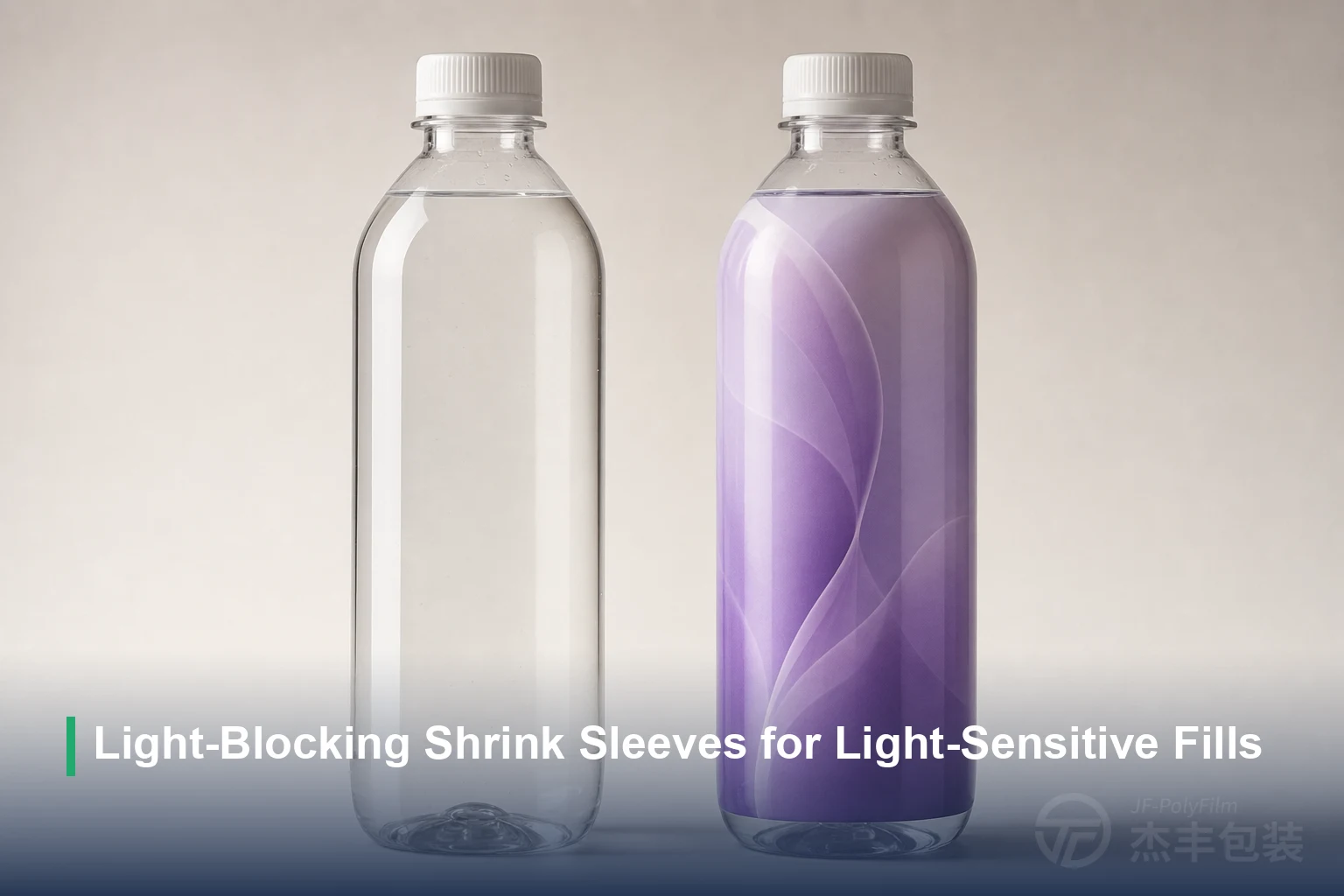
Light-Blocking Shrink Sleeves for Light-Sensitive Fills
Beer, dairy, supplements, and some medicines degrade under light. Which fills need protection, and how a full-body opaque PETG sleeve wraps the whole container to keep light off the contents.
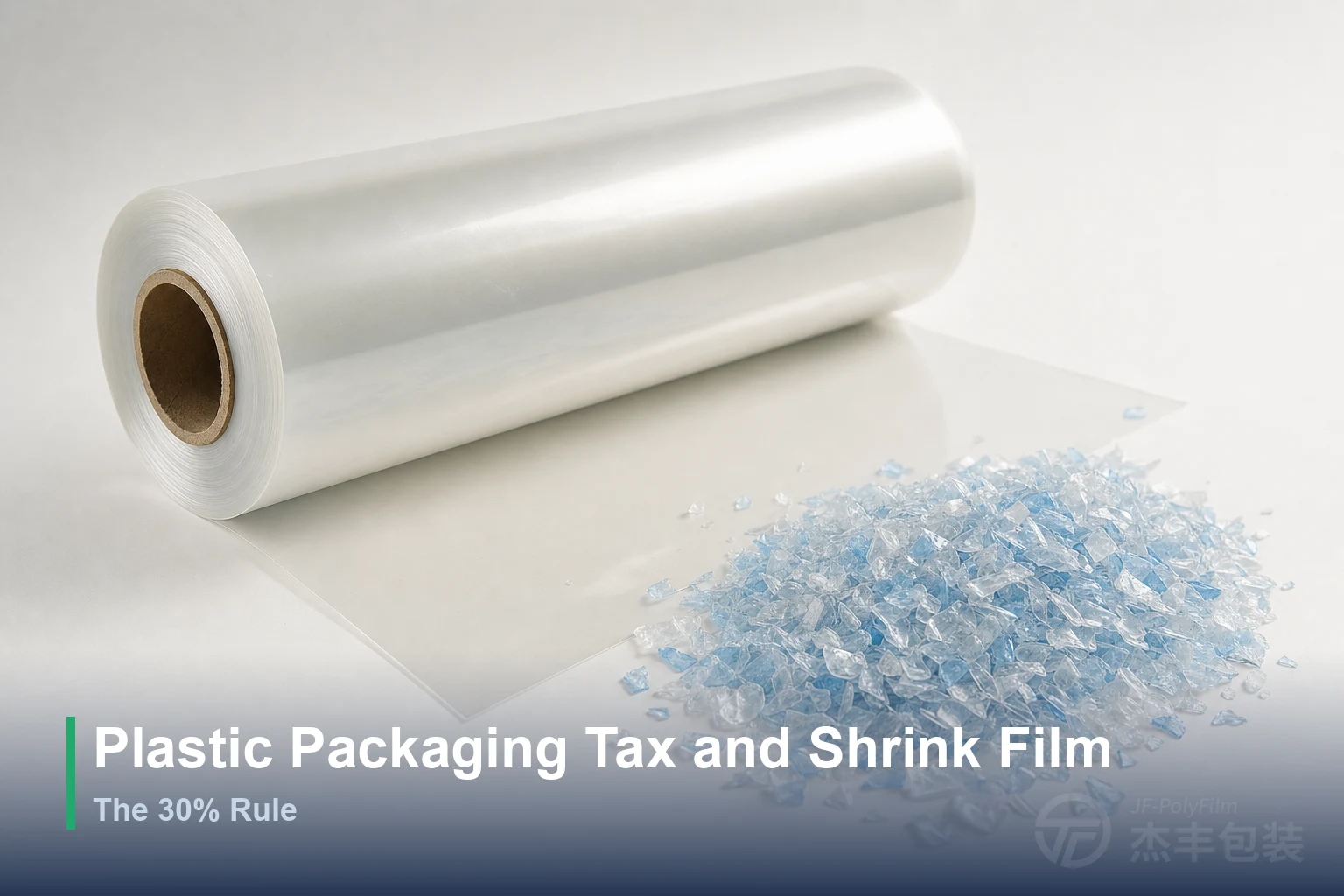
Plastic Packaging Tax and Shrink Film: The 30% Rule
How plastic packaging taxes in the UK, Spain, Italy and the EU treat shrink sleeves, why the 30% recycled-content threshold is the number worth remembering, and how RPET film helps a sleeve cross it.
Need Expert Advice on Shrink Film?
Our technical team can help you choose the right film for your application.
Contact Us