
Shrink Sleeve vs In-Mold Label: Which Fits Your Container
How in-mold labels and shrink sleeves differ on the containers they fit, tooling and volume economics, mono-material recycling, and shelf durability — and which decoration route suits your pack.
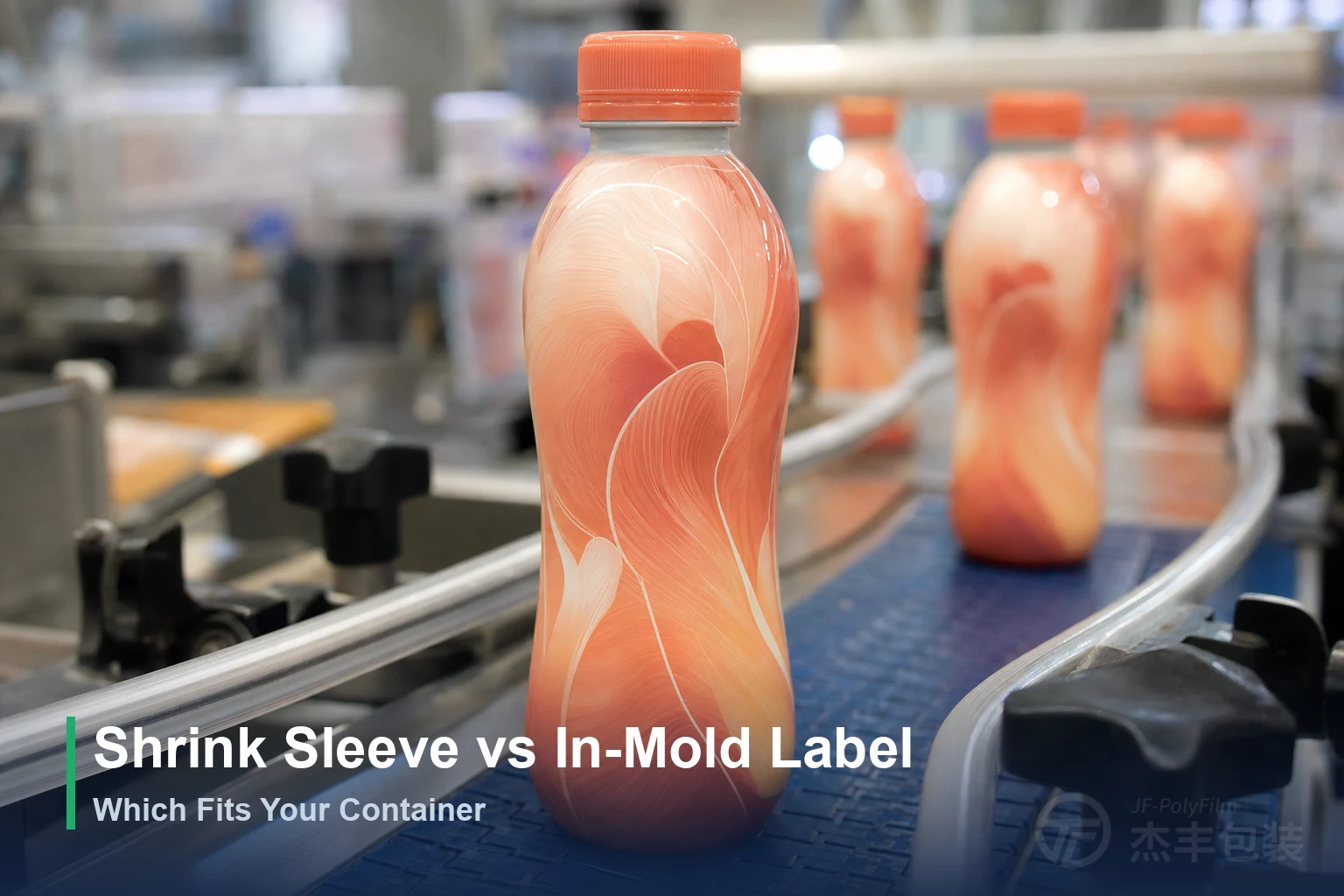
A shrink sleeve is a pre-printed film tube slipped over a finished container and drawn tight to its contour under heat; an in-mold label is a pre-printed film set inside the mold and fused into the container wall as the container itself is formed. The gap between wrapped afterward and formed together drives almost every other difference between them.
Key takeaways
- The dividing line is when and where the graphic meets the container: an in-mold label becomes part of the wall during molding, while a shrink sleeve wraps a container that already exists.
- In-mold labeling only decorates plastic containers molded in-house — glass, metal, and any pre-formed container are out of reach, which is exactly the ground a shrink sleeve owns.
- In-mold labeling front-loads mold and robotics cost and repays it only over one container in large, long-running volumes; a sleeve changes over on a new printed roll, so it stays flexible across short runs and many SKUs.
- Recycling can favor a matched in-mold label: a polypropylene label in a polypropylene container is a single material. A PETG sleeve reads as a different material over a PET bottle unless a crystallizable PET film keeps it in the bottle’s stream.
- A fused in-mold graphic cannot lift or scuff, but its reach is limited to moldable faces; a shrink sleeve covers a full 360 degrees over contours no moldable face could carry.
The two methods at a glance
The two differ on the surfaces they can decorate, where their equipment lives, how their cost behaves with volume, how they recycle, and how they wear — and those axes rarely all point the same way. The table places them side by side before the detail that follows.
| Axis | Full-body shrink sleeve | In-mold label (IML) |
|---|---|---|
| When decoration happens | After the container is formed and filled | During molding, as the container is formed |
| Container types | Any finished container — plastic, glass, metal | Only plastic containers molded in-house |
| Container shape | Tapered, waisted, oval, deeply contoured | Developable, moldable faces; rounded corners |
| Coverage | Full 360 degrees, body and shoulder | Full wrap within mold geometry; complex 360 hard |
| Equipment | Applicator plus heat tunnel on the fill line | Placement robot inside the molding cell |
| Cost profile | Light tooling, flexible on short runs and many SKUs | High mold and robotics outlay; needs long runs |
| Best for volume | Mid-to-small batches, seasonal, multi-SKU | One container in large, stable, recurring volume |
| Recycling | Cross-polymer unless a CPET film matches the bottle | Mono-material when label resin matches container |
| Durability | Film graphic conforms but can scuff | Fused into the wall; will not lift or scuff |
Each row is a decision on its own. The sections below take them in the order they actually resolve a brief, starting with the mechanism that separates the two methods before any surface trade-off matters.
When the graphic meets the container
The decisive difference is timing: an in-mold label becomes part of the container while the container is being made, whereas a shrink sleeve decorates a container that already exists. In injection or blow molding, a robot sets the pre-printed film against the open cavity wall, the mold closes, and the incoming resin bonds to the label as it forms the part — so the container leaves the press already decorated, with no separate labeling stage anywhere downstream. A shrink sleeve reverses that order. The container is molded, filled, and only then does a seamed film tube drop over it and a heat tunnel draw it down to the shape. One method builds the graphic in; the other applies it on. Every difference that follows traces back to this single split.
Which containers each can decorate at all
That timing dictates which containers each method can decorate in the first place. An in-mold label can only go onto a plastic container molded in-house, because the label has to sit inside that mold when the container forms — glass, metal, and any pre-formed container that arrives already made are simply out of reach. A shrink sleeve carries no such precondition. It wraps a finished container of any material — a glass spirits bottle, a metal aerosol can, a blow-molded jug, an oddly shaped tub — because it is applied after forming, by whoever fills the container rather than whoever molds it. For a brand that buys containers ready-made, or fills glass and metal, in-mold labeling is off the table before any other factor is weighed, and the sleeve is the only full-body route left.
Where the equipment lives: molding cell vs filling line
Because the decoration happens at different moments, it also lives on different equipment. An in-mold label is not added to the filling line at all; it folds into the molding cell, where the label-placement robot and its magazine sit alongside the press. Holding the label to the cavity until resin arrives is done by vacuum through the tool or by an electrostatic charge, and electrostatic fixturing is common because it avoids cutting vacuum ports into the mold. A shrink sleeve line runs downstream of forming, in stages: the film is welded into a continuous tube at a single seam, an applicator cuts and drops each sleeve over the container, and a heat tunnel — steam, hot air, or infrared — shrinks it to fit. That sequence asks for floor space and tight synchronization between applicator and tunnel, and films like ours run cleanly across those tunnel types with a forgiving window. The practical read is that in-mold spending sits in the mold, while sleeve spending sits in the applicator and tunnel — two different lines, owned by two different parts of the operation.
Volume, tooling, and where the cost sits
The two also draw their cost from very different places, and this is where volume decides. In-mold labeling front-loads heavy fixed cost: purpose-built molds and the placement robotics are expensive to commission, and the setup is long, so the method only repays when a single container runs in large, stable, recurring volumes over a long program — enough units for the mold and automation cost to disappear into the per-piece figure. A first run, a seasonal variant, or a set of SKUs that changes often leaves that fixed cost stranded. A shrink sleeve inverts the equation. Switching artwork means printing a new roll, not cutting new tooling, so short runs, frequent redesigns, and many-SKU programs change over without a capital event. The deciding number is never the lowest unit price in isolation but the total fixed cost spread across the run length and SKU count actually produced — which is why sleeves suit brands whose graphics or container mix move often, and in-mold labeling suits one high-volume container held steady for years.
Recycling: mono-material label vs matched-polymer sleeve
Recyclability is the one axis where a well-matched in-mold label can be the cleaner option, and it is worth being straight about that. When the label and the container share a single polymer — the common case of a polypropylene label molded into a polypropylene container — the finished pack is mono-material, and recycler associations treat a compatible-polymer in-mold label as a preferred decoration for PP and HDPE precisely because the whole package reduces to one material with nothing to separate. A shrink sleeve is, by default, a cross-polymer case: a PETG sleeve reads as a different material from the PET bottle at the reclaimer, so it has to be sorted out before the bottle is reground — unless the film is chosen to match the bottle’s stream. That match is possible. A crystallizable PET (CPET) sleeve shares the bottle’s chemistry and survives the wash, so label and bottle stay together in the RIC 1 PET stream and are recovered as one. PET sorting leans on density — PET sinks near 1.38 grams per cubic centimeter while polyolefins float — and on near-infrared reading of the polymer, and a CPET sleeve passes both checks with the bottle. So the honest summary is that a matched in-mold label is mono-material by construction, while a sleeve reaches the same single-stream outcome only when its film is engineered for it, the mechanics of which are set out in the CPET same-stream explainer. What a sleeve should not claim is a blanket recycling advantage over a same-polymer in-mold label; on that specific ground, the fused label is cleaner.
Durability and how far decoration can reach
Durability and decoration reach pull in opposite directions between the two. A fused in-mold graphic is about as tough as decoration gets: it is part of the container wall, with nothing standing proud of the surface, so it cannot lift at an edge, peel, or scuff, and it holds through abrasion, moisture, and cold with no separate layer to fail. The trade is reach — a flat label has to lie against the cavity before resin arrives, so it is confined to the moldable, developable faces of the part, and a deeply sculpted body or a graphic that has to run unbroken around the full 360 degrees is hard or impossible to place. A shrink sleeve makes the opposite bargain. It decorates the whole body top to base and over the shoulder, follows tapers, waists, and oval cross-sections that no moldable face could carry, and reads as one continuous graphic broken only by a single vertical seam. Because it is a film applied to the outside, it can be scuffed in handling — though a reverse-printed sleeve carries its ink on the inner face, so abrasion wears the film rather than the graphic. What draws a sleeve onto irregular bottles in the first place is shrink range: our clear PETG is specified with high transverse shrink across grades reaching 80 percent, with machine-direction shrink held at or below 3 percent, which is what lets one film draw down cleanly over a deep curve without flowering. Matching that grade to the container is worked through in the grade selection guide.
Tamper evidence: a sleeve can seal the cap, a molded label cannot
Tamper evidence is one thing a shrink sleeve does that an in-mold label structurally cannot. A full-height sleeve can be run up and over the closure, or a separate neck band applied across the cap-to-shoulder joint, so the first opening tears a perforation and leaves visible proof the pack was breached. An in-mold graphic is fused flat into the wall below the closure, purely decorative, with nothing bridging the cap, so a molded-label pack that needs a breach-evident seal has to add one as a separate component. Where a first-open signal is part of the brief — beverages, pharmaceuticals, nutraceuticals — that requirement usually points to a sleeve or band before the decoration method is even weighed, since it is the closure the seal has to cross, not the body panel the label sits on.
Routing the choice: who forms the container, then type, then volume
The choice resolves in a fixed order, because the first question removes most options before cost or coverage is weighed. Start with who forms the container. A brand that injection- or blow-molds its own plastic containers can consider in-mold labeling; one that buys containers ready-made, or fills glass or metal, cannot, and a shrink sleeve is the full-body route by default. Next weigh volume and SKU mix: one container running in large, stable volume over a long program can absorb in-mold tooling, while short runs, seasonal editions, or a shifting SKU set favor the roll-to-roll flexibility of a sleeve. Then read the recycling target: a goal of a mono-material pack points to a same-polymer in-mold label where the container allows it, or to a crystallizable PET sleeve that recovers with a PET bottle. Finally weigh the decoration itself — a deeply contoured or waisted body, or a full 360-degree wrap over relief, lands on a sleeve, while a flush, unliftable finish on a simpler moldable shape favors the fused label. The film chemistry behind the sleeve side sits in the PETG versus PVC comparison, and what a sleeve is and how it is built is covered in the shrink sleeve primer. Where the routing lands on a sleeve, our clear PETG and CPET grades cover the high-shrink and PET-stream-recyclable films a contoured or mono-material brief calls for in the clear PETG shrink film range.
Frequently Asked Questions
Can in-mold labels be applied to glass or metal containers?
Which is cheaper for a short or first production run — shrink sleeve or in-mold label?
Is an in-mold label more recyclable than a shrink sleeve?
Does an in-mold label give full 360-degree decoration like a shrink sleeve?
Why does an in-mold label resist scuffing better than a shrink sleeve?
Related Articles
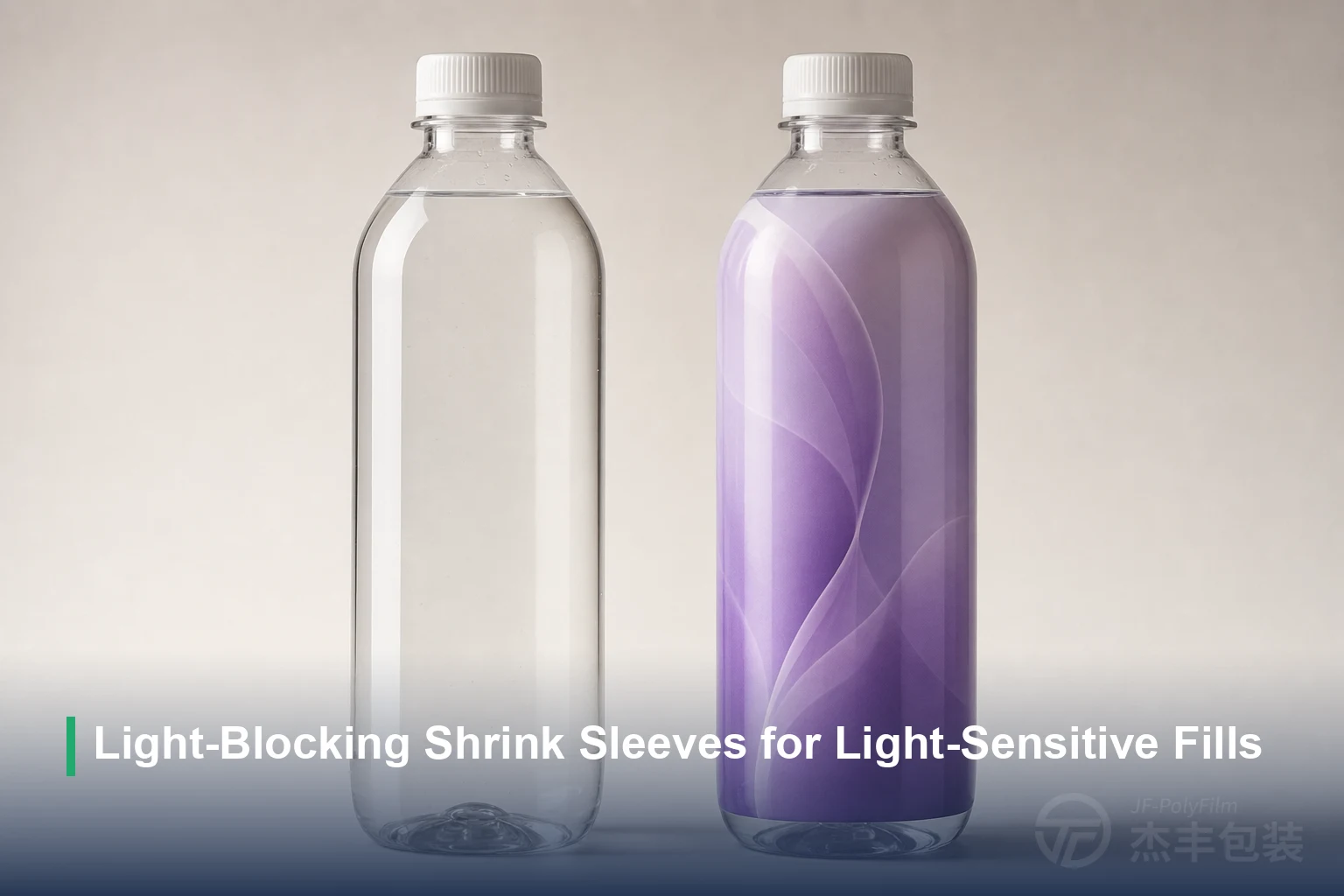
Light-Blocking Shrink Sleeves for Light-Sensitive Fills
Beer, dairy, supplements, and some medicines degrade under light. Which fills need protection, and how a full-body opaque PETG sleeve wraps the whole container to keep light off the contents.
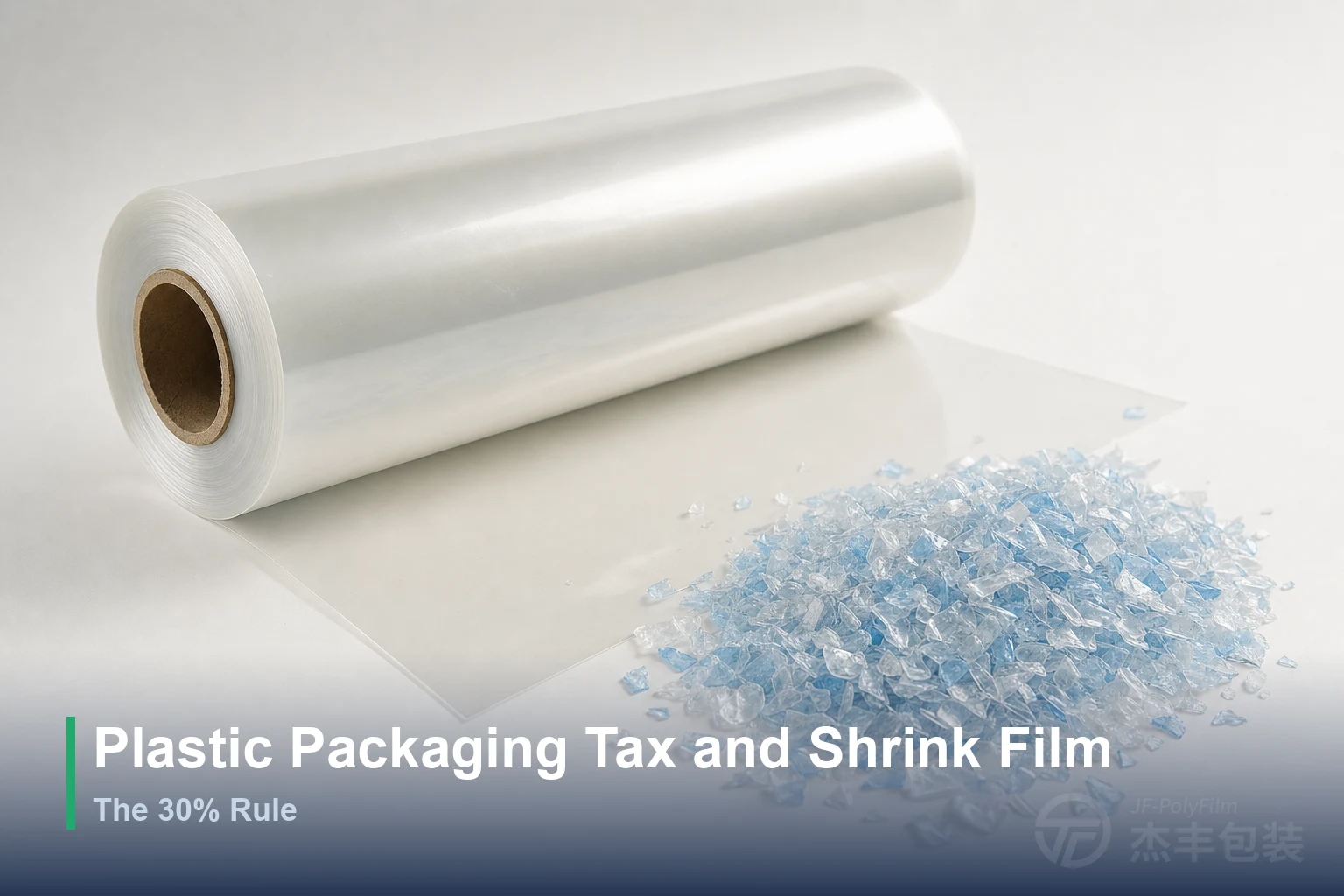
Plastic Packaging Tax and Shrink Film: The 30% Rule
How plastic packaging taxes in the UK, Spain, Italy and the EU treat shrink sleeves, why the 30% recycled-content threshold is the number worth remembering, and how RPET film helps a sleeve cross it.
Need Expert Advice on Shrink Film?
Our technical team can help you choose the right film for your application.
Contact Us