
Importing Shrink Film from China: A Buyer's Guide
Source, sample, spec-lock and clear customs on PETG shrink film from China: Incoterms, payment, export packing, HS 3920.62 and the pitfalls importers miss.
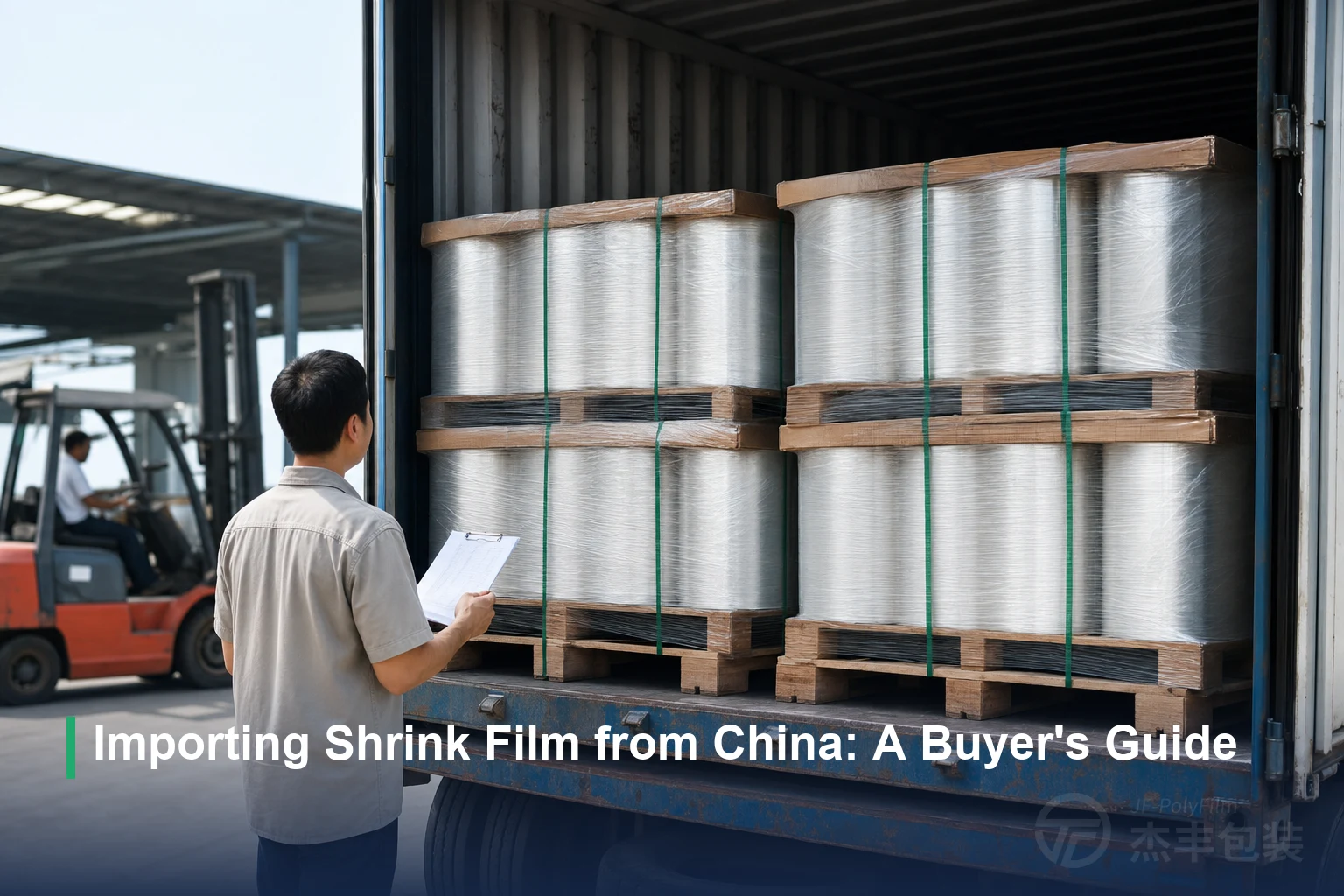
Importing PETG shrink film from China is a documented sequence — sourcing a supplier, sampling, locking specifications, agreeing Incoterms and payment, arranging shipment, and clearing customs — that moves a compliant roll onto a production line at a controlled landed cost.
Key takeaways:
- Under both FOB and CIF, transit risk passes to the buyer the moment the goods are loaded on board at the Chinese port; CIF only adds a seller-bought minimum insurance that excludes theft, water and rough handling.
- Finished PETG shrink film classifies under HS heading 3920.62, “Of poly(ethylene terephthalate)” — confirm the full destination code and duty rate with a licensed customs broker, never a guessed number.
- State TD and MD shrinkage separately in the purchase order, alongside thickness and width tolerances and a per-batch certificate of analysis tied to a lot number, before any balance is paid.
- A hand-picked sample that beats the bulk run is the classic import trap; the shrink trial has to run on the actual container at the buyer’s own tunnel temperature, not a datasheet ideal.
- A single duty figure invented from an online lookup, or a “food-safe” claim on an outer label film, are the two errors most likely to cause a customs hold or a compliance dispute later.
How do you find and first-screen a China shrink film supplier?
The first screen is a short set of verifiable signals, not a long shortlist. Candidates surface through B2B marketplaces, industry directories and trade-fair listings, but the ones worth a sample request are those that answer film-specific questions in numbers and release records before payment: a current business licence and export record, a specification sheet that separates transverse and machine-direction shrinkage, and a stated willingness to send a sample accompanied by a certificate of analysis. A supplier that replies only in adjectives — “high shrinkage,” “top quality,” “fully certified” — has failed the first screen regardless of how polished the storefront looks.
Whether the counterpart runs its own extrusion lines or consolidates several qualified ones matters less at this stage than whether its claims resolve into documents — both a manufacturer and a capable trading company can supply a compliant roll, so the paper decides, not the business model. This article stays at the first-screen level deliberately; the full vetting depth, factory-versus-distributor trade-offs and audit questions live in the companion guide to choosing a PETG shrink film supplier, where a shortlist should be pressure-tested before an order.
What should you sample and pilot before committing to tonnage?
A pre-order pilot on the buyer’s own equipment is the step that prevents the most expensive import mistakes. The sample sequence is the same regardless of which supplier is being evaluated: check clarity and haze against the artwork in hand, run a shrink trial on the actual container at the production line’s real tunnel temperature rather than a datasheet ideal, confirm print and ink adhesion after the film has shrunk, stress the seam or seal under normal handling, and run the film through the actual seamer and applicator at line speed to confirm it feeds, seams and sleeves without curl or misfeed. A film that conforms to a tapered bottle at 90 °C on a supplier’s bench can still wrinkle at a converter’s own setting, which is why the trial belongs on the buyer’s line. The sample that carries any weight is one drawn from a real production run, not a hand-made lab roll, so the request should specify a production-representative sample from the outset. China film mills also quote against a minimum order tied to a production run — often around a tonne, as with JFPolyFilm’s roughly one-tonne minimum — so the tonnage floor is worth confirming before sampling begins.
The recurring pitfall is a sample that does not represent the bulk. A hand-selected roll can outperform the tonnage that follows it, so the approved sample should be recorded as the contractual reference and the production lot required to match it. A first-article check or a pre-shipment inspection against the running order, tied back to that reference, keeps the sample honest once volume is in play.
Which specifications must you lock in the purchase order?
A purchase order becomes enforceable only when every specification is stated against a method and a tolerance rather than a single nominal figure. Shrinkage is reported in two directions for a structural reason: transverse-direction (TD) shrinkage, typically in a 70–80% band for these films, governs how a full-body sleeve hugs a contoured container, while machine-direction (MD) shrinkage is held low so registered artwork does not distort lengthwise. A quote that blends the two into one “shrinkage” number has concealed the half that protects the print. Because finished PETG film runs around 1.27–1.33 g/cm³ (PET nearer 1.38), two offers at the same price per kilogram rarely yield the same number of labels — the figure that compares them is cost per finished sleeve, not per kilogram.
The specification lines worth fixing in writing, each against a stated method:
| Specification | What it governs | How to lock it |
|---|---|---|
| TD shrinkage (~70–80%) | Fit to container geometry | Stated alone, referenced to a shrink method such as ASTM D2732 |
| MD shrinkage | Lengthwise artwork distortion | Reported separately and held low |
| Thickness (~30–60 μm) | Material used and sleeve stiffness | Quoted with a tolerance, not a nominal gauge |
| Width | Fit to the converter’s press and seamer | Given with a tolerance and slit to order |
| Roll / core diameter | Compatibility with the applicator | Fixed to the running equipment |
| Splice policy | Line stoppages on high-speed sleeving | Zero splices specified where lines run fast |
| Certificate of analysis | Proof the lot was measured, not described | One per batch, tied to a lot number |
Grade selection itself sits upstream of this order — whether to specify clear, white, CPET or RPET is worked through in clear vs white PETG, and the material trade-off against PVC in PETG vs PVC shrink film. Here the grade is already chosen and simply named in the specification.
Which certifications should you request — and which claim is a red flag?
Certification is verified at the material level, and the request depends on the destination market. Recycled-content claims are substantiated with GRS or RCS documentation; restricted-substance limits, particularly on sleeves sold into the European market, are covered by REACH and RoHS; a quality-management system is evidenced by ISO 9001. Separate from these market certificates, a credible per-batch certificate of analysis carries the measured TD and MD shrinkage, thickness, density, the test methods used, and a lot number that ties the figures back to the shipped roll — that is what “good” looks like on the document. Background on recycled grades is covered in RPET packaging explained and PET shrink sleeve recyclability.
The claim to treat as a red flag is any “food-safe” framing, or any assertion that the film is cleared for direct contact with the packaged product, applied to shrink film. A shrink sleeve wraps the outside of a container and never touches what is inside, so an end-use food-safety claim is out of scope. EU 10/2011 is legitimately cited only as a plastics material standard that a resin can comply with, never as a direct-contact safety clearance for the finished label. Requesting the right certificate is one step; confirming it is genuine rather than borrowed or expired is another, and the authentication mechanics — registry lookups, scope checks and the common forgery signals — are handled in how to verify shrink film certifications.
FOB, CIF or DDP — which Incoterm should a shrink film importer choose?
FOB is the practical default for a first China import, because it splits the transaction where each party operates best: the Chinese seller handles inland haulage and export clearance, and the buyer controls the ocean freight and import side through a chosen forwarder. The critical and widely misread point is that under both FOB and CIF, risk passes to the buyer once the goods are on board the vessel — CIF differs only in that the seller pays the main freight and buys insurance, not in who carries the transit risk.
| Incoterm | Main ocean freight | Insurance | Risk transfers | Import clearance | Fits |
|---|---|---|---|---|---|
| EXW | Buyer | Buyer | At the seller’s factory door | Buyer (incl. China export) | Experienced importers with a China agent |
| FOB | Buyer | Buyer | On board at the China port | Buyer | Most first-time and repeat importers |
| CFR | Seller | Buyer | On board at the China port | Buyer | Buyers wanting the seller to book freight |
| CIF | Seller | Seller (minimum) | On board at the China port | Buyer | Buyers accepting minimum marine cover |
| DDP | Seller | Seller | At the buyer’s delivery point | Seller | Buyers wanting a single all-in price |
Two traps sit in this table. Under CIF the mandatory insurance is a named-perils policy covering events such as sinking, fire and collision, but excluding theft, water damage and rough handling — the very causes of most roll damage; a buyer wanting broad cover arranges an all-risk policy independently or negotiates CIP, which requires all-risk cover at 110% of value. At the other end, EXW pushes foreign export formalities onto a buyer who may not be set up for them, while DDP hands route and carrier choice to the seller with no incentive to pick the most reliable path. Requesting both EXW and FOB quotes exposes the supplier’s inland and export cost, which is useful even when FOB is the term finally agreed.
How should payment terms be structured to balance risk?
Payment terms are structured so that leverage stays attached to documents rather than to goodwill. The common norm for China sourcing is a telegraphic transfer with a deposit up front and the balance before shipment, which leaves the buyer’s balance exposed if quality slips after the deposit clears. That exposure is rebalanced by tying the balance to shipping and quality documents — releasing it against the bill of lading and a matching certificate of analysis — or by using a letter of credit conditioned on the COA and a pre-shipment inspection report.
The instrument is chosen against the size and history of the order. For a first small trial order, an escrow or trade-assurance platform caps exposure by holding funds until the shipment is confirmed, and a letter of credit — despite its bank cost — is worth using while a supplier is unproven; for established repeat orders a telegraphic transfer with the balance released against documents is cheaper and faster than carrying LC fees each time. One term sits outside the instrument choice: the order should name the settlement currency and fix the pricing basis, because a deal costed in RMB but paid in USD leaves the buyer carrying the exchange-rate movement across the gap between deposit and balance. The workable posture is to name the instrument, define the release condition, fix the currency, and write the remedy for a later defect into the order, so that leverage stays on the buyer’s side until the goods are verified.
How is bulk shrink film packed and shipped for export?
Roll orientation on the pallet is a purchase-order instruction the buyer sets, and it trades density against edge protection. Rolls loaded vertically, eye to the sky, pack more units per pallet and lower the freight cost per roll but bear on the edges; rolls loaded horizontally, eye to the wall, protect delicate printed edges at a lower packing density. For a sea shipment, protective boards, PE wrapping and moisture and crush protection guard the material inside the container, and the choice between consolidating into an LCL load and taking a full FCL container follows the order volume. Shrink film is light for its bulk, so a container fills its cubic space long before it approaches a weight limit — it cubes out rather than weighs out — which means roll count and pallet footprint, not tonnage, drive the LCL-versus-FCL decision.
Shipment integrity is also a documentation habit. Photographing the pallet before the wrap is broken and logging batch numbers against the certificate of analysis on arrival preserves any transit-damage claim, which would otherwise be difficult to substantiate once the film is on the line. As one worked example, JFPolyFilm ships roughly 20 rolls per pallet loaded vertically or 6 loaded horizontally, PE-wrapped with protective boards, so the buyer can specify the orientation that suits the priority — freight economy or printed-edge protection — in the order itself.
How do you clear customs — HS code, documents and duties?
Finished PETG shrink film clears under HS heading 3920.62, the subheading for film of poly(ethylene terephthalate), and getting the classification right is the first step to a clean release. A multi-layer or laminated construction shifts to heading 3921, PVC film to 3920.43 or 3920.49, and raw PETG resin — the pellet, not the film — to 3907.61 or 3907.69, a frequent misfile. The six-digit heading is internationally harmonised, but the full code and the duty rate depend on the destination country and change over time, so the exact figure should be confirmed with a licensed customs broker rather than pulled from an online lookup and never invented. Beyond the base tariff, some markets apply anti-dumping or countervailing duties to PET or plastic film from China, and where they apply they can exceed the ordinary duty — the broker can confirm whether an order is affected before a first-time importer budgets on the base rate alone.
The document set that accompanies the shipment is standard but unforgiving of inconsistency:
- Commercial invoice — the value and duty basis, carrying the agreed Incoterm.
- Packing list — quantities, weights and dimensions, with no pricing.
- Bill of lading or air waybill — the transport contract and title document.
- Certificate of origin — proof of China origin; a preferential form such as Form E or an RCEP certificate can cut the tariff where a free-trade agreement applies.
- Customs declaration — filed in the destination country.
- Fumigation / ISPM-15 certificate — required whenever wooden pallets are used.
- Certificate of analysis — travelling with the goods so the lot can be matched on arrival.
Every quantity, weight and declared value must agree across these documents; a mismatch, or an under-declared value to reduce duty, is a customs risk that falls on the importer of record, not the supplier.
Which pitfalls trip up shrink film importers — a reusable checklist?
The recurring import failures cluster into a short, scannable list worth checking before every order:
- Sample beats bulk — the approved sample is not made contractual, so the tonnage underperforms the roll that won the trial.
- Blended shrinkage — a single TD/MD figure hides the machine-direction number that protects the artwork.
- Mis-scoped certificates — a material standard such as EU 10/2011 is presented as a food-safety clearance for an outer label film.
- Tolerance surprises — width or splice tolerance is left unstated, and rolls arrive out of spec for a high-speed seamer.
- CIF under-insurance — the minimum named-perils policy is assumed to be all-risk, and a water-damaged load is uncovered.
- HS and value errors — the film is misclassified against resin, or the value is under-declared, exposing the importer to a customs penalty.
- Wrong roll orientation — pallet loading is left to the supplier, and printed edges arrive crushed.
- Payment-node exposure — the full balance is paid before any document confirms the goods, removing all leverage if quality slips.
- Unfixed currency — the settlement currency and pricing basis are left open, so exchange-rate movement between deposit and balance quietly shifts the landed cost.
Films built to answer this checklist — such as JFPolyFilm’s clear PETG shrink film, which ships with a per-batch certificate of analysis and zero-splice roll traceability — let a buyer verify the specification against the paperwork before the balance moves.
Frequently Asked Questions
What HS code applies to PETG shrink film?
Does FOB or CIF put the ocean transit risk on the buyer?
Which documents clear a shrink film shipment through customs?
How is a supplier stopped from sending a sample that outperforms the bulk run?
Should GRS and REACH be requested, and is EU 10/2011 a food-safety certificate?
Related Articles
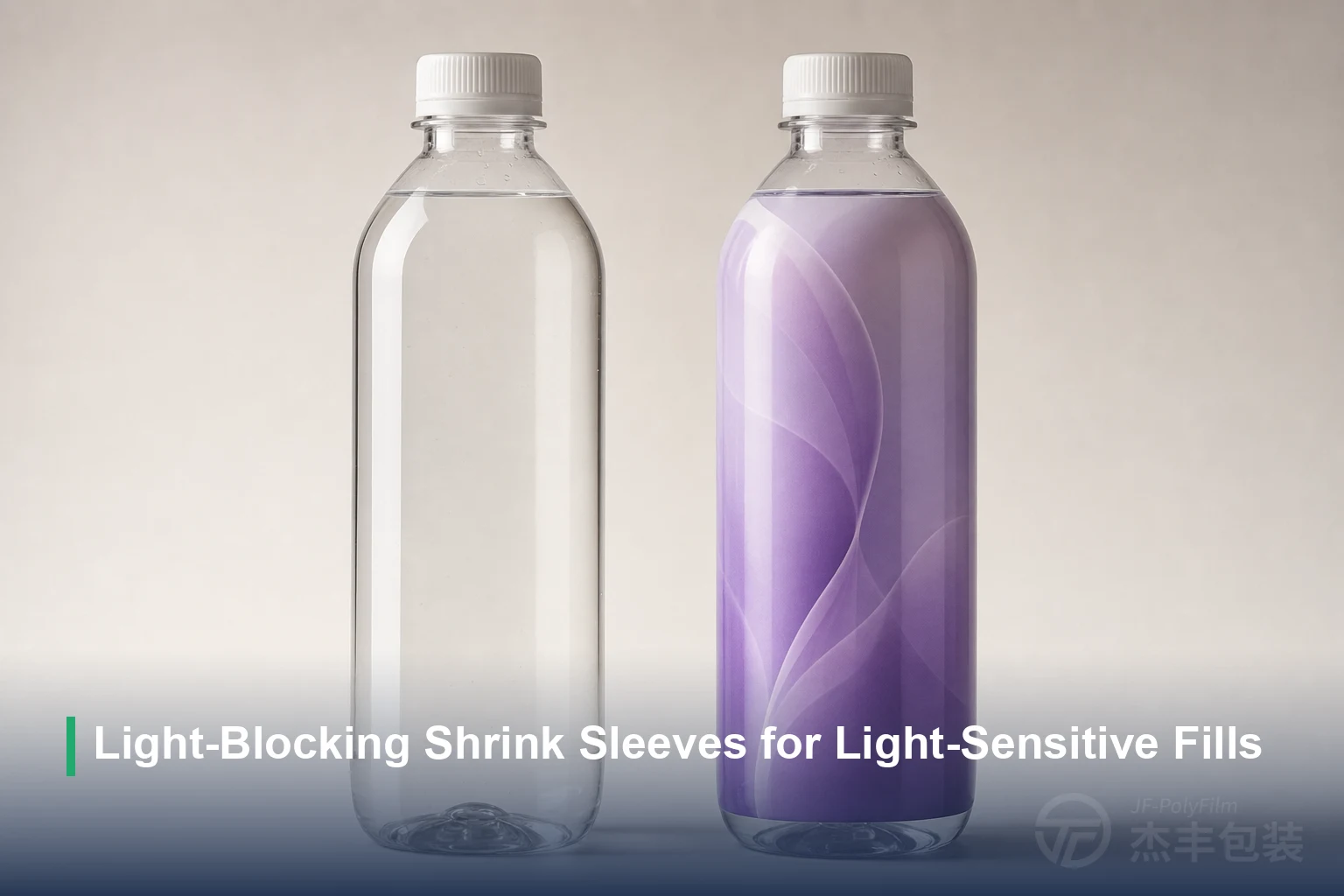
Light-Blocking Shrink Sleeves for Light-Sensitive Fills
Beer, dairy, supplements, and some medicines degrade under light. Which fills need protection, and how a full-body opaque PETG sleeve wraps the whole container to keep light off the contents.
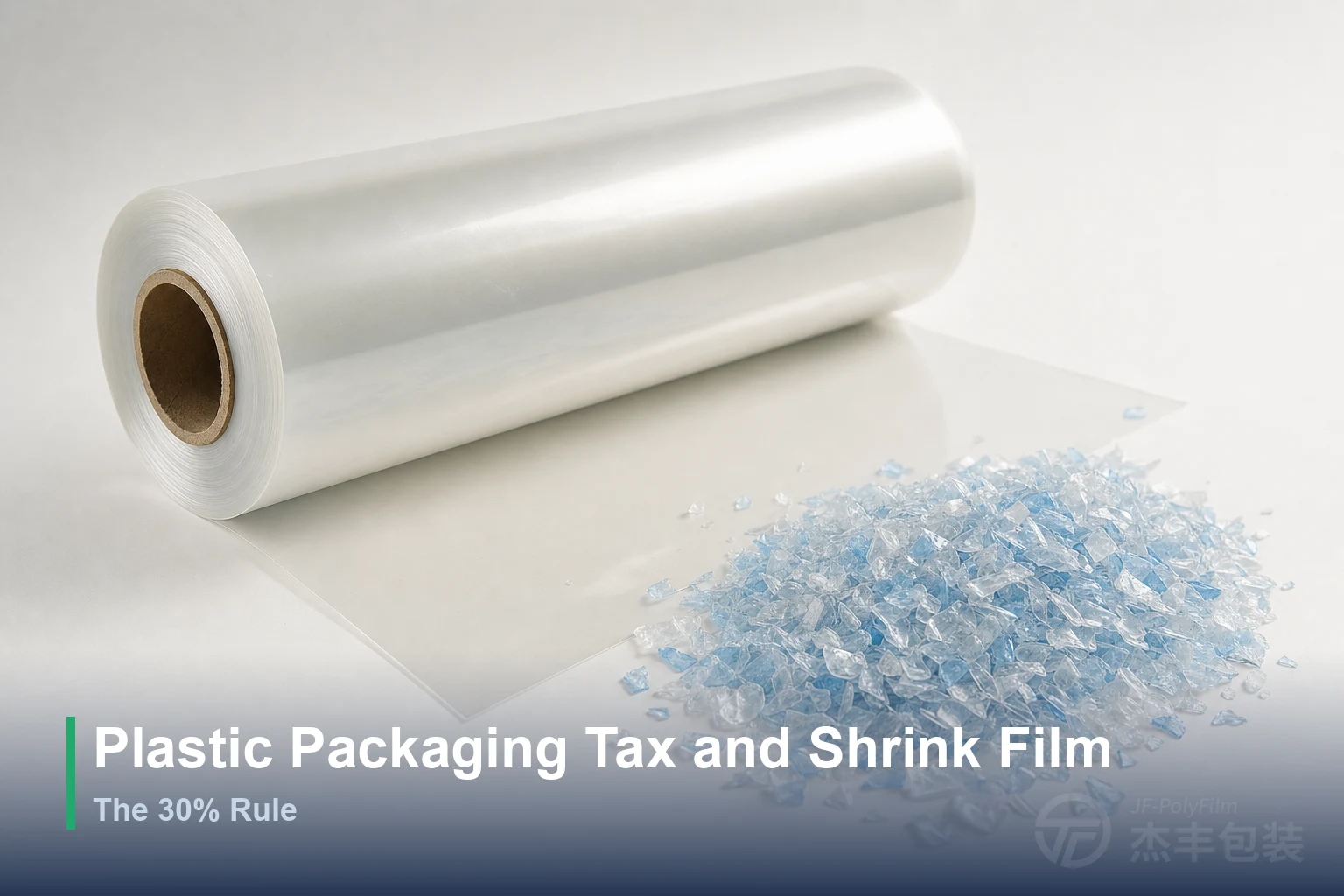
Plastic Packaging Tax and Shrink Film: The 30% Rule
How plastic packaging taxes in the UK, Spain, Italy and the EU treat shrink sleeves, why the 30% recycled-content threshold is the number worth remembering, and how RPET film helps a sleeve cross it.
Need Expert Advice on Shrink Film?
Our technical team can help you choose the right film for your application.
Contact Us