Laser Coding on Shrink Sleeves: Marking Without Ink
How end-of-line laser coders put permanent dates, batch numbers, and traceability codes on finished shrink sleeves — the marking mechanisms, laser wavelengths, how the film has to withstand the beam, and how laser compares with inkjet and thermal transfer.
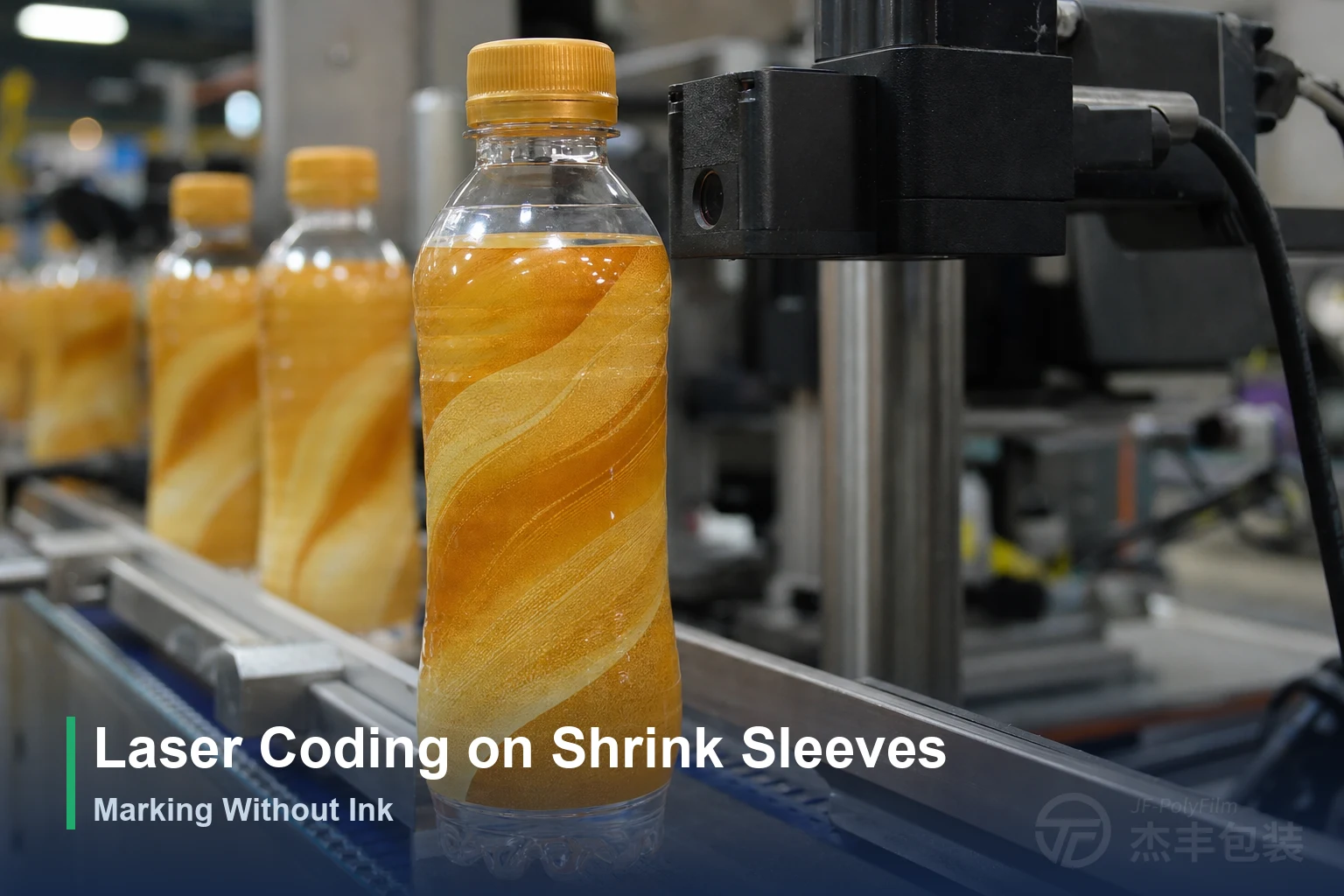
Laser coding on a shrink sleeve is the end-of-line step that marks variable data — a production date, a batch or lot number, a serial or traceability code — directly into the finished sleeve with a focused beam, permanently and without ink.
Key points
- The mark is not printed on. It forms inside the sleeve’s surface layer, where laser energy foams, carbonizes, or color-shifts an ink or coating, so the code appears with no material added and nothing raised to scuff off.
- Wavelength decides how gently the beam treats a thin film: CO₂ lasers work at 10.6 μm — with a 9.3 μm variant the PET polyester absorbs more readily — fiber lasers at 1064 nm, and UV lasers at 355 nm.
- Coding runs after the shrink tunnel, on the container-supported sleeve, because the date and batch are only fixed at the filling line — not on flat web while the sleeve is printed.
- This is a different operation from digital variable-data printing: digital prints a changing image as the sleeve is printed, while laser coding stamps the true, current date and batch onto each unit as it is filled.
- A thin sleeve marked at too much energy can perforate or heat-distort, so coders reach for lower power, foaming rather than ablation, and cold UV lasers when the film is heat-sensitive.
What laser coding writes on a finished sleeve
Laser coding writes the data that changes from unit to unit — the date, batch, lot, serial, or a scannable traceability code — onto a sleeve that has already been printed, applied, and shrunk. A focused beam does the marking, so there is no ink, no solvent, and no ribbon involved. The head never touches the sleeve, the line runs fast underneath it, and because the mark becomes part of the film surface rather than a layer sitting on top, it cannot be wiped, smeared, or solvent-rubbed away. That permanence is the whole reason coding lasers appear at the end of high-speed filling lines.
The coder itself is mounted over or alongside the conveyor and steers the beam across each unit on the fly, so containers never stop for marking — they pass under the head at line speed and leave already coded. That non-contact, on-the-fly arrangement is what lets a single station keep pace with filling and capping without becoming the bottleneck, and it is a large part of why laser marking scales to fast beverage and personal-care lines.
None of that is the brand artwork. The graphics, the fixed copy, and the color that make the sleeve look like the product were laid down far earlier at the print stage, on flat film, and they repeat identically on every unit. Laser coding adds the one thing that could not be known back then — the information tied to this specific unit at this specific moment on the line.
That distinction is worth drawing sharply, because a digital press can also print variable data, and the two are easy to confuse. A digital run can put a unique code or a region-specific version into the printed artwork, but the printed image is still fixed at print time — weeks or months before the bottle is filled — so it cannot carry the real production date or the batch that gets assigned at filling. Laser coding is what fills that gap: each unit receives its actual date, lot, or serial at the moment it is filled. How the artwork itself is put on the film is a separate subject, covered in the shrink sleeve printing methods guide; laser coding picks up where printing leaves off.
How the mark forms: ablation, foaming, carbonizing, color change
The code becomes visible because the laser physically changes a thin surface layer of the sleeve rather than depositing anything onto it, and it does that through one of four mechanisms. Which one applies depends on the material, the ink or coating, and how the beam is tuned.
| Mechanism | How the mark forms | Where the contrast comes from | Fit for sleeves |
|---|---|---|---|
| Ablation | The beam heats the surface to degradation and vaporizes it, etching a shallow recess | Usually low — a clear groove that also thins the material | Rarely used; it weakens a thin film |
| Foaming | Heat releases gas that is trapped as micro-bubbles under a sealed surface; the bubbles scatter light | A pale, light-scattering mark against a darker ground — high contrast, almost no penetration | The workhorse on PETG sleeves |
| Carbonizing | Polymer chains break down into carbon-rich residue | A dark brown-to-black mark against a light ground | Used on light-colored substrates |
| Color change | The beam degrades one colorant in a mix, shifting its shade | A selective color shift, often needing a laser-reactive additive in the layer | Used where the material is pre-doped for it |
Foaming is the mechanism most shrink sleeves rely on, and the reason ties back to wavelength: a CO₂ beam near 9.3 μm is absorbed well by the PET polyester, producing a bright foamed mark with high contrast and almost no penetration into the film. A single coder can move between mechanisms on the same material by adjusting power, pulse frequency, and marking speed, which is how one head handles different sleeve colors. Color-change marking is the exception that depends on chemistry rather than tuning alone — it usually needs a laser-reactive additive built into the ink or coating, so not every substrate will produce a high-contrast code when marked bare.
Which laser suits a thin sleeve
The laser type comes down to how much of its energy the film absorbs and how much heat it leaves behind, and thin heat-sensitive sleeves are unforgiving on both counts. CO₂ lasers at 10.6 μm are the mid-infrared workhorse for organics and packaging, but that wavelength can scorch heat-sensitive plastic; the 9.3 μm variant is absorbed more efficiently by the PET polyester and produces the clean foamed white mark instead. Fiber lasers at 1064 nm sit in the near-infrared and excel on metal, but they tend to pass straight through clear plastics and can heat-damage a delicate film rather than mark it cleanly.
Ultraviolet lasers at 355 nm take a different route. They mark by a “cold,” photochemical process — high-energy photons break molecular bonds directly rather than melting the surface — so the heat-affected zone stays very small, typically under 5 μm, with pulses typically shorter than 20 ns. That keeps scorching and distortion off a heat-sensitive film, which is why UV is the go-to for thin sleeve stock. Green lasers at 532 nm work along similar lines: high contrast on white, pale, and clear plastics with far less heat than the near-infrared, and often without a laser additive. The pattern is consistent — the cooler, better-absorbed wavelengths are the ones that mark a thin sleeve without damaging it.
What the film decides, and what the converter decides
Reliable coding on a sleeve is a shared result, and being honest about who controls what keeps expectations straight. The base film sets the physical envelope. A PETG sleeve has to take the beam without perforating or heat-distorting, and that risk rises as the gauge gets thinner — the same physics that lets a controlled laser cut vent holes and tear lines in packaging film means an uncontrolled one will punch straight through a thin sleeve. Two practices keep the film intact: coding after the shrink tunnel, when the film is set and backed by the rigid container rather than suspended as flat web, and using lower power or a cold UV laser on heat-sensitive stock. Because a shrink tunnel already brings the film to 95–100 °C to draw it down, marking afterward also keeps the coding step clear of the heat that shaped the sleeve.
The film’s optics matter too. A foamed mark reads as pale against a darker ground, so whether the sleeve is clear or white changes how the code stands out, and it helps to reserve a flat, low-shrink window in prepress where the code will land — a barcode or date placed on a steeply curved or high-shrink zone can distort past the point of scanning, the same contour effect that distortion compensation in prepress maps for the artwork itself. What sits outside the film mill’s control is the layer that actually produces a high-contrast mark: the laser-reactive ink or coating is chosen and applied by the printer or converter. Markability rides mostly on that layer, not on the bare film. JFPolyFilm supplies the PETG base film and does not print, code, or apply laser-reactive coatings — the role here is to provide a substrate that stays compatible with the downstream step and survives the beam energy, with the batch-to-batch consistency that lets a coding profile hold from one roll to the next.
Laser versus inkjet and thermal transfer coding
Laser is one of several ways to put variable data on a package, and the trade-offs decide which one a line runs — often more than one, at different stations. Continuous inkjet (CIJ) fires charged, deflected droplets; thermal inkjet (TIJ) heats a cartridge to eject them; thermal transfer (TTO) melts pigment off a ribbon onto flexible film.
| Laser | Continuous inkjet | Thermal inkjet | Thermal transfer | |
|---|---|---|---|---|
| Marks by | Changing the substrate itself | Deflected ink droplets | Heated ink droplets | Ribbon melted onto film |
| Permanence | Highest — permanent, tamper-resistant | Moderate; ink can rub or dissolve | Moderate | Durable print on film |
| Consumables | None | Ink and solvent | Ink cartridges | Ribbon |
| Substrate | Needs a markable surface; sometimes an additive | Widest — curved and irregular shapes | Non-porous surfaces need specific ink | Built for flexible film |
| Capex | Higher up front, low running cost | Moderate | Lower | Moderate |
The short version: choose laser for a permanent, consumable-free, hard-to-falsify mark, and accept the higher up-front cost and the need for a markable substrate in return. Reach for inkjet when the priority is high speed across almost any surface, including curved and irregular ones, with the ongoing cost of ink and the chance of a wet mark smearing. Thermal transfer earns its place printing durable codes onto flexible packaging film. Real lines frequently mix them, matching each technology to the surface and the code at each station.
Coding, serialization, and traceability
A unique code on every unit is the foundation of downstream traceability. It ties each item to a batch, which is what lets a recall be contained to the affected lot rather than a whole production run, and it supports serialization programs where each unit carries its own identity. That identity role is distinct from a physical seal: a laser code proves what a unit is and traces it, whereas a tamper-evident shrink band physically shows that a closure was opened. The two often appear on the same package because they answer different questions — one about identity and history, the other about interference.
Planning a sleeve that codes cleanly
The decisions that make end-of-line coding reliable are largely set before the film ever ships: picking a PETG grade that tolerates the beam, reserving a flat coding window in prepress, and settling the laser-reactive ink or coating with the converter. Film consistency underwrites all of it — a coding profile dialed in on one roll only carries to the next if shrink rate, thickness, and haze hold batch to batch, which is why the clear PETG film supplied here is sampled every batch, tested against a Certificate of Analysis, and marked with traceable roll data. For the basics of how a sleeve wraps and shrinks in the first place, the shrink sleeve label overview covers the ground, and the heat and distortion faults that trace back to the tunnel are diagnosed in the PETG shrink film application problems guide. For sleeve stock matched to a specific shrink rate and container, JFPolyFilm supplies clear PETG shrink film built to hold its spec roll to roll.
Frequently Asked Questions
Does laser coding use ink?
Why is the sleeve coded after it shrinks rather than during printing?
Can a thin shrink sleeve be laser-coded without burning through?
Is laser coding the same as the variable data a digital press prints?
What makes a shrink sleeve laser-markable?
Related Articles
Light-Blocking Shrink Sleeves for Light-Sensitive Fills
Beer, dairy, supplements, and some medicines degrade under light. Which fills need protection, and how a full-body opaque PETG sleeve wraps the whole container to keep light off the contents.
Plastic Packaging Tax and Shrink Film: The 30% Rule
How plastic packaging taxes in the UK, Spain, Italy and the EU treat shrink sleeves, why the 30% recycled-content threshold is the number worth remembering, and how RPET film helps a sleeve cross it.
Need Expert Advice on Shrink Film?
Our technical team can help you choose the right film for your application.
Contact Us