
Shrink Sleeve vs BOPP Wrap-Around Label: Which to Use
Shrink sleeves and BOPP wrap-around labels suit different bottles. Compare them on shape, cost, line speed, coverage, and how each separates in PET recycling.
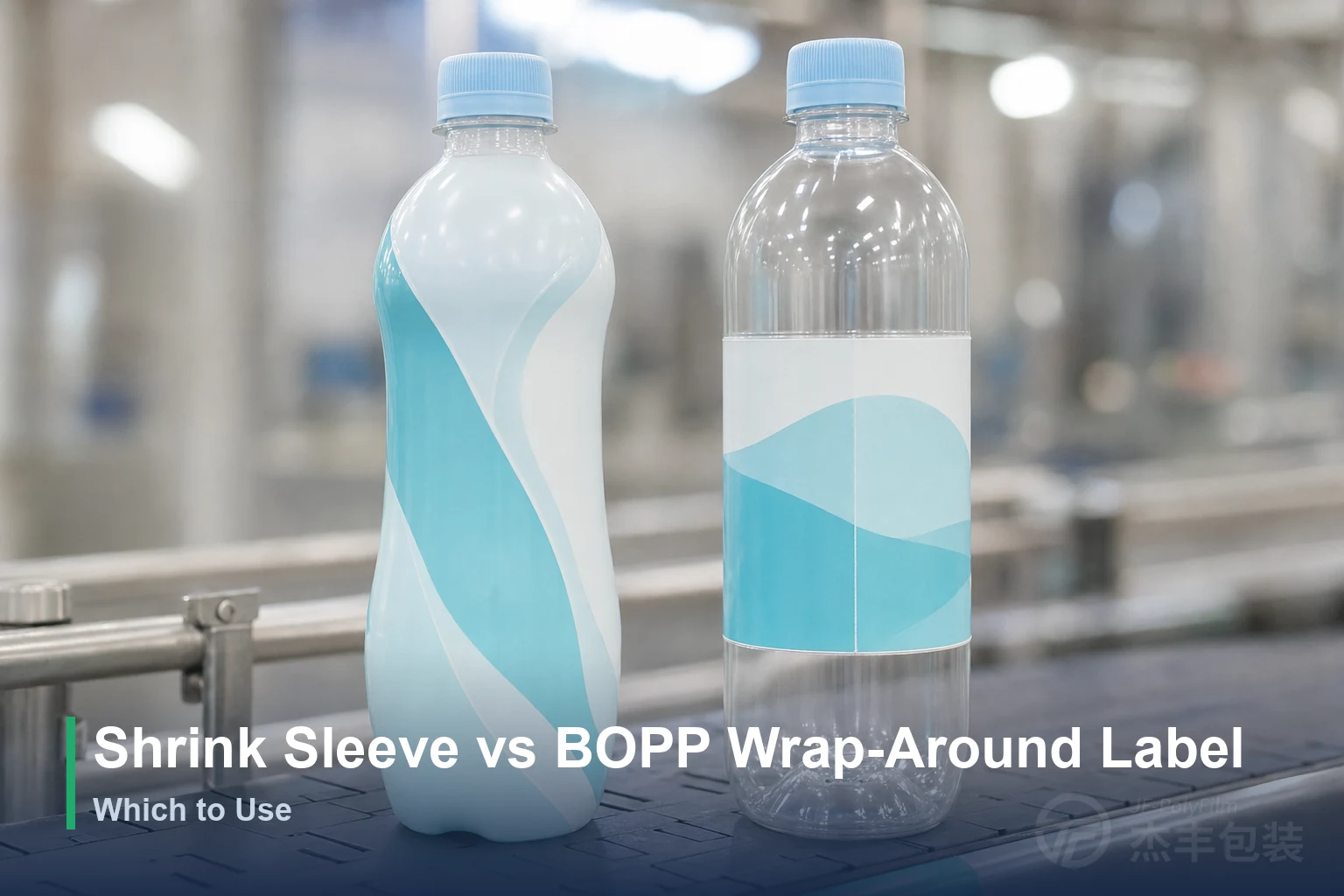
A shrink sleeve is a printed film tube slipped over a container and drawn tight under heat; a BOPP wrap-around label is a pre-printed polypropylene film glued in a band around the body. The split between wrapped-and-shrunk and glued-around-a-cylinder drives every other trade-off between them.
Key takeaways
- Bottle shape is the first filter: a flat BOPP band conforms only to straight cylindrical walls, while a shrink sleeve draws down onto tapers, waists, ovals, and contoured bodies.
- A reel-fed BOPP wrap-around labeler is the lowest-cost way to decorate a straight cylinder at high speed, which is why bottled water and commodity beverages lean on it.
- Only a shrink sleeve gives true 360-degree, full-body coverage over the shoulder; a BOPP band covers a strip on the cylinder and closes on a single glued seam.
- On a PET bottle, a polypropylene BOPP band floats off in the recycling wash (near 0.90 grams per cubic centimeter) and separates from the sinking PET, while a sleeve’s recyclability depends on matching the bottle — a crystallizable PET film recovers with it.
The two methods at a glance
The two differ on every practical axis — the shape they fit, the coverage they give, the line they need, what they cost to run, and how they behave in recycling — and those axes rarely all point the same way. The table places them side by side before the detail that follows. Pressure-sensitive labels and in-mold labels are separate routes with their own economics and sit outside this two-way comparison.
| Axis | Full-body shrink sleeve | BOPP wrap-around label |
|---|---|---|
| Best bottle shape | Tapered, waisted, oval, contoured | Straight cylindrical walls only |
| Coverage | Full 360°, body and shoulder | A band on the cylinder |
| How it closes | Single welded seam | Single glued overlap (hot-melt or cold) |
| Application | Seamed tube, applicator, heat tunnel | Reel-fed film, glue, high-speed wrap |
| Line footprint | Applicator plus tunnel | Compact single-stage labeler |
| Entry cost | Medium, run-flexible | Lowest for straight-wall high volume |
| Recycling on PET | Grade-dependent; CPET recovers with bottle | Floats off (~0.90) and separates from PET |
| Tamper signal | Strong with sleeve-and-cap band | Body band only, no closure seal |
Each axis carries its own trade-off. The sections below follow the order a real brief resolves them in, starting with the filter that removes options before any other criterion matters.
Bottle shape decides the shortlist first
A BOPP wrap-around label is a flat, pre-printed film, so it behaves correctly only on a straight cylindrical wall — a flat sheet rolls onto a cylinder without wrinkling, but the moment the diameter changes the band cannot keep up. On a tapered, waisted, or oval bottle the top or bottom edge runs short or long against the shifting circumference, so the film puckers, lifts at the corner, or bridges across the low point instead of following it. Because the band is cut to a fixed circumference, even a slight taper or a molded grip feature shows up as a loose edge or a diagonal wrinkle, and there is no shrink margin to take it up. A shrink sleeve solves the same shapes from the opposite direction: it goes on loose and contracts under heat until it draws down onto the contour, so a cone, an hourglass, or a shoulder transition ends up fully wrapped. How deep a curve a sleeve can follow comes down to transverse shrink, the sideways contraction that pulls the film against the wall. Our clear PETG runs high transverse shrink across 65, 75, and 80 percent grades, matched to how sharply the bottle turns, with machine-direction shrink held at or below 3 percent so the graphic does not distort down the height. That margin is the practical reason contoured and grip-feature bottles default to a sleeve, while a plain cylinder keeps both options open. Matching the grade to a specific container is worked through in the grade selection guide.
Coverage: a full 360-degree wrap versus a glued band
A shrink sleeve decorates the whole body top to base and over the shoulder as one continuous graphic, broken only by a single welded seam; a BOPP wrap-around label covers a band around the cylinder and closes on a single glued overlap, typically leaving the shoulder and base bare. The band prints sharp, high-resolution graphics on a stiff oriented film and carries everything a straight-walled water or beverage bottle needs on its cylindrical face, but it is partial coverage by design, and the glued overlap is a visible start-and-stop edge rather than a seamless wrap. Because a sleeve conforms to relief, embossing and shoulder curves stay readable instead of being spanned, and the image runs unbroken around the full circumference and up onto the shoulder. Where a brand wants the entire container decorated — a continuous 360-degree image, the shoulder included — the flat band cannot reach it and the sleeve is the only route. Where a straight cylinder only needs a clean cylindrical panel, the band’s partial coverage is enough and its lower cost decides it. What a sleeve is and how it is built is covered in the shrink sleeve primer.
On the line: reel-fed glue wrap versus applicator and tunnel
The two apply through completely different machinery, and that requirement often decides which suits a given plant. A BOPP wrap-around labeler feeds pre-printed film straight from a reel, cuts each label, lays down a stripe of hot-melt or cold glue, and wraps the band around the body at very high speed, closing it on the overlap — no tube-making, no heat tunnel, and quick changeover between jobs. That compact, single-stage line, with its low energy draw and small footprint, is a large part of why the method dominates fast straight-walled bottling. A shrink sleeve runs through more stages: the printed film is welded into a continuous tube at a seam, an applicator cuts and drops each sleeve over the container, and a heat tunnel — steam, hot air, or infrared — shrinks it to fit, with films like ours running cleanly between roughly 95 and 100 degrees Celsius across those tunnel types. That sequence asks for floor space and tight synchronization between applicator and tunnel, which is the cost of the shape range and full-body coverage a sleeve buys. A plant already running a reel-fed labeler on a straight-wall line weighs that added hardware very differently from one dedicating a line to contoured, premium packs.
Cost: why reel-fed BOPP is the low-cost route for straight cylinders
For a straight cylindrical bottle run at volume, a BOPP wrap-around label is usually the lowest-cost decoration available: the oriented film is thin and inexpensive, the labeler is compact, and the line runs fast with little changeover overhead. Because the oriented film also runs thin, each label adds little material weight to the pack, which keeps both the per-label cost and the shipped weight low across a long production run. That combination is why high-throughput commodity lines — bottled water, everyday soft drinks — lean on it, and it is a genuine cost advantage a sleeve does not undercut on that specific job. A shrink sleeve carries a higher per-unit and equipment cost that pays back through what it makes possible rather than through unit price: full-body coverage, contoured shapes, and a built-in tamper path folded into one component. So the deciding figure is not the lowest sticker price in isolation but the total spread across the shape, coverage, and volume the pack actually needs. A plain cylinder that only needs a cylindrical band rewards the BOPP route, while a contoured or premium container the flat band cannot fit moves the comparison off price entirely — there, the band is not a cheaper way to do the same job but a method that cannot do the job at all. Reading cost by fit rather than by sticker price is what keeps the two from being mistaken for interchangeable.
Recycling: which one leaves the PET stream cleaner
On a PET bottle, recyclability is where a BOPP band can hold a real advantage, and the point is worth stating plainly. BOPP is a polyolefin — biaxially oriented polypropylene — with a density near 0.90 grams per cubic centimeter, well below water, so in the float-sink tank that sorts reclaimed PET the band floats while the heavier PET flake sinks. Paired with a wash-off or separable glue, the label lifts away and floats off, leaving the PET regrind uncontaminated — a label designed to separate rather than a material the sorter has to fight. A shrink sleeve sits on the other side of that split. A PETG film has a density near 1.28 to 1.33 grams per cubic centimeter, above water, so it sinks with the PET rather than floating off, which means float-sink alone will not lift it away. Its recyclability therefore depends on the film grade. A crystallizable PET (CPET) sleeve shares the bottle’s chemistry and survives the wash, so label and bottle stay in the same RIC 1 PET stream and are recovered together instead of being pulled apart. The honest read is not that a sleeve recycles better — on a straight PET cylinder a BOPP band separates off more easily than any sleeve — but that the two reach a clean outcome by opposite routes: the band floats away and is removed, while a matched CPET sleeve is engineered to stay and recover with the bottle. The mechanics of that same-stream match are set out in the CPET same-stream explainer.
Durability, seams, and tamper evidence
Because a BOPP band closes on a single glued overlap, its weak point is that seam: if the adhesive is stressed, chilled, or soaked over a long shelf life, the overlap can lift or an edge can peel, and a body band does not cross the closure, so it carries no built-in signal of first opening. A shrink sleeve has a different profile. Its single seam is welded rather than glued, it grips the container mechanically once it has shrunk rather than relying on adhesive to stay closed, and it can be run up over the cap as a sleeve-and-cap band so a perforation tears the moment the closure turns — tamper evidence built into the decoration rather than added as a separate seal. On the printed graphic itself the two converge more than the seam picture suggests: a stiff oriented BOPP film is water- and abrasion-resistant and holds its print through condensation and chilled handling, and a reverse-printed sleeve carries its ink on the inner face so transit and handling wear the film rather than the image. The split that actually separates them is the glued seam and the missing closure seal, not whether the print lasts the shelf; where a first-open signal is part of the brief, that points to a sleeve or band before decoration is even weighed, as the tamper-evident band guide sets out.
Routing the choice: shape, speed, cost, then recycling target
The choice resolves in a fixed order, because the earlier filters remove options the later ones would otherwise weigh. Start with the bottle: a straight cylindrical wall keeps both options open, while any taper, waist, oval, or sculpted contour removes the flat BOPP band and leaves a shrink sleeve as the route. On a straight cylinder, weigh throughput and cost next — a high-speed, cost-sensitive line decorating a plain water or beverage bottle is exactly where a reel-fed BOPP wrap-around label wins, and a sleeve would add cost and hardware for coverage the pack does not need. Then read the recycling target against the destination market: a goal of the label separating cleanly off a PET bottle points to a float-off BOPP band with a wash-off glue, while a goal of the label recovering with the bottle points to a crystallizable PET sleeve that stays in the RIC 1 stream. Finally weigh decoration ambition — full-body 360-degree coverage over the shoulder, a continuous wrap on a contoured shape, or a built-in tamper band all land on a sleeve. Pressure-sensitive and in-mold labels sit alongside these as separate routes, compared in shrink sleeve vs pressure-sensitive label and shrink sleeve vs in-mold label. Where the routing lands on a sleeve, our clear PETG shrink film covers the high-shrink and CPET grades a contoured or PET-stream brief calls for.
Frequently Asked Questions
Can a BOPP wrap-around label go on a tapered or waisted bottle?
Which is cheaper, a shrink sleeve or a BOPP wrap-around label?
Does a BOPP wrap-around label recycle with a PET bottle?
Do shrink sleeves and BOPP wrap-around labels use the same equipment?
Related Articles
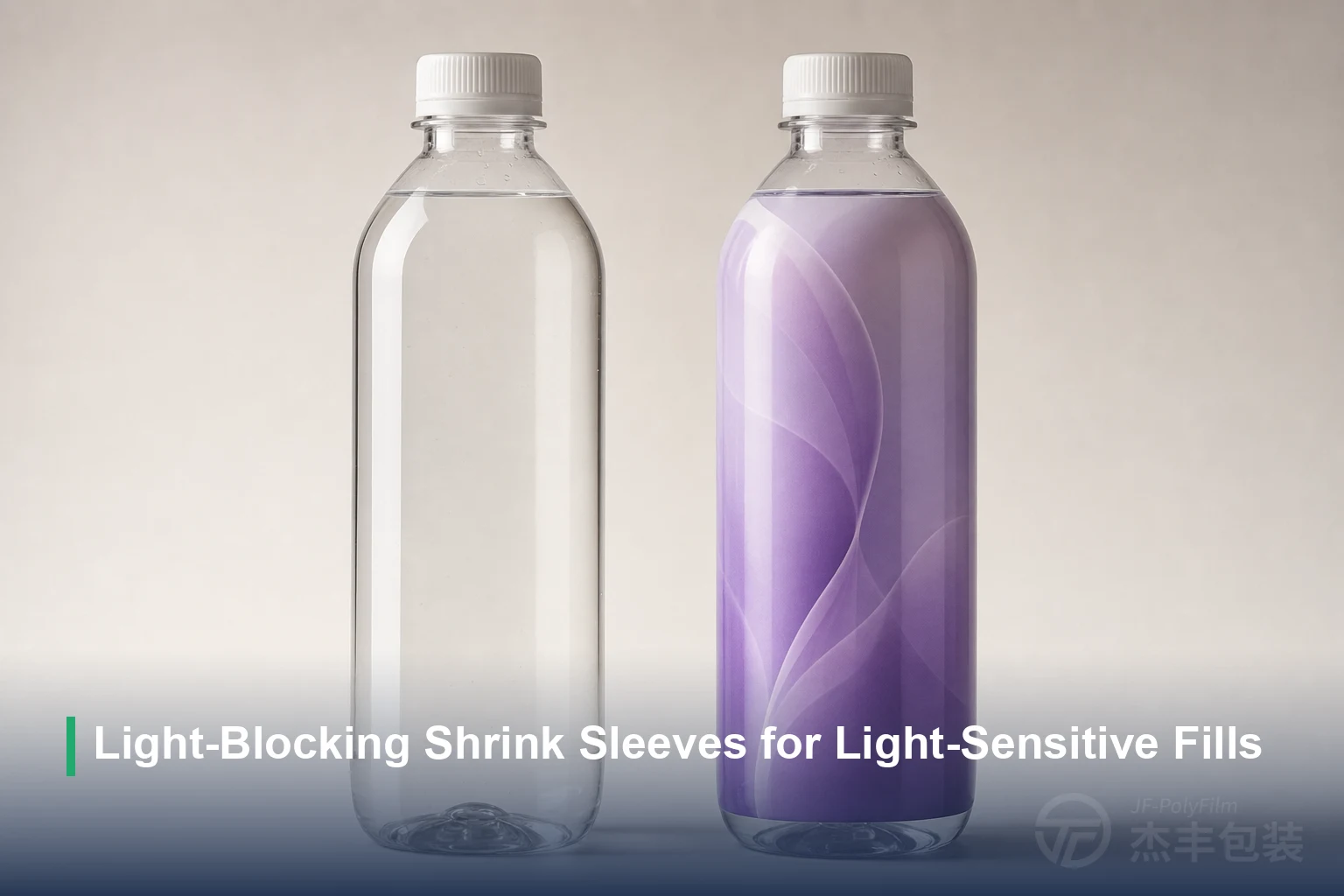
Light-Blocking Shrink Sleeves for Light-Sensitive Fills
Beer, dairy, supplements, and some medicines degrade under light. Which fills need protection, and how a full-body opaque PETG sleeve wraps the whole container to keep light off the contents.
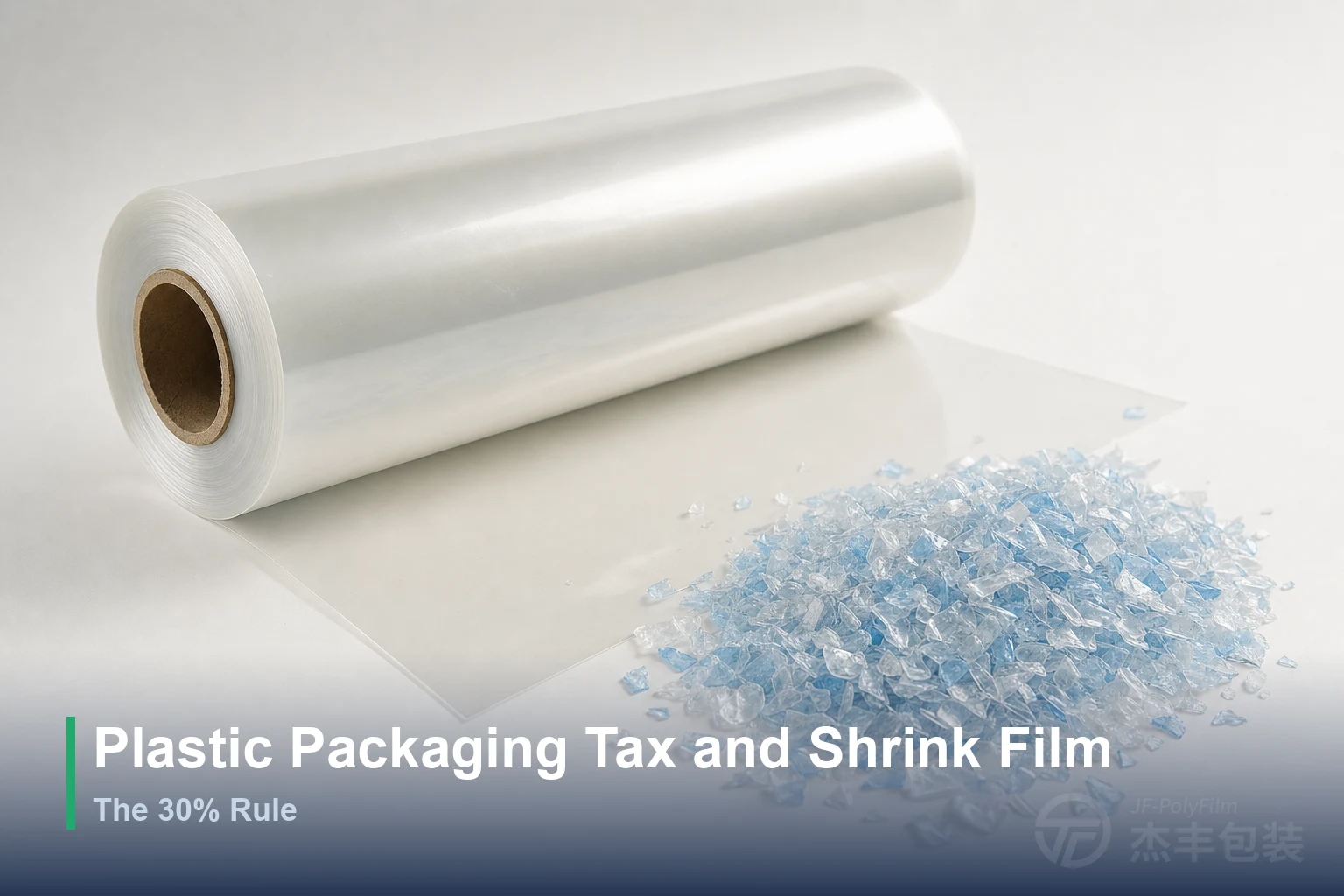
Plastic Packaging Tax and Shrink Film: The 30% Rule
How plastic packaging taxes in the UK, Spain, Italy and the EU treat shrink sleeves, why the 30% recycled-content threshold is the number worth remembering, and how RPET film helps a sleeve cross it.
Need Expert Advice on Shrink Film?
Our technical team can help you choose the right film for your application.
Contact Us