
Shrink Sleeve vs. Pressure-Sensitive Label: Which to Use
Shrink sleeves and pressure-sensitive labels suit different bottles. Compare the two on shape, decoration, tamper evidence, line speed, cost, and recycling.
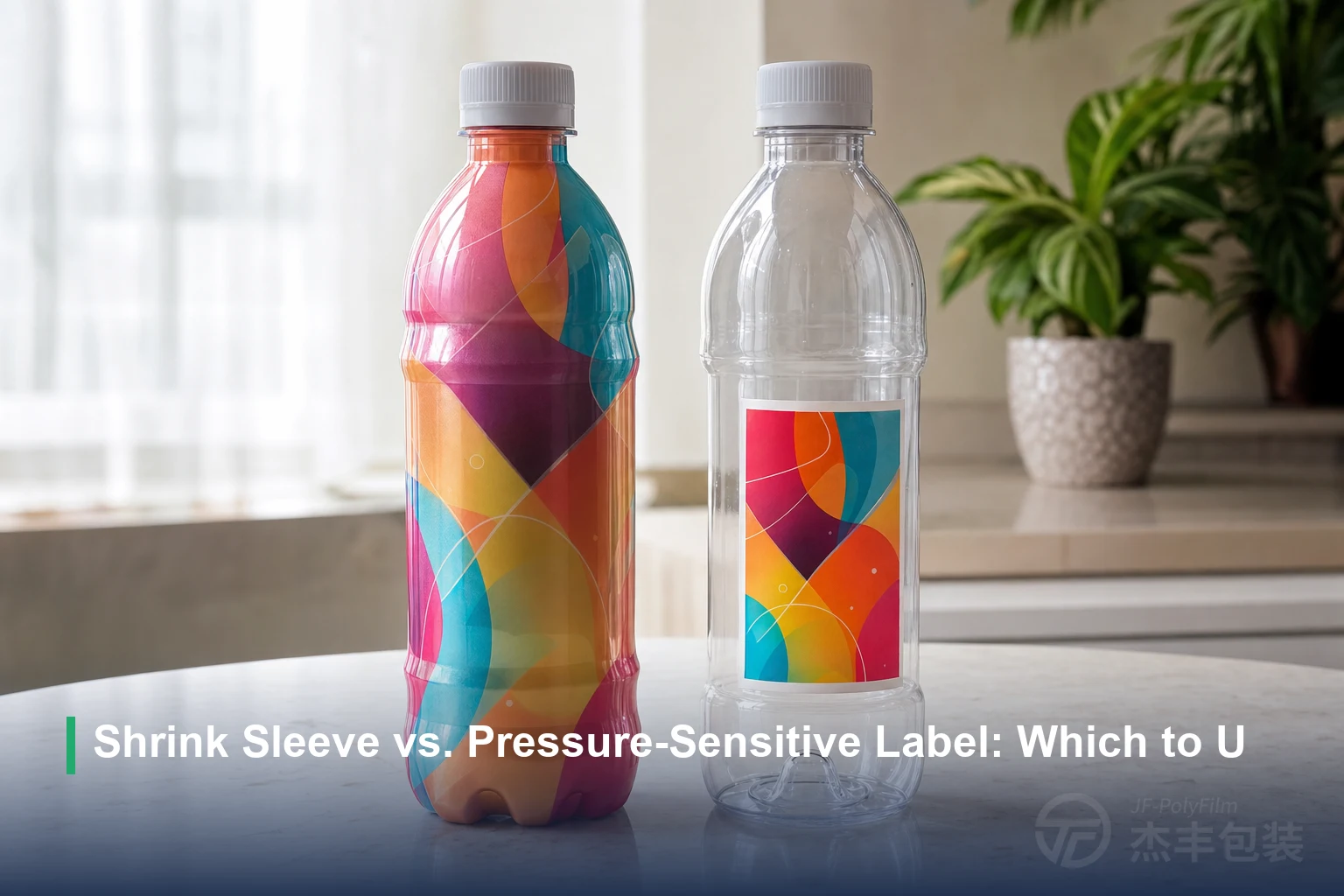
A shrink sleeve is a printed PET-family film tube heat-shrunk 360° around a container; a pressure-sensitive label is an adhesive-backed facestock pressed onto a flat or lightly curved panel. The choice turns on bottle shape, decoration, tamper needs, line setup, cost, and recycling.
Key takeaways
- Match the label form to the bottle: shrink sleeves wrap curved, tapered, and waisted containers 360°, while pressure-sensitive labels suit flat or gently curved panels.
- Following a deep curve takes a high transverse shrink. JFPolyFilm’s clear PETG is offered across transparent grades of 65%, 75%, and 80% TD, matched to how sharply the bottle turns, with machine-direction shrink held to 3.0% or below.
- Pressure-sensitive labels apply in one step and change over quickly, favouring short runs and many SKUs; shrink sleeves add an applicator plus a heat tunnel and spread that cost over larger volumes.
- “Sleeves are harder to recycle” depends on the film: adhesive glue and facestock can contaminate the PET stream, while CPET and RPET sleeves stay with the bottle in the RIC 1 stream.
- Shrink sleeves give built-in tamper evidence over the cap and backprinted graphics that survive fridge, freezer, and wet use; pressure-sensitive edges can lift or curl under condensation.
The decision in one table
For most packs the choice sorts on two axes — container shape and run size. Down the left are common situations, and each leans toward one form: a curved bottle, a tamper requirement, or a fridge shelf points to a sleeve; a flat panel, a short run, or many quick-changing SKUs points to a pressure-sensitive label.
| Your situation | Shrink sleeve | Pressure-sensitive label |
|---|---|---|
| Contoured, tapered, or waisted bottle | Best fit — shrinks to the curve | Struggles — edges lift on deep curves |
| Flat or gently curved panel | Works well | Best fit — simple and fast |
| Full-body 360° graphics | Seamless wrap, top to base | Single panel; container shows around it |
| ”No-label” transparent look | Clear film hugs the wall | Facestock edges stay visible |
| Built-in tamper evidence | Extend over the cap as a seal | Add a separate tamper feature |
| Fridge, freezer, or wet use | Backprinted, protected artwork | Edges can lift or curl |
| Short runs, samples, many SKUs | Higher setup to justify | More economical, quick changeover |
| Large, long production runs | Cost spreads over volume; one wrap replaces a label pair plus band | Mature, high-speed labelling |
| Recycle with a PET bottle | CPET/RPET stay in the RIC 1 stream | Adhesive and facestock can contaminate |
These two are not the only label routes — in-mold labeling, BOPP wrap-around film, and direct-to-container printing sit alongside them as a separate layer of choice, each weighed against the sleeve in shrink sleeve vs. in-mold label and shrink sleeve vs. BOPP wrap-around label. This guide stays on the two most brands weigh first; the sleeve itself is explained in what is a shrink sleeve label. The sections below unpack each row.
Decoration coverage: 360° full body vs. single panel
A shrink sleeve prints across the entire container — front, back, shoulder, and base — so the graphic reads as one uninterrupted wrap with no start or stop edge. A pressure-sensitive label covers the face it is applied to and leaves the rest of the container exposed, which is why brands often run a front and back pair to carry everything a single sleeve holds at once.
That difference decides the look before it decides anything else. A design that wants an immersive, edge-to-edge treatment — a spirit that dresses the whole bottle, a supplement that uses every surface for claims and directions — leans to the sleeve, which turns the container into a continuous canvas. A design that only needs a clean front mark and a regulatory back panel, or that deliberately shows off the container material and fill, leans to the adhesive label, where the bare surface between panels is part of the intent rather than a gap. Neither is richer by default; the question is how much of the container the brand wants to speak on.
There is a subtler coverage effect at the transparent end. A clear sleeve contracts flush to the wall with no lip standing off the surface, so print can float on an otherwise invisible film for a near “no-label” look where the graphic appears to sit directly on the glass or plastic. A pressure-sensitive label, even on clear facestock, keeps a defined edge and a slight step where the material starts and stops, and that edge is where scuffing and lift begin over time. For a premium bottle sold on the purity of its contents, the seamless option is often the sleeve; for a design that wants a crisp, framed panel rather than an invisible one, the label’s defined edge is a feature, not a flaw.
Container shape: where the label physically fits
An adhesive facestock lies flat. It sits well on straight walls and gentle curves, but on a taper, a waist, or a tight radius it lifts at the corners, wrinkles, or bridges across the low point instead of following it — the geometry simply outruns what a flat sheet can do. A shrink sleeve solves the same shape from the other direction: applied loose, it contracts under heat until it draws down against the contour, so an oval, an hourglass, a conical tub, or a narrow neck ends up fully wrapped.
How deep a curve a sleeve can follow comes down to one readable number — the transverse (TD) shrink rate, the sideways contraction that pulls the film against the wall. A higher TD reaches into steeper curves without flowering, the puckering a low-shrink film shows when it cannot keep up with the contour. JFPolyFilm’s clear PETG is offered across transparent grades of 65%, 75%, and 80% TD, so the shrink can be matched to how sharply the bottle turns; the deeper the waist or shoulder, the higher the grade it asks for. A near-straight bottle or a plain cylindrical jar calls for far less of that shrink, and there both forms apply cleanly, so shape stops being the deciding factor. Once a sleeve is the direction, which grade to choose works through matching the shrink rate and film to the specific container.
Tamper evidence and security
A shrink sleeve can be extended past the shoulder and over the closure so the same film that carries the graphic also seals the cap — one component doing double duty as label and tamper band, torn on first opening. A pressure-sensitive label sits on the body and does not cross the closure, so tamper evidence becomes a separate feature to specify and apply, planned in from the point the line is equipped rather than added later.
For a category where a broken seal is the visible proof a pack has not been opened — pharmaceuticals, nutraceuticals, many food and beverage lines — that built-in path makes the sleeve the simpler route to a tamper-evident pack, since the security and the branding arrive in a single pass. The band mechanics, perforation styles, and where a full sleeve differs from a neck band alone are covered in tamper-evident shrink bands.
On the line: equipment, speed, and changeover
The two forms apply through different machinery, and that shapes which suits a given line. A pressure-sensitive label applies in one step: the facestock peels from its liner and presses onto the container. The applicator is compact, drops into an existing line without much rearrangement, tolerates hand application for short runs, and swaps to a new artwork roll quickly — which keeps it steady on fast lines and where changeovers are frequent.
A shrink sleeve runs in two stages. An applicator places the seamed tube over the container, then a heat tunnel — steam, hot air, or infrared — contracts it to fit. That asks for more floor space, a stable flow of containers through both stages, and accumulation buffering on lines that start and stop, since the applicator and the tunnel have to stay synchronised or the sleeve shrinks skewed or distorted. Condensation on chilled containers can also call for drying the surface before sleeving, so the graphic seats cleanly. None of this rules the sleeve out; it means the line’s current layout, changeover rhythm, and whether a tunnel is already in place all feed into the choice — a program running many short SKUs on a compact line weighs that overhead differently from one dedicating a line to a long-running pack. A brand that fills through a contract packer inherits whichever equipment that packer already runs, so the heat tunnel is not always a capital cost the brand carries itself.
The two forms also leave different waste at the machine. A pressure-sensitive label arrives on a release liner that is stripped off and discarded as the label applies, so every roll carries a matrix-and-liner stream to handle. A sleeve seals as a printed tube with no carrier to throw away, but it needs a clean seam and correct diameter for the container, so its setup effort moves upstream into tube-making and sizing rather than into liner disposal at the line. Neither is waste-free; they simply put the handling in different places.
Cost structure and run size
Per piece, a pressure-sensitive label usually starts lower: the label and its applicator both cost less to bring online, the material buys by the roll in small quantities, storage is simple, and a short run or a sampling batch carries no penalty for staying small. Because rolls stock flat and pull as needed, a wide SKU count also holds less capital in inventory than a set of pre-formed sleeves sized to each container. Those pre-formed, container-sized sleeves also carry a higher practical minimum order than roll-stock labels, which pull in any quantity — a run-length floor worth confirming with a supplier early. That makes the adhesive label the economical route for low volumes, frequent design changes, and a broad range of products where no single item runs long.
A shrink sleeve carries a higher per-unit and equipment cost that pays back at scale — the figure settles as quantity climbs, and one printed sleeve can stand in for several separate labels plus a tamper band, folding steps and components together. So the practical read is by volume and SKU spread rather than by unit price alone: a large, steady run rewards the sleeve, while a short or highly varied one favours the adhesive label. Because these numbers move with quantity, artwork, and finishing rather than sitting fixed, the sleeve side is worked through in the PETG shrink film pricing guide instead of quoted here.
Recyclability: where each one trips up the PET stream
The common line that “shrink sleeves are harder to recycle” is only half the picture, and both forms have a way of tripping up the PET stream. A pressure-sensitive label can carry adhesive that will not release from the PET flake, ink that bleeds into the wash, and a facestock that follows the flake through sorting and taints the recovered material. A shrink sleeve uses heat and no glue, so it avoids the adhesive problem outright — but the sleeve’s own recycling behaviour then depends entirely on which film it is made from.
That is where the grade decides the outcome. A PVC sleeve contaminates PET reclaim and is ruled out for a bottle bound for recycling. A conventional PETG sleeve melts cooler than PET and can clump in the dryer, so it has to clear recycling-industry protocols before it counts as compatible. Crystalline PET and recycled PET, by contrast, share the bottle’s chemistry and heat tolerance, so they recover with the container in the same RIC 1 stream — no separation step, no downgrade. JFPolyFilm’s CPET and RPET grades take that single-stream path, which is the point the blanket claim misses: a sleeve’s recyclability is set by the film, not by the format. Buyers holding recycling as a hard requirement can compare the routes in PET shrink sleeve recyclability and pin the film choice in which grade to choose.
Durability, artwork, and confirming the choice
Where the two forms live matters as much as how they look. A shrink sleeve carries its graphic on the inside face of the film, so the print sits protected against scuffing and moisture and holds up through fridge, freezer, and wet or shower-room use; a full-body sleeve also blocks part of the incoming light across the container. A pressure-sensitive label prints on the outer face, and under long condensation, freezing, or rough handling its edges can lift, wrinkle, or scuff, with the adhesive itself sometimes failing when soaked or held cold. On the artwork side there is a workflow difference too: a sleeve design has to be distorted in prepress to pre-compensate for the shrink, so the graphic reads true once contracted, while an adhesive label prints what you see with no such step.
Once a sleeve is the direction, the same checks confirm it against any supplier. A batch certificate of analysis carries the shrink figures; pull samples verify them — JFPolyFilm cuts a five-metre sample from every batch for shrink and thickness — and shrinking real containers at the target tunnel temperature proves the fit better than a datasheet alone. Certifications belong to the material, not to a logo on the page: GRS, REACH, RoHS, and EU 10/2011 material standards read as such. A brand that lands on a pressure-sensitive label instead leans on facestock and adhesive matched to the surface and the storage conditions. For a clear full-body wrap on a contoured bottle, the clear PETG shrink film grade is the starting point to sample against a target container.
Frequently Asked Questions
What is the main difference between a shrink sleeve and a pressure-sensitive label?
Can pressure-sensitive labels go on curved or shaped bottles?
Are shrink sleeves harder to recycle than adhesive labels?
Which costs less, a shrink sleeve or a pressure-sensitive label per unit?
Do shrink sleeves and adhesive labels need different application equipment?
Related Articles
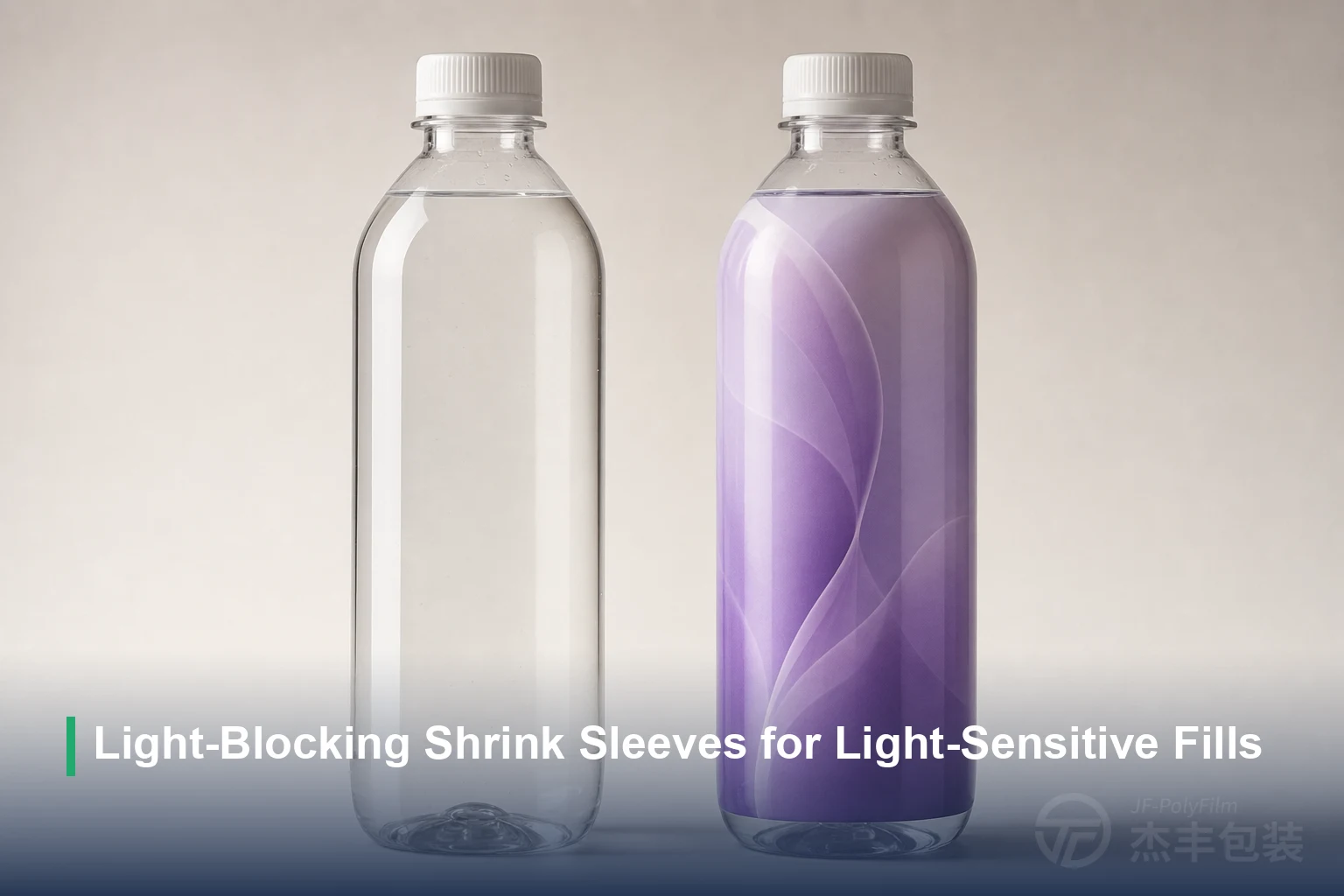
Light-Blocking Shrink Sleeves for Light-Sensitive Fills
Beer, dairy, supplements, and some medicines degrade under light. Which fills need protection, and how a full-body opaque PETG sleeve wraps the whole container to keep light off the contents.
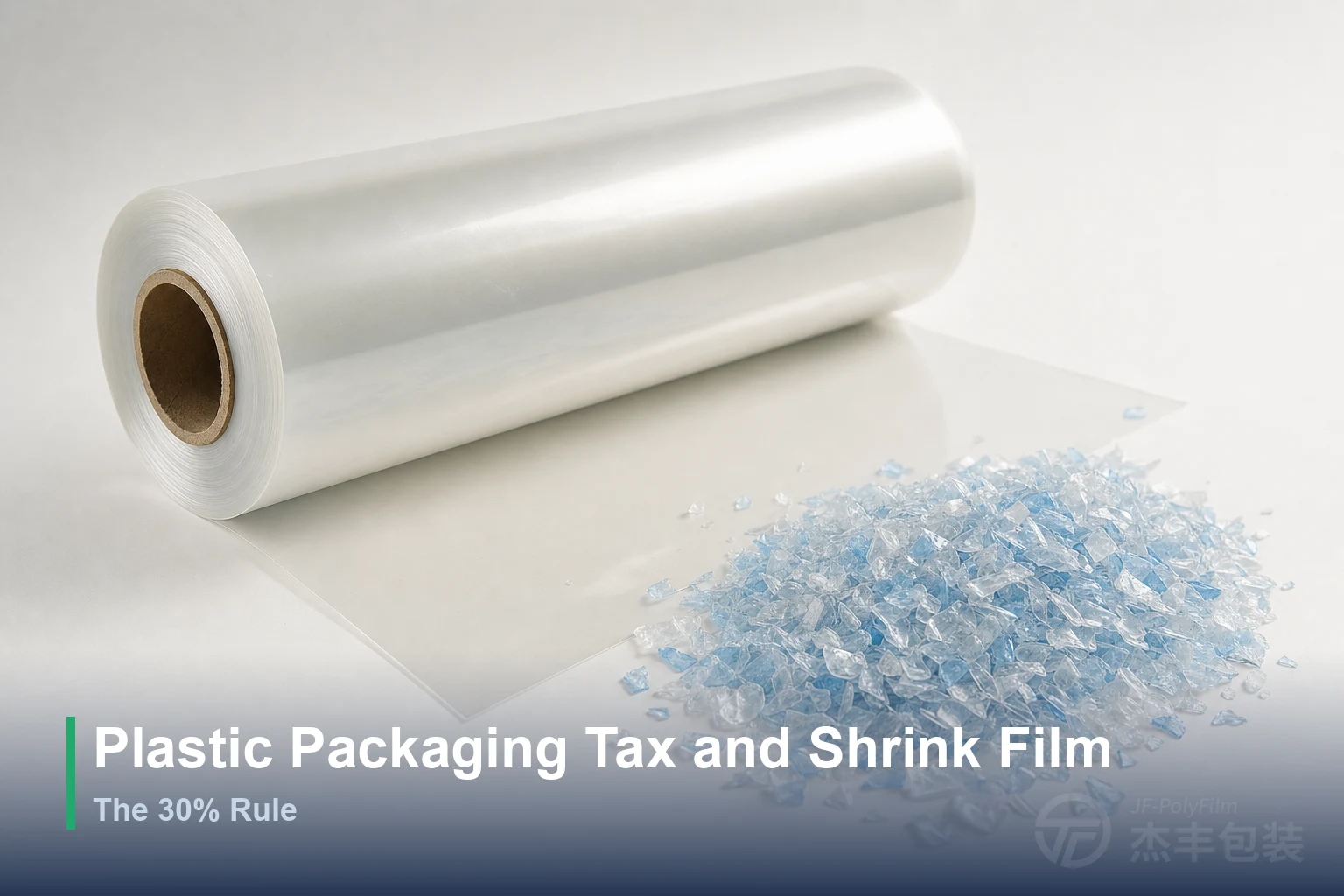
Plastic Packaging Tax and Shrink Film: The 30% Rule
How plastic packaging taxes in the UK, Spain, Italy and the EU treat shrink sleeves, why the 30% recycled-content threshold is the number worth remembering, and how RPET film helps a sleeve cross it.
Need Expert Advice on Shrink Film?
Our technical team can help you choose the right film for your application.
Contact Us