
Sustainable Shrink Sleeves: What Actually Recycles
Being made of PETG does not make a shrink sleeve sustainable. This guide maps the six design levers that decide whether a sleeve helps or harms PET bottle recycling — same-stream CPET, recycled content, float separation, wash-off, PVC-free and the regulations forcing the choice — and where each is covered in depth.
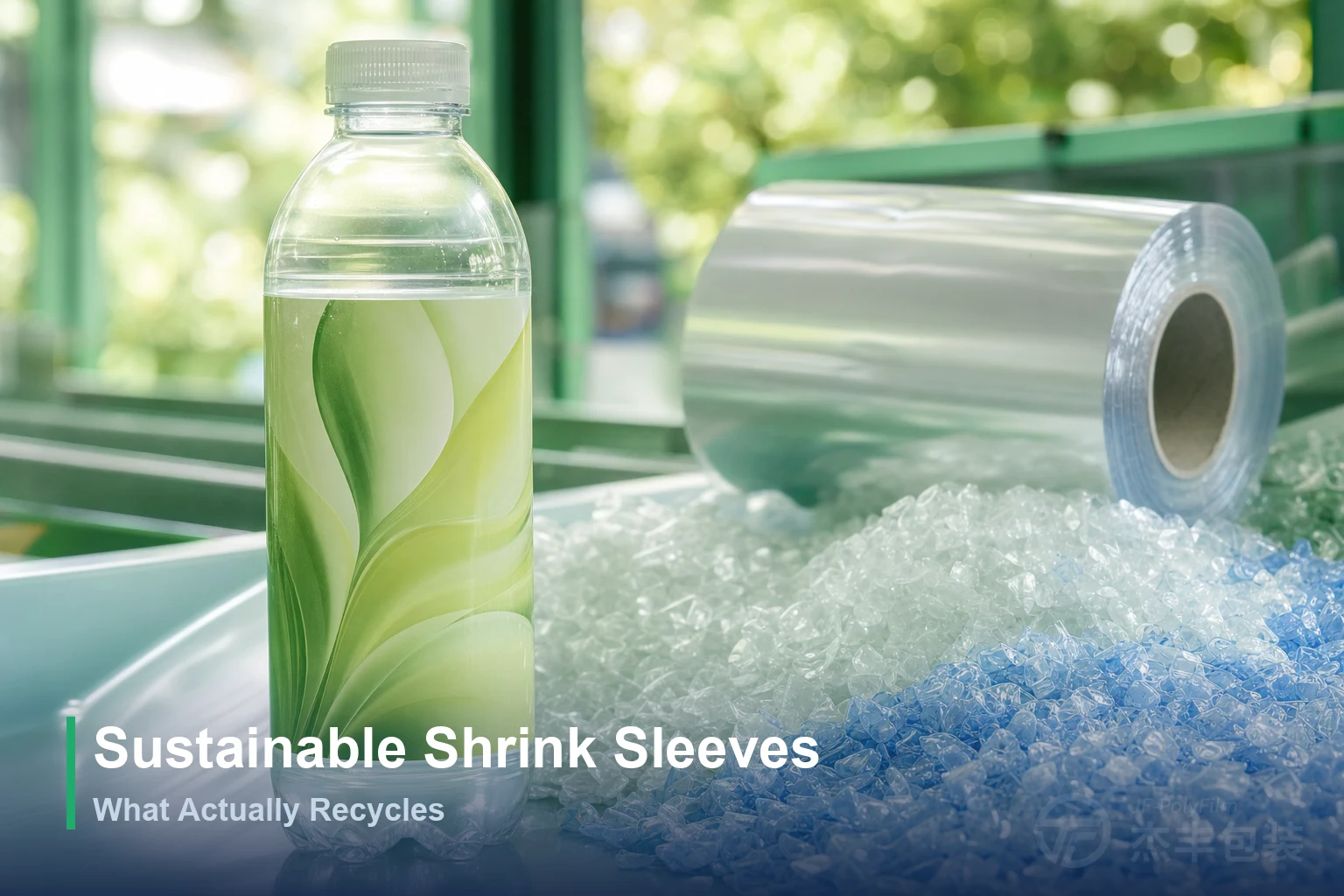
A sustainable shrink sleeve is one designed so it can be recovered or cleanly separated at end of life instead of contaminating the bottle it wraps — a property of how the film is engineered, not of the PETG name on the spec sheet.
Key takeaways
- A conventional full-body PETG sleeve is, by default, a challenge for PET bottle recycling rather than an automatic green choice — it sinks with the flake, softens into clumps under recycling heat, and its full coverage hampers optical sorting.
- Sustainability is a design decision spread across six levers, not a material label: same-stream CPET, recycled content in RPET, float-separable micro-voided white, wash-off release, PVC-free chemistry, and the regulations forcing the choice.
- Recyclability and recycled content are two independent levers; a sleeve can carry recycled content and still be hard to recover, or be fully recoverable and made from virgin resin.
Why a PETG sleeve is not sustainable by default
Being made of PETG does not, on its own, make a shrink sleeve sustainable — a conventional full-body PETG sleeve actively complicates the recycling of the PET bottle underneath it. Those separation mechanics are the territory of the recyclability pillar and are not re-derived here; what this guide carries forward is only the conclusion they force — a full-body PETG sleeve begins as a recycling problem, not a green credential earned by its resin name.
The six levers that decide a sleeve’s sustainability
| Lever | What it solves | Read the mechanics in |
|---|---|---|
| Same-stream CPET (RIC 1) | Lets label and bottle recycle together in one PET stream, with no extra sorting | CPET in the RIC 1 stream |
| Recycled content (RPET/PCR) | Puts post-consumer PET back into the film and cuts virgin demand | RPET shrink film explained |
| Float separation (micro-voided white) | Density below water lets an opaque sleeve float off and separate from the sinking flake | PETG shrink film density |
| Wash-off design | Sleeve and adhesive release in the recycler’s caustic wash, keeping the flake clean | Bidirectional wash-off film |
| PVC-free chemistry | Removes the chlorine contamination a PVC sleeve brings to recovered PET | PETG vs PVC shrink film |
| Regulation-driven | Turns recyclable design and recycled content into market-access and cost conditions | PPWR and plastic packaging tax |
The EU’s packaging rules and a spread of national plastic taxes are converting recyclable design and recycled content from voluntary virtues into hard conditions — the timeline in what PPWR means for shrink sleeves and the recycled-content thresholds in plastic packaging tax and shrink film.
Recyclability and recycled content are not the same lever
The most common mistake in a sustainability spec is treating recyclability and recycled content as one property — they are two independent levers, and answering one says nothing about the other. A sleeve can carry a high recycled share and still be almost impossible to recover cleanly, and a sleeve that recovers perfectly can be made entirely from virgin resin.
From slogan to a specification you can defend
Of the six levers, only two are the film’s to hold outright — material compatibility, through a same-stream CPET grade, and recycled content, through a documented RPET grade; a float-separable white construction is a third the film can offer where an opaque pack allows it.
Frequently Asked Questions
Are PETG shrink sleeves environmentally friendly?
What actually makes a shrink sleeve sustainable?
Is recycled content the same thing as being recyclable?
Related Articles
How Is PETG Shrink Film Made? Where Roll Quality Is Decided
How PETG shrink film is made, and which production stage sets each line buyers check on arrival: gauge tolerance, TD/MD shrink, haze, tensile strength, roll labels.
Shrink Film Roll Length Calculation: The 3-Inch Core Trap
Formulas linking roll diameter, length and weight, worked metric and imperial examples, a 30–60 μm diameter table, and why core size and trapped air shift the result.
Need Expert Advice on Shrink Film?
Our technical team can help you choose the right film for your application.
Contact Us