
Shrink Sleeve vs Stretch Sleeve: Which to Use
Shrink sleeves and stretch sleeves suit different bottles. Compare them on heat, fit to contours, film clarity, line speed, and how each behaves in PET recycling.
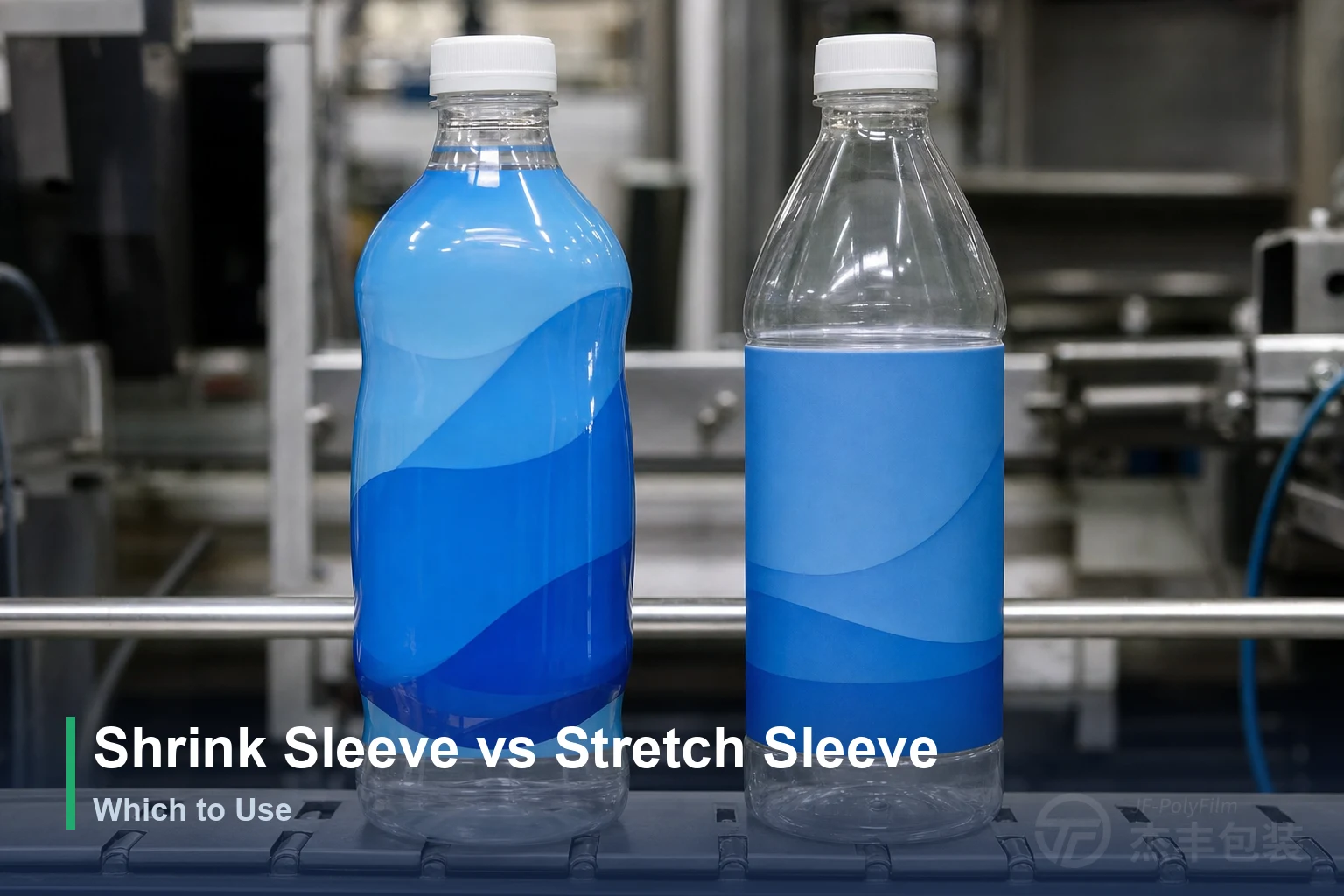
A shrink sleeve is a printed PETG film tube slipped over a container and drawn tight by heat; a stretch sleeve is an elastic polyethylene tube pulled wider than the body, dropped over it, and released so it springs back and grips with no heat and no glue. That split between heat-shrunk and cold-stretched drives every trade-off that follows.
Key takeaways
- A stretch sleeve applies cold — the polyethylene tube is stretched, slid over the body, and released to snap back mechanically, so there is no tunnel, no glue, and nothing to heat, which suits heat-sensitive fills and fast lines.
- A shrink sleeve draws down onto the tapers, waists, ovals, and shoulders an elastic sleeve bridges over instead of gripping; transverse shrink runs to 80 percent across its grades while lengthwise shrink stays at or below 3 percent, so the label tightens without stretching out of shape.
- A PETG shrink sleeve carries higher clarity and a brighter gloss for a premium, near no-label look; a stretch sleeve’s polyethylene film is thicker and tougher but hazier and flatter in print.
- In PET recycling the two split by density: a glue-free polyethylene sleeve is lighter than water and floats clear of the sinking PET flake, while a PETG sleeve near 1.28 to 1.33 grams per cubic centimeter sinks with the bottle and stays in the stream cleanly only as a crystallizable PET grade.
The two methods at a glance
The two differ on how they attach, the heat they need, the shapes they fit, the look they carry, and how they behave in recycling, and a bottle that wins on one of those rarely wins on all of them. The table sets them side by side before the detail that follows. Pressure-sensitive, in-mold, and BOPP wrap-around labels are their own routes with their own economics, and this comparison sets them aside to keep to the two sleeve methods.
| Axis | Shrink sleeve (PETG) | Stretch sleeve (PE) |
|---|---|---|
| How it attaches | Heat tunnel contracts the film to fit | Elastic film snaps back cold |
| Heat and glue | Heat tunnel, no glue | No heat, no glue |
| Best bottle shape | Tapered, waisted, oval, shoulder | Straight cylinder, shallow taper |
| Coverage | Full 360°, body and shoulder | 360° around the body, not the shoulder |
| Film look | High clarity, high gloss | Tougher, hazier, flatter print |
| Line footprint | Applicator plus heat tunnel | Applicator only, no tunnel |
| Energy use | Tunnel draws heat | Cold, low energy |
| Tamper seal | Can seal over the cap | Body band only |
| Recycling on PET | Sinks; CPET recovers with bottle | Lighter than water, floats off and separates |
None of these axes is settled on its own. The sections below take them in the order a packing decision actually runs, starting with the one that removes the most options before anything else weighs in: whether the fill and the line can take heat at all.
The heatless difference: cold stretch versus a shrink tunnel
The clearest divide is heat — a stretch sleeve goes on entirely cold, while a shrink sleeve has to pass through a heat tunnel to take its shape. On a stretch line, an applicator opens the elastic tube, stretches it wider than the container, slides it over the body, and lets go; the polyethylene’s own recovery pulls it snug, with no tunnel behind the applicator, no adhesive, and nothing to cure. That absence of heat is the method’s whole argument. Nothing thermal reaches the product, so a chilled, live, or otherwise heat-sensitive fill stays untouched by the labeling step; the line draws less energy with no tunnel to hold at temperature; and the equipment is shorter and simpler, since there is no tunnel to buy, run, and keep synchronized with the applicator. A shrink sleeve reverses that. Once the tube is over the container, a tunnel — steam, hot air, or infrared — lifts the film to roughly 95 to 100 degrees Celsius so it contracts down to the wall, and films like ours settle cleanly across that window. That heat step is what buys the shape range and over-the-shoulder coverage a cold sleeve cannot reach, but it also adds the tunnel’s energy draw, its floor space, and a burst of heat the pack has to tolerate. A line built for speed and thermal gentleness leans to stretch; one built for shape and finish accepts the tunnel.
Fit: elastic snap-back versus heat draw-down
Shape is where the two physically part ways: a stretch sleeve grips only by elastic recovery, so it holds what a stretched band can spring back against, while a shrink sleeve contracts under heat onto nearly any contour. A polyethylene stretch sleeve works off its own tension — on a straight cylinder or a shallow taper the stretched tube snaps back evenly and stays put. But a deep waist, a pinched grip, a sharp shoulder, or an oval cross-section defeats it: the elastic tension pulls toward the smallest circumference and bridges over the recesses instead of dropping into them, so the sleeve stands off the wall wherever the body narrows or curves in. A shrink sleeve solves those same shapes from the opposite side — applied loose, heat drives it down until it follows the profile, over the shoulder and into the waist. What lets it do that is transverse shrink — the film contracts around its circumference far more than along its height, so it tightens against the wall without the print sliding down the bottle. Our clear PETG is built for that pull in three grades — 65, 75, and 80 percent transverse — chosen against how hard the bottle turns, while the lengthwise shrink is held at or below 3 percent to keep the artwork in proportion top to base. There is a hold difference beneath the shape one, too. A stretch sleeve stays on by friction and standing tension against a smooth wall, so on a slick cylinder it can be rotated or slid along the axis if it is pushed, whereas a shrunk film settles into whatever relief the bottle carries and locks to it mechanically once cool. That extra hold is why a contoured or shouldered bottle ends up on a shrink sleeve almost by default, and why a plain cylinder is the one shape that leaves the decision genuinely open. Which grade a given container needs is the subject of the grade selection guide.
Material and look: elastic polyethylene versus clear PETG
The films are built for opposite jobs — a stretch sleeve is a thick, elastic polyethylene that has to stretch and recover, while a shrink sleeve is a clear PETG that has to contract and hold a sharp graphic. Polyethylene has to open far past its resting width and spring back without tearing, so it runs heavier in gauge, tougher, and more forgiving of knocks and drops — useful qualities on a returnable or roughly handled bottle. That elasticity comes at a cost to optics: the film carries more haze and a softer gloss, so print reads flatter and a genuinely clear, near-invisible wall is out of reach. PETG is engineered to shrink rather than stretch, and it carries high clarity and a bright gloss, so a reverse-printed graphic stays crisp and a clear film can hug the wall for a near no-label look where the design appears to float on the container. The two also print through different prepress. A shrink graphic has to be distorted ahead of printing so it reads true only after the film contracts, which means the artwork is drawn to the shrink map of a specific bottle; a stretch graphic prints closer to what the eye sees but has to account for the film opening under tension, so fine detail and tight registration are harder to hold once the sleeve springs onto a wider body. Where a pack sells on shelf gloss, deep transparency, or a high-end finish — spirits, premium beverages, personal care — the PETG sleeve carries the look. Where the pack values a rugged, knock-tolerant band on a returnable bottle, the polyethylene’s toughness earns its place. The make-up of the sleeve itself — film, seam, and print order — is walked through in the shrink sleeve primer.
Coverage and the line: a full wrap versus a body band
Both are pre-seamed tubes that wrap the body a full 360 degrees, so the coverage question is not whether the graphic goes all the way around — both do — but how far up the container it can follow. A stretch sleeve holds by elastic tension against the straight wall, so its wrap stops where the body starts to curve in: it rides evenly around the cylindrical section but cannot pull onto the shoulder or seal down over the cap. A shrink sleeve is drawn by heat onto whatever the bottle does above that straight wall, so one continuous graphic climbs over the shoulder and can carry on across the closure. Because both apply without adhesive, neither raises the wash-off glue question a wrapped label does — but from there the lines diverge. A stretch line is short: the applicator stretches the tube and releases it, and the pack is finished with no tunnel behind it, which is much of what makes the method fast and cheap to run on straight returnable and reusable bottles. A shrink line adds the tunnel stage and the synchronization it needs, and what that buys back is not just the shoulder coverage already described but a first-open seal: the same film can be run over the closure as a band that tears the moment the cap turns, a built-in tamper signal a stretched body band cannot provide; the tamper-evident band guide walks through how that band and its perforation are built. Where the brief is a plain body panel on a fast line, the stretch route is enough; where it is full-body decoration, a contoured shape, or a first-open seal, the shrink sleeve is the only one that reaches.
Recycling: floating off versus recovering with the bottle
Recycling is where a stretch sleeve holds its own genuine edge, and the reason is one a wrapped label cannot match: there is no glue anywhere in the equation. A stretch sleeve is polyethylene, a polyolefin lighter than water, and it stays on the bottle by elastic grip alone — no adhesive is ever applied. So in the sink-float bath reclaimers use to sort PET by density, the elastic tube rises while the heavier PET flake settles, and because nothing was ever glued down, the sleeve lifts away with no residue to strip and no bond to break. A wash-off wrapped label still lives or dies on whether its adhesive was specified correctly; a stretch sleeve takes that variable off the table entirely, which is a large part of why returnable and recycled-content PET bottles reach for it. A PETG shrink sleeve sits on the far side of that water line — heavier than water, it settles with the PET rather than rising off, so a density bath alone will not part it from the flake, and its recyclability turns instead on the film grade. Choose a crystallizable PET grade and the sleeve carries the same chemistry as the bottle and holds up through the caustic wash, so the two stay together in one RIC 1 PET stream and are reclaimed as a single material. So the fair reading is not that one sleeve is greener than the other — on a plain PET bottle the glue-free stretch sleeve does part more cleanly than any shrink film can — but that each reaches a clean stream from the opposite end: the stretch sleeve leaves, a matched CPET sleeve stays. How that same-stream recovery works is traced in the CPET same-stream explainer.
Routing the choice: line, then shape, then look, then recycling target
For this pairing the order matters, because the first question can settle the choice before the others get a say. Start with the fill and the line: a heat-sensitive or chilled product, or a high-speed line with no room and no energy budget for a tunnel, points straight at a cold stretch sleeve — its glue-free, heatless application is the whole reason to run it. If heat is not the blocker, read the bottle next: a straight cylinder or a gentle taper leaves both in play, but a deep waist, a sharp shoulder, an oval, or any sculpted profile is beyond what elastic recovery can grip, and only a shrink sleeve will follow it. Then the look: shelf gloss, deep transparency, a near no-label wall, or decoration that has to run up over the shoulder all belong to PETG, while a tough, knock-tolerant band on a returnable bottle sits happily in polyethylene. Last, weigh where the pack is recycled — if the aim is for the label to lift off and leave clean PET regrind, the glue-free PE stretch sleeve does it; if the aim is for the label to be recovered along with the bottle, a crystallizable PET shrink sleeve keeps both in the one RIC 1 stream. Pressure-sensitive, in-mold, and BOPP wrap-around labels each get their own head-to-head — shrink sleeve vs pressure-sensitive label, shrink sleeve vs in-mold label, and shrink sleeve vs BOPP wrap-around label. When the answer comes out a shrink sleeve, our clear PETG shrink film spans the CPET and high-shrink grades that a contoured bottle or a single-stream recycling goal calls for.
Frequently Asked Questions
What is the difference between a shrink sleeve and a stretch sleeve?
Do stretch sleeves need a heat tunnel?
Can a stretch sleeve fit a contoured or waisted bottle?
Which separates more easily in PET bottle recycling, a shrink sleeve or a stretch sleeve?
Which gives a glossier, more premium look?
Related Articles
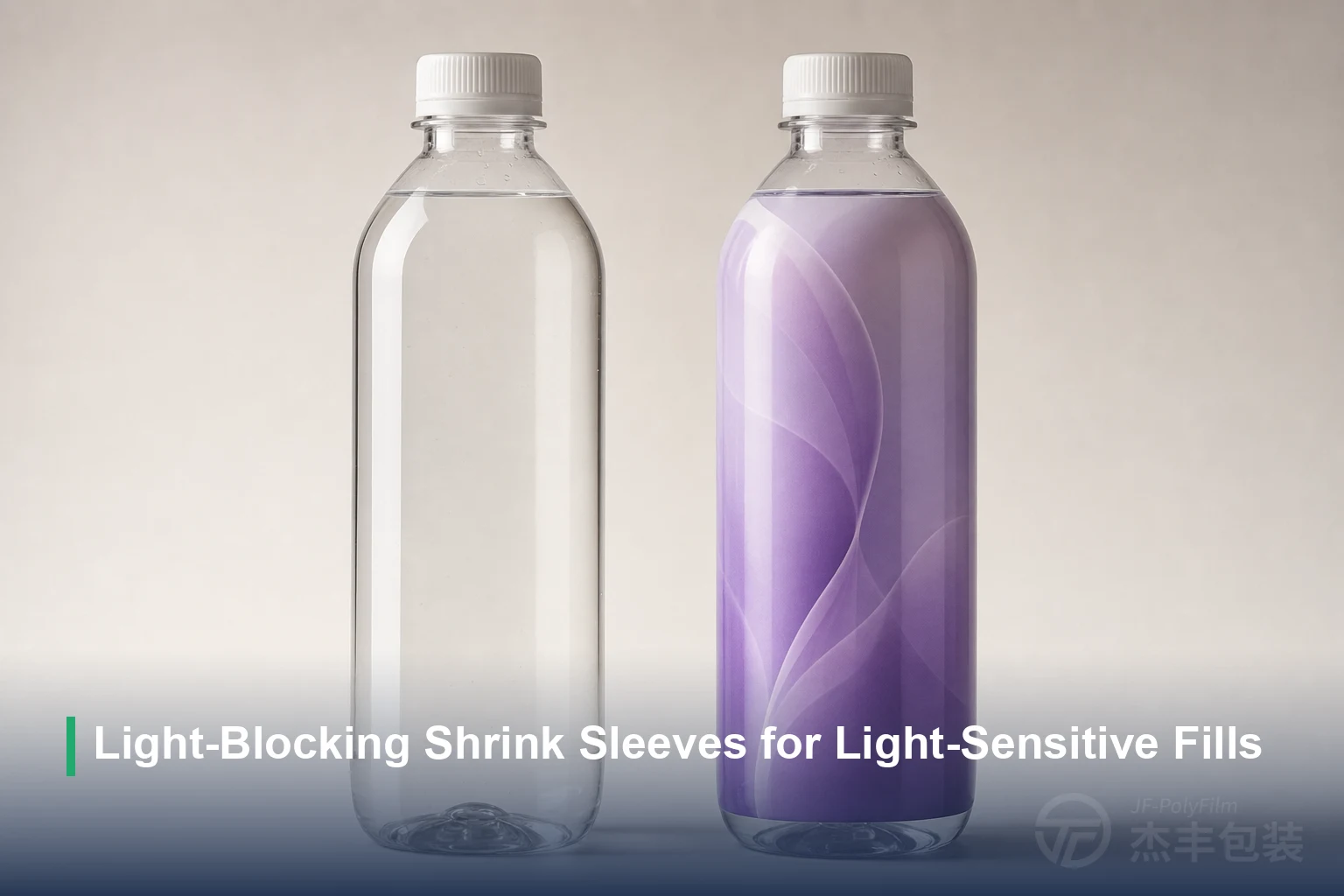
Light-Blocking Shrink Sleeves for Light-Sensitive Fills
Beer, dairy, supplements, and some medicines degrade under light. Which fills need protection, and how a full-body opaque PETG sleeve wraps the whole container to keep light off the contents.
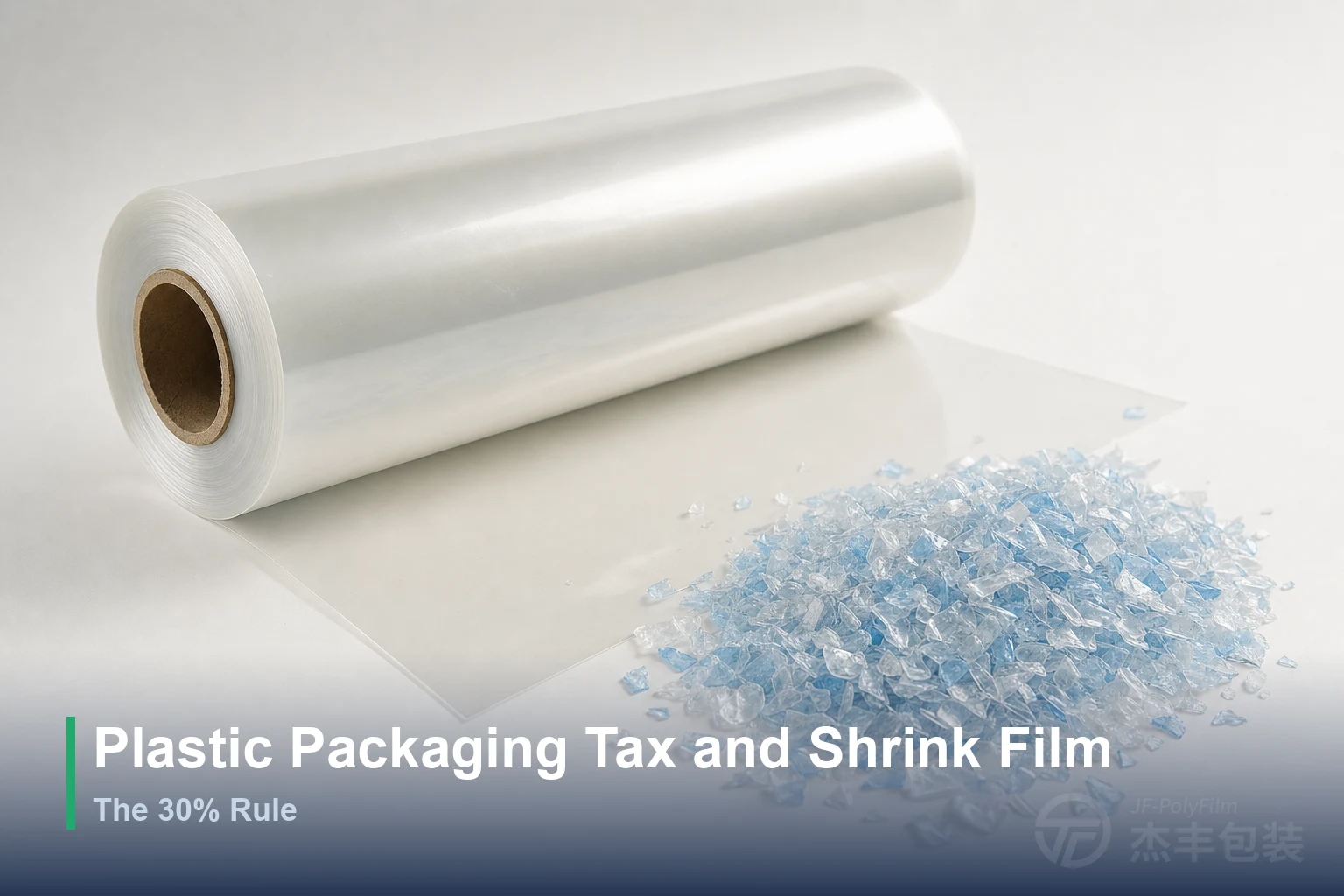
Plastic Packaging Tax and Shrink Film: The 30% Rule
How plastic packaging taxes in the UK, Spain, Italy and the EU treat shrink sleeves, why the 30% recycled-content threshold is the number worth remembering, and how RPET film helps a sleeve cross it.
Need Expert Advice on Shrink Film?
Our technical team can help you choose the right film for your application.
Contact Us