
Which Containers Cannot Use Shrink Sleeves — and Why
The container shapes, surfaces, sizes, and materials a shrink sleeve can't grip — handles, deep waists, flat panels, soft pouches, and heat-sensitive packs — and what to use instead.
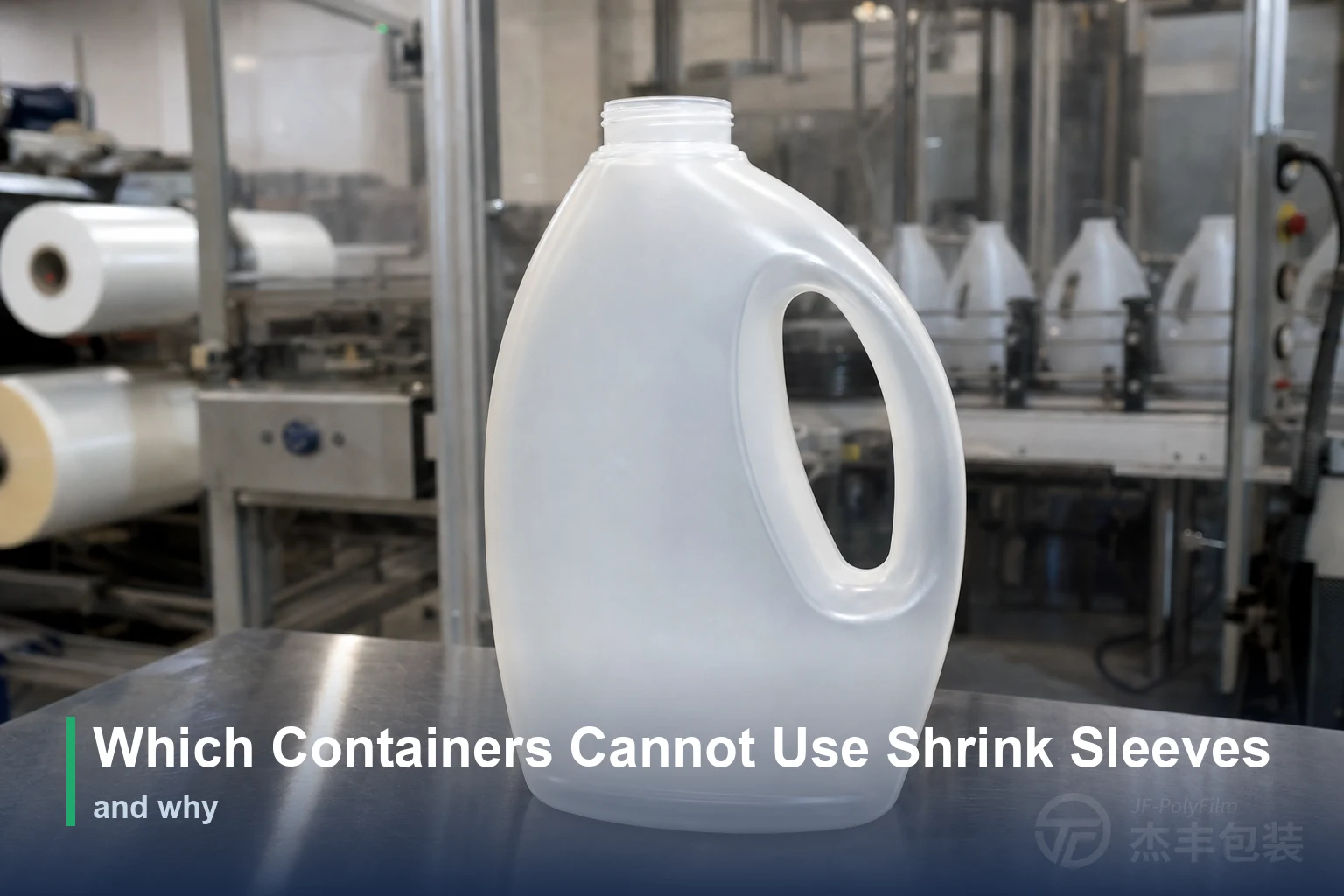
A container can’t use a shrink sleeve when its shape, surface, size, heat tolerance, or rigidity falls outside what the film can grip — because the label is a printed tube that only tightens around a continuous, rigid, roughly round body.
Key takeaways
- A sleeve’s shrink is finite: high-shrink PETG draws in at most about 75–80% across its width, so a container whose narrowest point falls below roughly one-fifth of its widest diameter is beyond what any sleeve can pull tight.
- Handles, spouts, and pronounced side protrusions break the continuous 360° surface the tube must encircle, so integrally handled jugs and jerry cans can’t take a standard full-body sleeve.
- Sharp corners, deep recesses, and very flat panels make the film bridge across high points instead of settling in — a property of heat contraction, not a mis-tuned line.
- Heat is the tunnel-side limit: the film reaches full draw around 95–100°C, hot enough to soften thin-walled low-melt containers or degrade heat-sensitive, already-filled products.
- Sleeve runs carry a minimum order quantity, so very small or short-run containers are often cheaper to label another way, while soft pouches give the film no rigid wall to grip at all.
The one rule that decides whether a container can take a sleeve
Every limit in this article traces back to a single fact: a shrink sleeve is a closed, printed tube that grips a container only where its surface is continuous, rigid, and roughly circular. In the tunnel the film contracts across its width and pulls inward against the wall, so it needs three things at once — an unbroken loop of surface to tighten onto, a contour it can physically close down to, and a wall firm enough to push back. Wherever a container breaks one of those conditions — the loop is interrupted, the shape is too extreme, the wall too soft, or the whole pack can’t take the heat — the tube has nothing to work against, and the result is a loose, wrinkled, bridged, or crushed label rather than a clean wrap. The mechanism behind the contraction is covered in how PETG shrink film works; what follows is the reverse question — the containers where it can’t.
Geometry that exceeds the film’s shrink ceiling
A sleeve is cut to slip over the widest part of a container and must then contract down to the narrowest, and when that gap is wider than the film can close, no specification will make it fit. High-shrink PETG draws in at most about 75–80% across its width — a typical ceiling near 78% — which means the narrowest point it can still hug is only around one-fifth of the widest diameter. A bottle with an extremely fine neck under a broad belly, or an unusually deep waist cut into the body, pushes past that: the film reaches its maximum contraction before it touches the wall, and the sleeve stays loose or gathers into slack folds. This is the far edge of shaped-bottle work, where sleeves normally excel — even a high-shrink PETG that draws 75% or more across its width still has a ceiling this geometry can cross. Turning a specific profile into the exact shrink figure it needs is a calculation in its own right, walked through in how to choose a PETG shrink rate; the point here is only that past a certain contour, the container is simply out of reach.
Handles, spouts, and side protrusions break the grip
A container with an integral handle, a molded pour spout, or a pronounced side protrusion breaks the continuous loop the tube depends on, so a standard full-body sleeve can’t close around it. The film can only encircle a surface it can wrap without interruption; where a handle leaves a gap between the grip and the body, the sleeve either seals that opening shut — making the handle unusable — or spans the cavity with nothing behind it to press against. Handled detergent and lubricant jugs, jerry cans, and kettles all fall here, and so does any body with a spout or a lug standing proud of the wall. Specialty sleeves with die-cut openings exist for a handful of these shapes, but they are engineered, container-specific exceptions with their own tooling — not something a stock full-body sleeve can be made to do. The honest way to read this is that the handle is a fixed geometric fact of the container, not a shortcoming in the film, so the design question is which label format the handle allows rather than how to force a sleeve past it.
Flat panels, sharp corners, and deep recesses
Heat-shrink film pulls along the shortest path between two raised points, so rather than settling into a sharp corner, a deep recess, or a very flat panel, it bridges — or “tents” — across the gap. On a square, rectangular, or strongly oval body the film spans corner to corner and leaves the flat face loose while drawing tight only at the edges; over a deep depression it stretches across the opening instead of sinking to the bottom; and the sharper the corner or deeper the recess, the more pronounced the bridge. This is inherent to how the film contracts, not a sign the line is mis-tuned — running cooler or slower softens the effect but never removes it, and forcing more shrink only concentrates the distortion at the high points. When the graphic itself skews on a complex contour, that is a separate prepress matter, solved by pre-distorting the artwork rather than by changing the container.
Very small and very large containers
At both size extremes a sleeve becomes either mechanically awkward or simply uneconomical, which is why very small vials and very large drums often move to a different label format. Tiny containers are hard to load, position, and carry through a tunnel, the usable sleeve height shrinks to an impractical band, and the minimum order quantity a sleeve run carries makes short runs cheaper to label with a pressure-sensitive sticker or direct print. Very large containers swing the other way: they burn far more film per unit, demand longer and more even heating, and make tunnel temperature harder to hold uniform across the whole surface. On the smallest packs there is a second problem beyond handling: the label band grows so short that there is little room left for the artwork the sleeve was meant to carry, so the format loses its main advantage. Neither end is an absolute ban — plenty of small and large packs do run sleeves — but they are boundaries where the format stops being the obvious choice, and where exactly the line sits depends on the applicator and tunnel rather than on any fixed dimension.
Containers and contents that can’t survive the tunnel
The tunnel heats the film to its shrink temperature — roughly 95–100°C for PETG — so any container or product that can’t take that heat is unsuitable even when its shape is a perfect fit. Two things get caught. Thin-walled, low-melt container bodies, such as some thin-gauge polypropylene or foamed and very light plastics, soften and lose their roundness before the film has fully seated. And heat-sensitive contents in an already-filled pack can be degraded on the same pass. The film’s working temperature is not the tunnel’s setting: a hot-air tunnel runs its air far hotter than the film ever gets, and the shrinking happens when the film itself reaches about 95–100°C, not when the container is baked. Gentler steam tunnels, working around 80–95°C, and lower-temperature OPS film relieve some heat-sensitive cases, though at the cost of the shrink power PETG brings to deep contours. The practical test is to run the trial on the container in the state it will ship — an empty bottle may pass the tunnel cleanly, then distort once a warm or pressurized fill changes how the wall behaves under the same heat.
Soft, collapsible, and flexible packaging
A shrink sleeve needs a rigid or semi-rigid wall to press against, so stand-up pouches and very soft, collapsible, or crushable packs give the film nothing to grip. As the sleeve contracts it pushes inward with real force; a bottle, can, or jar holds its shape and lets the film seat cleanly against the wall, but a limp pouch buckles, crushes, or deforms under the same load. The format was built for rigid and semi-rigid containers, and flexible packaging is decorated another way — printed into the laminate itself, or carried on a pressure-sensitive label. There is a middle ground worth naming: a squeezable bottle with enough spring-back to hold its form can take a softer sleeve film, whereas a fully limp pouch cannot, so “squeezable” and “unsupported” are not the same test, and only the second one rules a sleeve out.
The unsuitable-container table: what to use instead
The pattern across all six cases is the same — the sleeve fails wherever the container breaks one of its physical requirements — and each failure points to a cleaner alternative. The table maps the container or situation to the reason a sleeve struggles and the route that usually serves it better.
| Container or situation | Why a shrink sleeve fails | Better route |
|---|---|---|
| Neck or waist narrower than ~1/5 of the widest diameter | Contour gap exceeds the film’s ~75–80% shrink ceiling | Re-profile the bottle, or a partial / neck sleeve instead of full-body |
| Integral handle, spout, or strong side protrusion | Breaks the continuous 360° surface the tube must encircle | Pressure-sensitive label, or a specialty cut-out sleeve |
| Sharp-cornered, very flat, or deep-recessed bodies | Film bridges or “tents” across the high points instead of settling in | Pressure-sensitive panel label, or direct print |
| Very small or very short-run containers | Awkward to run and below a sleeve run’s minimum order quantity | Pressure-sensitive sticker or direct print |
| Thin-wall low-melt containers, or heat-sensitive fills | Tunnel heat (~95–100°C) softens the pack or harms the contents | Lower-temperature steam tunnel or OPS film; otherwise a non-heat label |
| Stand-up pouches, or very soft collapsible packs | No rigid wall for the film to grip — it crushes the pack | Pre-printed flexible packaging, or a pressure-sensitive label |
Checking a container before you commit
Whether a container will take a sleeve is testable at the design stage, long before a production run, and three checks catch almost every mismatch. The first is geometry: measure the widest diameter, the narrowest point the sleeve must reach, and the label height, and if the narrowest point drops below roughly one-fifth of the widest, the shape is past what a full-body sleeve can close — the method for turning those measurements into a required shrink figure sits in choosing a shrink rate. The second is a prototype on the real container: run a sample sleeve over the actual pack at tunnel temperature and look for bridging, loose zones, and skewed print. The third is heat tolerance: confirm that the wall, and any pre-filled contents, can pass the tunnel window without distorting. When a borderline container throws wrinkles, curl, or registration drift on the line, that is a process-tuning question, worked through in solving PETG shrink film problems — and sometimes the honest finding is simply that a sleeve is the wrong format for that pack.
The honest read: put the sleeve where it belongs
As a film maker, we would rather see a sleeve go onto a container that suits it than watch a marginal shape fight its way through a run, because routing an unsuitable pack to the right label format protects the brand far more than forcing a sleeve where the physics resist it. Where a container is a genuine fit — a continuous, rigid, round-enough body inside the shrink and heat window — a high-shrink clear PETG film delivers the tight, seamless 360° wrap the format was built to give.
Frequently Asked Questions
Can a shrink sleeve fit any container shape?
Why can't a shrink sleeve go on a jug with a handle?
Can you sleeve a stand-up pouch or a squeezable bottle?
Will the shrink tunnel damage a thin-walled or heat-sensitive container?
How do I know if my container suits a sleeve before ordering?
Related Articles
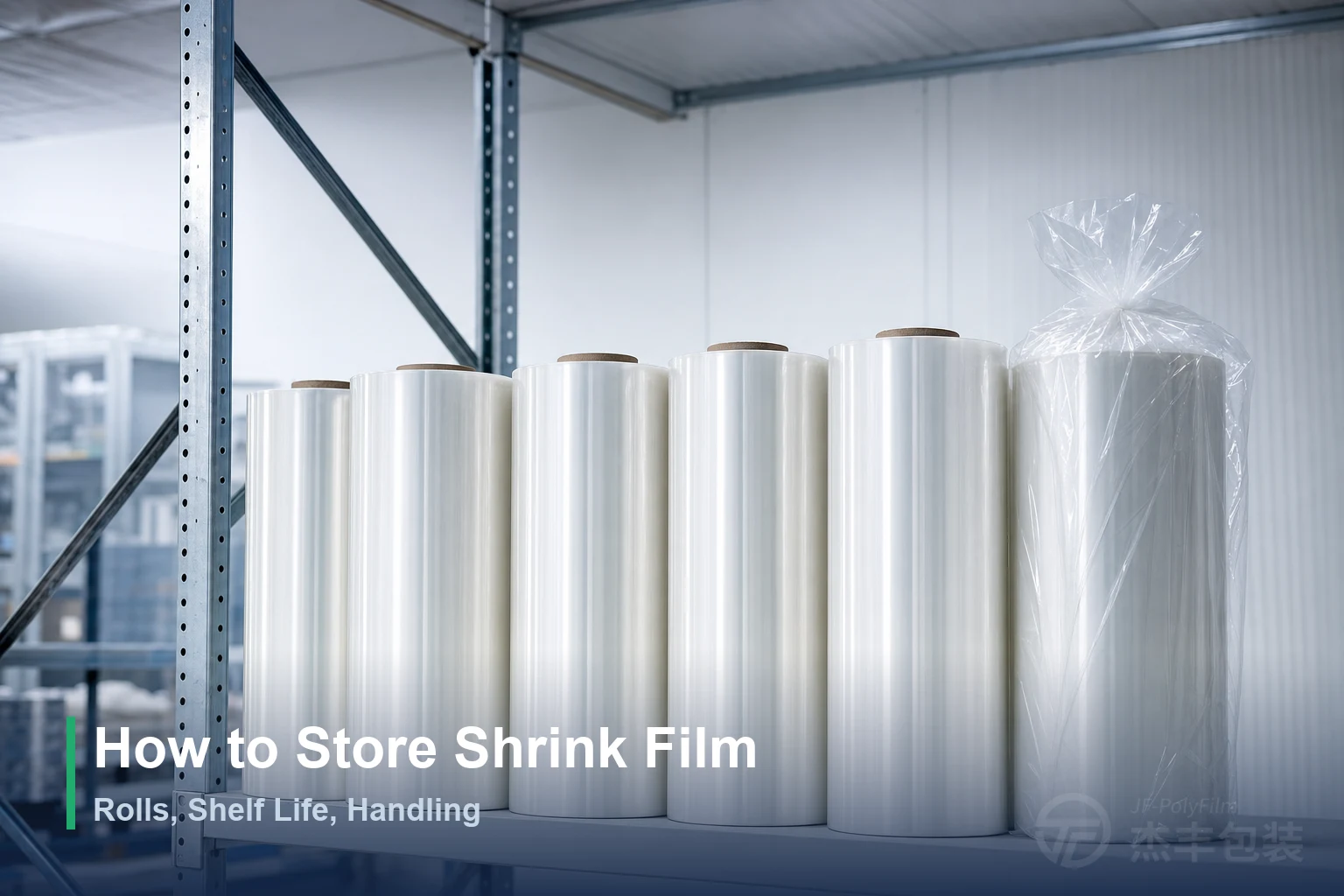
How to Store Shrink Film: Rolls, Shelf Life, Handling
What the 10–30°C, 12-month storage window actually protects, how to stand rolls so they don't flat-spot, and why film has to acclimate before it reaches the line.
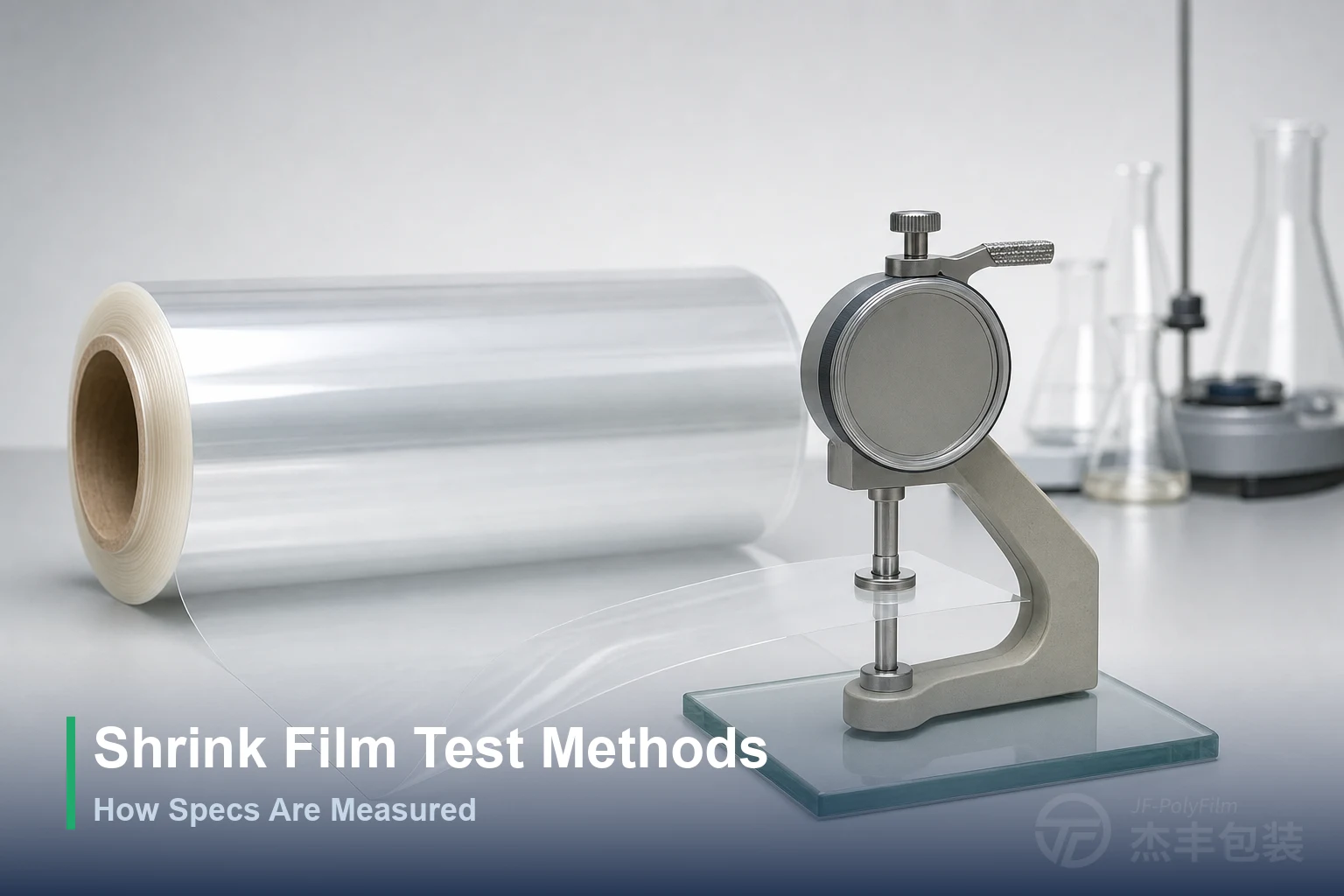
Shrink Film Test Methods: How Specs Are Measured
Every figure on a shrink film datasheet or COA traces back to a standard method. See which ASTM and ISO tests measure shrinkage, tensile, haze, and gauge, and how to read the report.
Need Expert Advice on Shrink Film?
Our technical team can help you choose the right film for your application.
Contact Us