
PETG vs PE Shrink Film: Sleeve vs Bundle
How PETG sleeve film and PE bundling film differ by packaging layer, polymer family, gauge, surface energy, clarity and recycling stream — and which job each is built for.
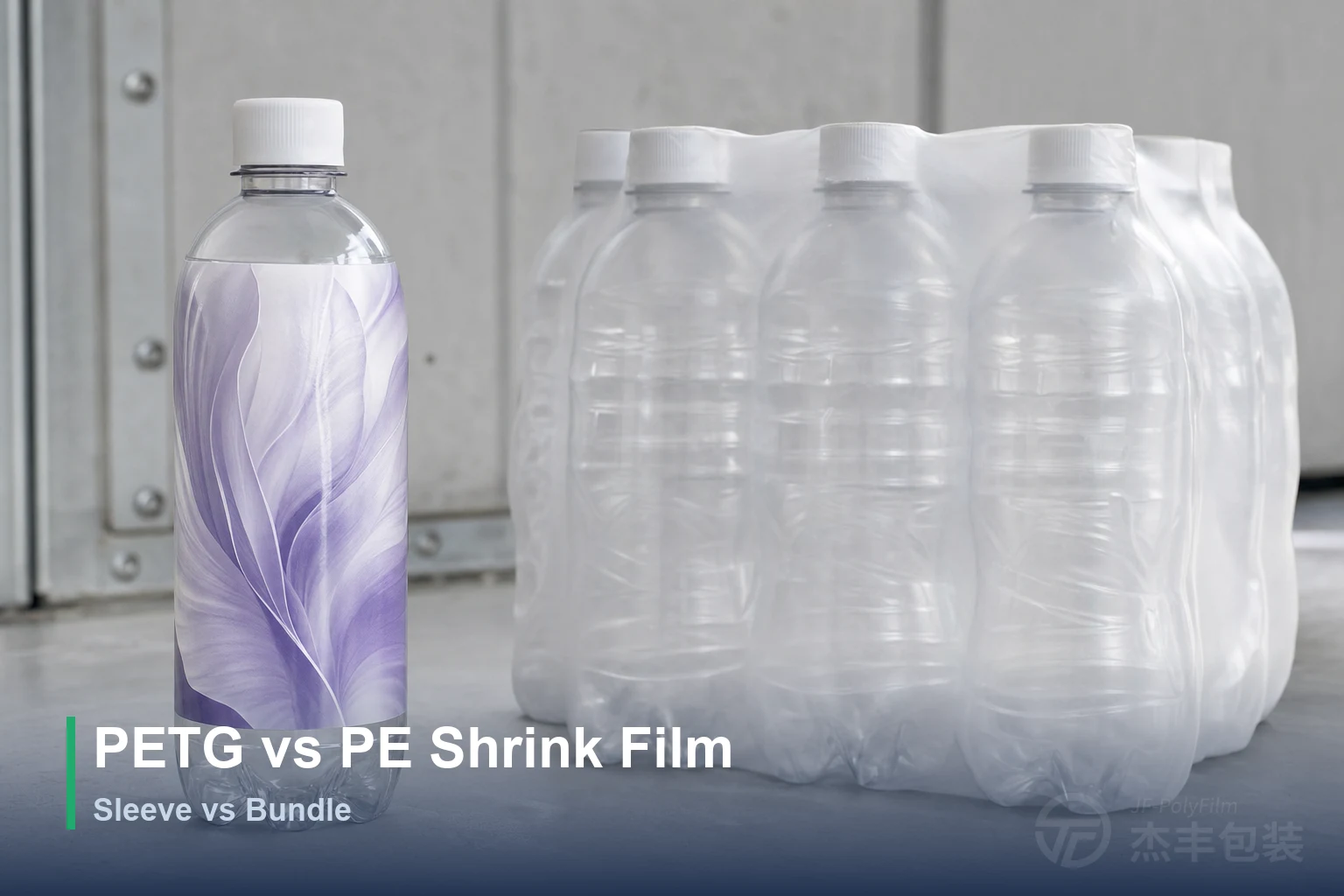
“Shrink film” is a single phrase covering two jobs that share almost nothing. PETG shrink film is a printed polyester sleeve that wraps one container 360° — the glass-clear, decorated label a shopper sees on the shelf. PE (polyethylene) shrink film is a transit material that bundles several units into a multipack or shrouds a full case or pallet for shipping. One film decorates a single unit; the other holds many together for the trip through distribution. They occupy different layers of the same package, so they rarely compete for one specification — and a “PETG vs PE” question is nearly always really a question of which packaging layer is being bought.
- PETG decorates one container; PE bundles many — a primary display layer against a secondary transit layer, not two grades fighting over one spec.
- PE is a polyolefin (polyethylene), not a member of the PET polyester family; it carries resin identification code 4 (LDPE) or 2 (HDPE), a stream of its own, while PETG belongs with PET at RIC 1.
- PE runs thick and tough to carry load — commonly 20-150 μm, heaviest on pallet shrouds — where a PETG sleeve is a thin 30-60 μm display skin.
- PE has a low, non-polar surface energy (~30-34 dynes/cm untreated) and needs corona or flame treatment before it holds print; high-surface-energy PETG takes ink directly.
- PE is translucent and hazy by design; PETG is glass-clear with the gloss a shelf-facing label needs.
- On cost, PE is the economical answer for bundling and PETG the premium one for display — different jobs carrying different value.
Primary decoration versus secondary packaging
The cleanest way to read a “PETG vs PE” search is through the packaging hierarchy rather than a spec sheet. A finished consumer product carries layers: the primary layer touches and decorates the individual unit, the secondary layer groups units for handling and retail, and the transport layer moves them in bulk. A PETG sleeve is a primary-decoration film — it is the branded surface on one bottle, jar, or can. A PE shrink film is a secondary and transport film — it collates several units into a saleable multipack, or shrouds a case or pallet so the load arrives intact. The two are not rival grades of one product; they are answers to two different questions asked at two different points in the same package’s build.
That distinction is worth more to a buyer than any single property, because naming the layer settles the material before the conversation about microns or shrink even begins. A beverage producer searching “shrink film” might mean the printed label that wraps each bottle, or the film that binds six bottles into a pack — two entirely separate purchase orders, often to two different suppliers. PETG is specified when the film is the label; PE is specified when the film holds the labeled units together. Get that fork right and most of the apparent overlap between the two disappears, which is why the sections below route by the job each film is built for rather than crowning a winner.
Polyethylene is not a polyester
PE and PETG are not variants of one chemistry — they belong to different polymer families, and that is the root of every difference that follows. PE is a polyolefin, built from polyethylene, usually as an LDPE or LDPE/LLDPE blend and often as a multilayer coextrusion; the heaviest pallet shrouds may be crosslinked to add strength. PETG is a glycol-modified copolyester, the same PET family as a beverage bottle. Calling both “shrink film” hides the fact that one is a polyolefin and the other a polyester, with no chemical relationship between them.
The consequence surfaces most sharply at end of life. Polyethylene carries resin identification code 4 (LDPE) or 2 (HDPE) and belongs to a polyolefin recycling stream entirely its own, separate from the RIC 1 PET stream a PETG sleeve rides with. Density enforces the split physically: PE sits near 0.91-0.94 g/cm³, well below water, and floats, while PET-family film runs about 1.28-1.33 g/cm³ and sinks, so a PE bundle and the PET bottles it grouped part company rather than recover together. That is the whole point to carry here (the two films report to different streams), and the float-sink sortation mechanics behind it, along with the CPET construction that keeps a sleeve inside the bottle stream, are set out in the PET shrink sleeve recyclability and CPET and the RIC 1 stream guides rather than repeated here. The two films even contract by different physics and in different temperature windows, but the shrink mechanism is its own subject, covered in how PETG shrink film works.
PETG vs PE side by side
Everything below is compared at the material level, and any cost note points only to a direction, because an actual quote turns on region, gauge, and order size. The PETG numbers are the tested envelope of the sleeve grades made here; the PE numbers are general industry ranges for heat-shrink bundling film, cross-checked against independent sources.
| Dimension | PETG shrink film | PE shrink film |
|---|---|---|
| Polymer family | Glycol-modified PET copolyester (polyester) | Polyethylene (polyolefin, LDPE/LLDPE) |
| Packaging layer | Primary — decorates one container | Secondary / transit — bundles units, shrouds cases and pallets |
| Typical job | Printed 360° sleeve label | Multipack collation, case and pallet shrouding |
| Gauge | 30-60 μm | 20-150 μm (heaviest on pallet shrouds) |
| Surface energy / print | High energy, prints directly, no corona | Low, non-polar (~30-34 dynes/cm), needs corona or flame |
| Clarity / gloss | Glass-clear, high gloss | Translucent, hazy |
| Toughness / puncture | Conforms and decorates; not a load film | Tough, puncture- and tear-resistant |
| Shrink (transverse) | High, commonly ≥75% | Significant and directional; varies by grade |
| Density | ~1.28-1.33 g/cm³ (sinks) | ~0.91-0.94 g/cm³ (floats) |
| Recycling stream | PET family, RIC 1 (CPET grade recovers with the bottle) | RIC 4 (LDPE) / 2 (HDPE), separate stream |
| Cost positioning | Premium display | Economical bundling |
Everything supplied here sits in the PETG column: clear PETG at TD ≥75% with MD ≤3.0%, plus a crystallizable CPET grade for packages that must recover in the bottle stream.
Gauge and toughness: a decoration skin against a load film
Thickness follows the job, and the two jobs pull in opposite directions. PE bundling and pallet film spans roughly 20-150 μm: light consumer multipacks run at the thin end, around 25-50 μm, heavier beverage and can multipacks sit near 50-100 μm, and pallet shrouds reach up toward 150 μm where the film has to hold a full load steady. A PETG sleeve, by contrast, runs a thin 30-60 μm — it only has to cover and decorate one container, not carry any weight. The ranges do overlap at the light end, where a thin multipack PE and a heavier sleeve meet, so the honest statement is not “PE is always thicker” but that PE is built up as the load grows while a sleeve stays a display skin.
What PE gains in that build is toughness, and for its layer that toughness is the whole point rather than a drawback. Puncture and tear resistance let a bundling film wrap irregular or sharp-edged industrial goods, survive rough handling through distribution, and keep a pallet unitized without splitting. A PETG sleeve is engineered for the reverse virtue, conforming tightly to a contoured bottle and reproducing print faithfully, and would be the wrong, over-decorated choice for shrouding a case. Strength here is not an absolute either film wins; each is built against the failure that matters on its own layer, and PE’s ruggedness is exactly what a transit film should have.
Printing: a low-energy surface against a print-ready one
The clearest reason the decorated layer is PETG rather than PE comes down to surface chemistry. Polyethylene is non-polar, and its untreated surface energy sits low, around 30-34 dynes/cm, so inks, coatings, and adhesives bead up instead of wetting out and anchoring. To print PE at all, a converter first raises its surface energy with a corona or flame treatment, lifting it toward the 38-42 dynes/cm range that ink will hold to, and even then the treatment decays over time and has to be managed. That is acceptable on a bundling film, because a transit wrap at most carries a simple flexo brand mark or ships unprinted — high-resolution presentation is not its job.
PETG behaves the other way. As a polar polyester it has high inherent surface energy, so the grades supplied here accept gravure, flexographic, and UV-inkjet ink directly, with no corona pre-treatment step and one fewer variable on the press. When a package needs fine, full-color, edge-to-edge graphics on a curved container, that print-readiness is decisive — it is why the sleeve layer settled on polyester in the first place, and why no amount of surface treatment turns a polyolefin bundling film into a shelf-quality label stock. The print divide, in short, is a polarity divide.
Clarity: shelf presentation against transit shrouding
Optically the two films are built for opposite audiences. PE is a semicrystalline polyolefin, so it scatters light and reads as translucent and hazy rather than display-clear. That is no failing for a bundling film — a multipack wrap or a pallet shroud exists to enclose and protect a load for transport, not to present a crisp brand face, and a slightly cloudy film does that job perfectly well. Where a bundle needs its contents visible, the film only has to be see-through enough to identify the pack, not to carry premium graphics.
PETG is engineered for the shelf. It finishes glass-clear with a high-gloss surface that keeps printed artwork sharp and makes a transparent “no-label” look workable when a design calls for one. On the primary-decoration layer, where the film is part of the brand impression, that optical quality is load-bearing and worth paying for. On PE’s transit layer it would be wasted. The clarity gap, like the gauge and print gaps, simply reflects that one film faces a consumer and the other faces a warehouse.
Cost, POF’s middle ground, and the honest answer
On cost the positioning is stable even though specific prices are not: PE is the economical film for bundling, covering the most area at the lowest material cost across a large transit program, while PETG is the premium film for display. That is a cross-material comparison of two different jobs, not a like-for-like price fight — the two never appear on the same quotation because they are never bought for the same layer. Between them sits a genuine middle ground: light retail overwrap and small multipacks, where a clearer, thinner polyolefin than heavy bundling PE fits better. That transition band is POF territory, weighed against PETG in the PETG vs POF shrink film comparison rather than developed here, so that PE stays cleanly on the heavy-transit end of the scale.
The routing that results is unusually clean for a “versus” question. Collating units into a multipack, shrouding a case or pallet, resisting puncture through rough distribution, or covering the most area at the lowest cost per unit — these are PE, and PE is the mature, correct, economical choice for them. Decorating a single container with a 360° printed label, glass-clear optics and high gloss, tight conformance to a shaped bottle, high shrink, or recycling that stays inside the PET family — these are a PETG sleeve. The companion comparisons take PETG through the other decoration-layer films one at a time: PVC, PLA, OPS, and bottle-resin PET, each judged on the sleeve layer where it genuinely competes.
Our factory sits entirely on one side of this comparison: the polyester sleeve layer. What comes off the lines is PETG, CPET, and RPET, and we do not make PE at all. When a job is bundling, case shrouding, or pallet unitizing, polyethylene is the correct and long-established material, so the sound move is to buy it as PE rather than press a polyester into a transit role it was never built for. When the job is the decorated single-container sleeve, that is what these lines exist to produce. The clear PETG shrink film here reaches at least 75% shrink transversely, holds the machine direction to 3.0% or under, and is drawn between 30 and 60 μm; order widths extend to 2000 mm, the MOQ opens at 1-3 tonnes, and GRS, REACH, and RoHS paperwork backs every roll. The most useful thing a buyer can do before committing artwork is to name the packaging layer first, decorate one unit or bundle many, because that single answer, not the two films’ surface resemblance, decides which material the project actually needs.
Frequently Asked Questions
Is PE shrink film used to label a bottle the way a PETG sleeve is?
Why can't PE shrink film carry high-resolution print like a PETG sleeve?
Do PE and PETG shrink films go into the same recycling stream?
Is PE shrink film the same as pallet stretch wrap?
When does a project call for PE rather than a PETG sleeve?
Related Articles
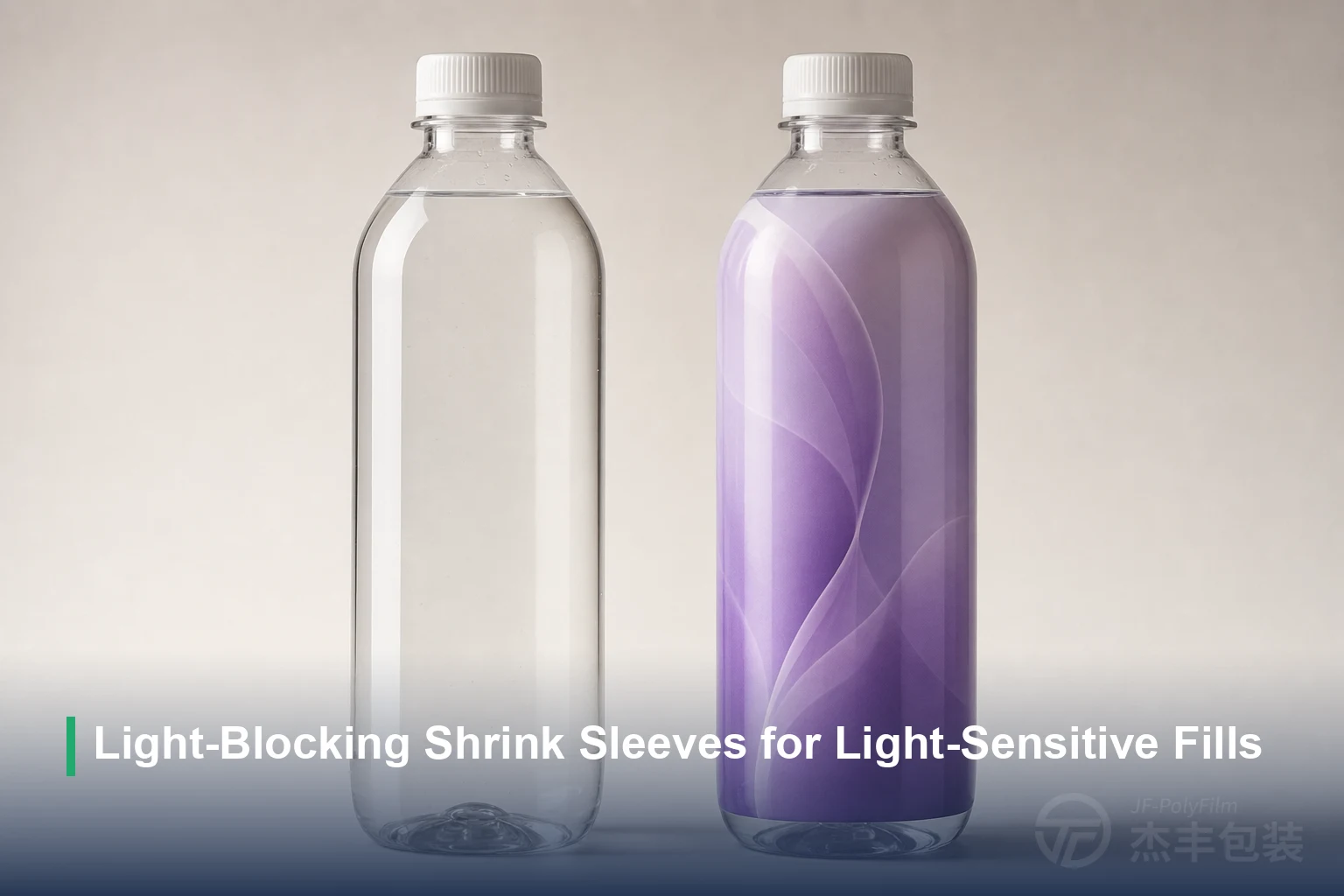
Light-Blocking Shrink Sleeves for Light-Sensitive Fills
Beer, dairy, supplements, and some medicines degrade under light. Which fills need protection, and how a full-body opaque PETG sleeve wraps the whole container to keep light off the contents.
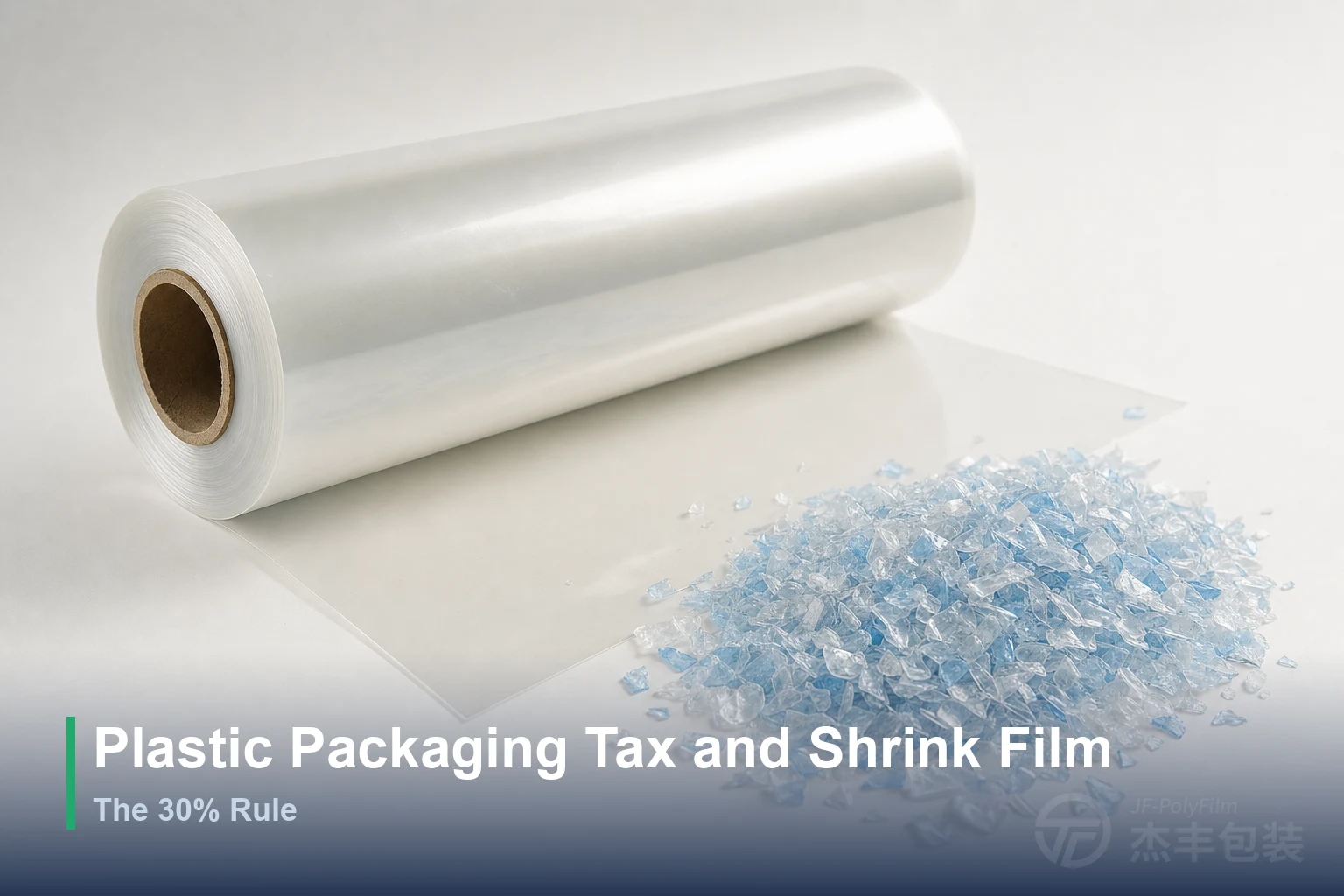
Plastic Packaging Tax and Shrink Film: The 30% Rule
How plastic packaging taxes in the UK, Spain, Italy and the EU treat shrink sleeves, why the 30% recycled-content threshold is the number worth remembering, and how RPET film helps a sleeve cross it.
Need Expert Advice on Shrink Film?
Our technical team can help you choose the right film for your application.
Contact Us