
Shrink Sleeves for Engine Oil and Lubricant Bottles
How to spec shrink sleeves for engine oil and lubricant bottles: conforming to shaped HDPE, surviving oily handling, tamper evidence, SKU sorting, recycling.
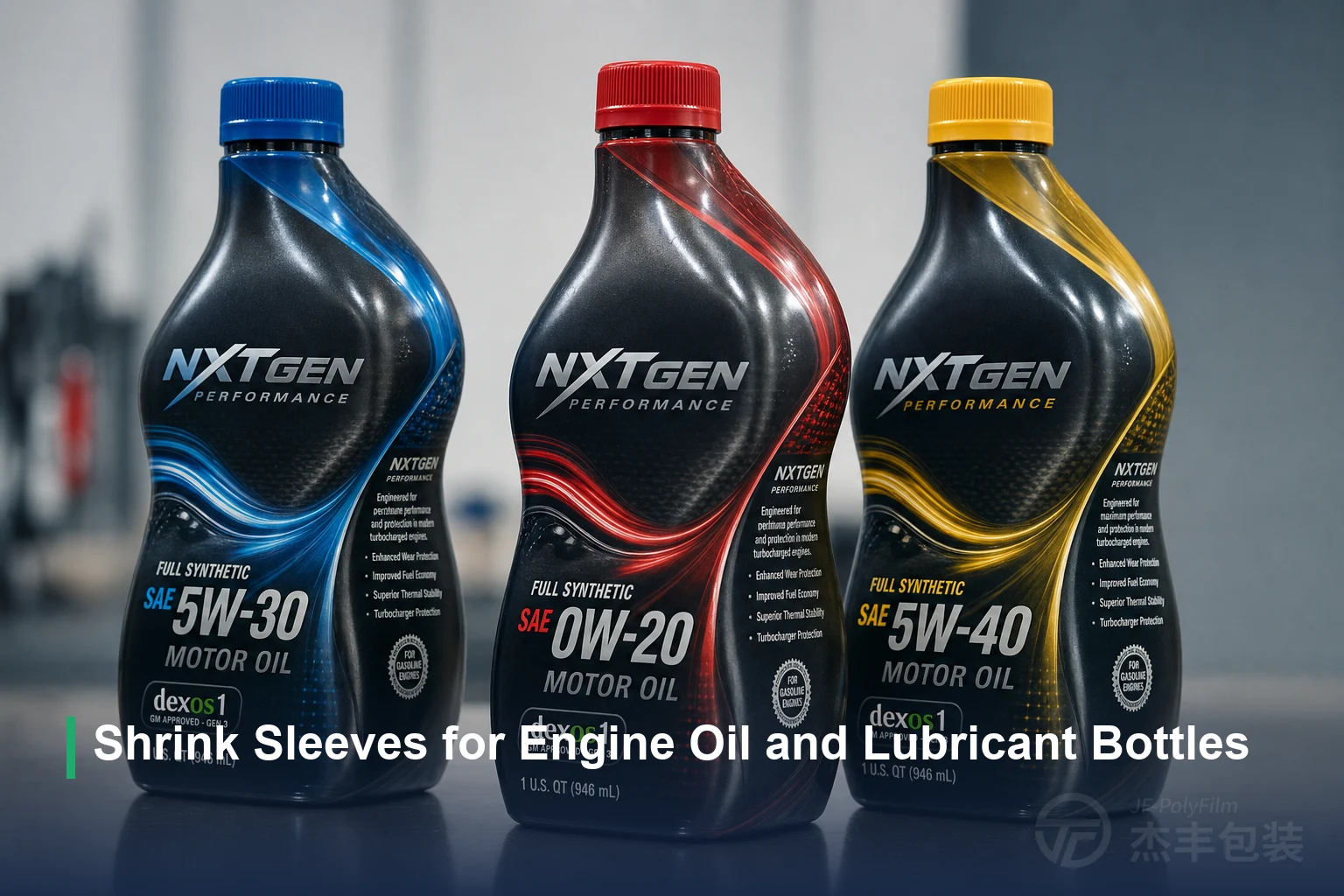
A shrink sleeve for an engine oil bottle is a pre-printed plastic tube slipped over the filled container and heated so it draws tight around the full contour, wrapping the whole body in 360-degree graphics no flat label can cover.
Key takeaways
- High-shrink film with transverse shrink of 70 percent or more seats into the deep curves, waists, and handle wells of shaped automotive bottles where a flat label would lift.
- Reverse (inside) printing locks the ink between the film and the bottle wall, so oil film, transit-case abrasion, and shelf handling never touch the graphic.
- Carried up over the closure and scored with a perforation, the sleeve tears on first opening — a destructive tamper feature that directly counters illegal refilling, the dominant lubricant counterfeit method.
- Recovery for an HDPE (resin code 2) or PP (resin code 5) lubricant bottle differs from a PET beverage bottle: a PET-based sleeve sinks and separates by density, while a polyolefin sleeve floats and stays with the HDPE.
- Recycler design guidance caps sleeve coverage at roughly 55 percent on bottles of 550 mL or less and 75 percent on larger ones before sort-testing is expected.
Why a shrink sleeve fits an oil bottle, and when another format wins
The defining advantage is full-body conformance: one printed surface covers the whole bottle shape, follows curves and recesses no adhesive label can sit flat against, and arrives as a tube that prints cold and shrinks later. The tube format also makes two things possible that the rest of the spec depends on: the graphic can be printed on the inner face, putting plastic between ink and the outside world, and the tube can bridge the closure so the label and the tamper seal become one part.
A sleeve is not the only way to decorate a lubricant bottle, and it does not win on every axis. The real comparison is against the formats a buyer actually chooses between:
| Decoration format | Full-body 360° coverage | Fit on shaped/handled bottles | Oil and scuff resistance | Built-in tamper evidence | SKU-change flexibility | Per-unit cost |
|---|---|---|---|---|---|---|
| Shrink sleeve | Yes | High (draws into deep contours) | High (reverse-printed) | Yes (over-cap perforation) | High (reel change) | Medium |
| Pressure-sensitive wrap label | Near-360° (seam; no vertical contour) | Low (tents on curves) | Low (edges lift, ink exposed) | No | High | Low–medium |
| In-mould label | Partial (panel, mould-set) | High (fused in the wall) | Very high (in the wall) | No | Low (set at moulding) | Medium–high |
| Direct screen/pad print | Partial | Medium | Medium | No | Low | Very low at volume |
The sleeve’s own per-unit cost is not fixed either: film gauge, press method, and run length are the levers that move it, the same ones weighed under printing methods later. On a low-SKU, ultra-high-volume single grade, a moulded-in or direct-print route can be the more economical call. The sleeve earns its place where range breadth, shelf differentiation, and tamper evidence outweigh the lowest possible unit cost.
Conforming to shaped HDPE and PP bottles
Conformance comes down to how far the film can shrink across its width. Lubricant bottles are rarely simple cylinders: F-style jugs, oblong quart bottles, waisted one-litre bottles, and integral pour handles all present tight radii where a flat label tents or wrinkles. Film that draws 70 percent or more in the transverse direction pulls into those recesses and reads as a seamless printed skin, while machine-direction shrink is kept low so the artwork holds its height instead of distorting vertically as the tube collapses inward. On waisted and handled bottles the print file is pre-distorted — distortion-mapped — so the graphics read true only once the tube has collapsed onto the contour, which is part of the prepress brief handed to the printer.
The bottle underneath sets the thermal budget. Aftermarket lubricants ship in HDPE and PP because those resins bring impact strength, low-temperature toughness, and low cost, and both soften well below their melting point, so the oil is filled at moderate temperatures and the bottle is fully cooled and set before it is sleeved. The shrink heat then acts on the sleeve alone: the sleeved bottle passes through a steam tunnel, hot-air tunnel, or boiling-water bath at roughly 85 to 100°C and the film contracts to the profile. JFPolyFilm’s clear PETG shrink film draws at least 75 percent across the width against 3.0 percent or less along its length — the combination that lets one sleeve seat cleanly on a handled jug and a slim quart bottle from the same job.
How the tube reaches the bottle drives feasibility as much as the film. Flat film is first joined into a continuous tube — most often with a solvent seam that welds the two edges rather than an adhesive lap — then cut to length and opened over each filled bottle by an applicator before the heat. The weld sits in a low-graphic zone so it disappears. It is the tube’s one engineered discontinuity, so its strength is what holds when an oily bottle is gripped and stacked. The base anatomy of the tube — seam, perforation, and format options — is set out in what a shrink sleeve label is.
Surviving oil, rough handling, and warehouse conditions
Durability is the real differentiator for aftermarket packaging, and reverse printing delivers it. Because the artwork sits on the inside of the film, the finished sleeve shows only bare film on the outside: a smear of oil, scuffing as bottles rub in a transit case, or a customer’s greasy grip all reach the outer film and stop there. The graphic underneath stays sealed against the bottle wall, and because the shrunk sleeve grips the full circumference there is no adhesive edge to catch and peel and no overlap flap to lift — the two failure modes most common on wrap labels exposed to oil.
Environmental exposure is a second axis. Lubricant bottles sit in car boots, on workshop sills, and in unheated warehouses, so the print also faces sunlight and wide temperature swings. Reverse printing helps here too, since the outer film takes the ultraviolet load first, but pigment and varnish choice still govern how a colour holds across the multi-year shelf life a lubricant is expected to keep, and the film and seam have to stay dimensionally stable through heat-and-cold cycling so the sleeve does not loosen or craze. When a sleeve wrinkles, finishes loose, or shows dog-ears, the cause is usually temperature, dwell, or sleeve size rather than the film — diagnostic ground covered in solving PETG shrink film problems.
Chemical containment, by contrast, is the bottle’s job, not the sleeve’s. US transport rules for hazardous liquids illustrate the split rather than govern an ordinary oil bottle: a permeation ceiling such as the 2.0 percent limit in 49 CFR Part 173, Appendix B is measured at the container, never at the decoration. The bottle resin holds the oil; the sleeve film protects the print and the seal — and a label unreadable by the time it reaches the shelf has failed the only job it was specified for.
Tamper evidence and counterfeit defence
A full-body sleeve does double duty as a security feature. Extended up and over the closure and scored with a perforation at the cap shoulder, the sleeve has to tear before the cap can turn. That first opening rips the printed graphic along the perforation, and because the artwork is continuous across the break, the torn pattern cannot be re-aligned to look untouched. The broken print is the evidence.
This matters more for lubricants than for most goods because of how they are faked. The aftermarket is one of the most counterfeited categories in automotive supply, and the dominant method is illegal refilling — recovering genuine, branded bottles, refilling them with substandard oil, and re-applying a fresh seal. A destructive over-cap sleeve is aimed squarely at that attack, since a genuine bottle cannot be re-dressed once its original sleeve has been torn. Counterfeiting accounts for a significant share of aftermarket lubricant volume, and substandard oil in convincing packaging can damage an engine, which is what makes the seal worth its cost.
On top of the destructive seal, the printed surface carries traceability data. Digital printing handles variable data, so each sleeve can take a unique serial code, batch number, or scannable QR mark without a separate label or a second pass, turning the decoration into a unit-level identifier. A sleeve does not authenticate on its own, but as a destructible cover plus a serialized print surface it raises the effort a counterfeiter has to spend. Matching band and cap geometry to closure type is its own subject, treated in the guide to tamper-evident shrink bands.
Differentiating a multi-viscosity SKU range on shelf
One sleeve format absorbs an entire product range. Because the artwork lives on changeable printed film rather than a moulded bottle, a brand can run the same bottle and sleeving line for every grade it sells and give each viscosity, specification, and pack size its own full-colour design. The bottle is constant; the printed film differentiates.
That flexibility is what a wall of near-identical oil bottles needs. A 5W-30 and a 10W-40 in the same container become instantly distinct when each wears a different colour field, icon system, and spec callout across the full body. Finish adds another axis: a high-gloss film reads as a premium pack while a matte film signals a quieter, technical positioning, and both come off the same base film. A white, light-blocking PETG adds an opaque ground where the design wants a solid canvas rather than a clear film over the bottle colour. The press method behind that artwork — rotogravure, flexographic, or digital — carries its own trade-offs in run length, colour, and variable data, and the right choice follows the order rather than the sleeve format, as laid out in PET shrink sleeve printing methods.
Material choice and recyclability on an HDPE/PP bottle
Three film families cover the field, and for a lubricant bottle the recycling logic decides the choice as much as print quality. PETG offers the highest transverse shrink and clean print; PVC shrinks aggressively but carries chlorine in its backbone and is losing ground on recyclability, with a full grade-by-grade view in PETG vs PVC shrink film; polyolefin (PO/PE) shrinks less but brings a recovery advantage on the right container. The key difference from beverage work is the bottle underneath — HDPE and PP, not PET — so the sleeve and bottle no longer share one material stream by default. That splits recovery into two clean routes.
| Sleeve material | Shrink fit on deep curves | Recovery behaviour on an HDPE / PP oil bottle | Note |
|---|---|---|---|
| PET-based (PETG) | Highest transverse shrink; seats on deep contours, waists, and handles | Specific gravity above 1.0, so it sinks and separates from the floating HDPE in a float tank; thin perforated gauges also strip mechanically | Recovered in its own PET stream, away from the bottle |
| Polyolefin (PO / PE) | Lower shrink; suits simpler bottle shapes | Less dense than water, so it floats together with the HDPE and stays in the same wash stream | Matched to the container’s own recycling route |
| PVC | High shrink but lower clarity and higher haze | Chlorine in the main chain; releases hydrogen chloride on incineration | Declining on recyclability grounds |
Those density routes come with design limits that a recycler-facing spec has to respect, most of them set out in the US Association of Plastic Recyclers design guidance for coloured HDPE. Three gates matter for a full-body oil-bottle sleeve:
- Coverage. A full-body sleeve is high-coverage by definition. The guidance treats up to about 55 percent label coverage as preferred on containers of 550 mL or less and up to about 75 percent on larger ones; beyond that, the pack is expected to be sort-tested rather than assumed compatible.
- Colour and near-infrared read. Sorters have to read the bottle resin through the sleeve. A dark sleeve — roughly an L value below 40, or near-infrared reflectance under 10 percent — can mask the container and mis-sort it, so heavy dark coverage is flagged for testing.
- Cap load. A PP cap on an HDPE bottle should stay under about 10 percent of pack weight, since PP and PE float together and too much PP embrittles the recovered resin.
A sleeve thin enough to strip before sorting — around 50 microns or less with a perforation — sidesteps most of these gates, and a wash-off construction goes further, engineered to release from the bottle in the caustic recycling wash — commercial wash-off tests report release above 95 percent, often above 99 percent — so the resin returns clean. PVC stands apart on chemistry: the chlorine in its chain releases corrosive hydrogen chloride when burned, whereas PET-family films carry none. How a PET-family sleeve returns cleanly — including a crystallizable grade that can travel back with a PET bottle, and recycled-content stock — is set out in PET shrink sleeve recyclability, CPET and the RIC 1 stream, and recycled-content RPET packaging. Choosing between those grades for a given bottle is its own decision, mapped in clear vs white vs CPET vs RPET.
Specifying and sourcing oil-bottle sleeves
A workable specification names four things — film material, gauge, format, and finish — and each maps to a decision already made above, which makes the brief easy to hand to a supplier:
- Material follows the recycling route: a PET-family film where the stream recovers PET separately, a floatable polyolefin where the sleeve should ride with the HDPE.
- Gauge sits within the 30-to-100-micron industry band, biased to the thinner, perforated end where mechanical de-labelling matters, since a sleeve around 50 microns or less strips off before sorting.
- Format is full-body versus a partial sleeve or cap band, driven by whether the closure itself has to be sealed for tamper evidence.
- Finish is gloss or matte to suit the brand, with the caution that a dark, high-coverage sleeve can trip the near-infrared sorters reading the bottle underneath.
A concrete brief, then, reads: for a handled F-style jug in an HDPE recovery stream, specify PETG, 30 to 60 microns, full-body with a cap perforation, in the gloss or matte finish the brand calls for. The same brief has to carry the bottle’s own dimensions — layflat width and cut length matched to the bottle profile — since those size the tube, and it should state order volume against the roughly one-tonne minimum that sleeve stock is usually bought at. The safest request to a supplier is that spec sheet plus a per-lot Certificate of Analysis the delivery can be held against — and confirming a supplier can repeat those figures run after run is its own step, laid out in how to choose a PETG shrink film supplier.
An oil-bottle sleeve has to be right in material, gauge, fit, and spec at once. JFPolyFilm makes its clear PETG shrink film to these figures — 75 percent transverse shrink, 30 to 60 microns, corona-free printing, at least five metres sampled per batch with a COA, and mostly seamless rolls — and supplies it as a stockable roll with a twelve-month shelf life at 10 to 30°C, so a single spec holds across a whole oil-bottle range order after order.
Frequently Asked Questions
Do shrink sleeves hold up against oil and grease on engine oil bottles?
Which film material works best for sleeves on HDPE or PP oil bottles?
Can a shrink sleeve provide tamper evidence on an oil bottle?
What film thickness is typical for lubricant bottle sleeves?
Are engine oil bottle shrink sleeves recyclable, and what are the design limits?
Related Articles
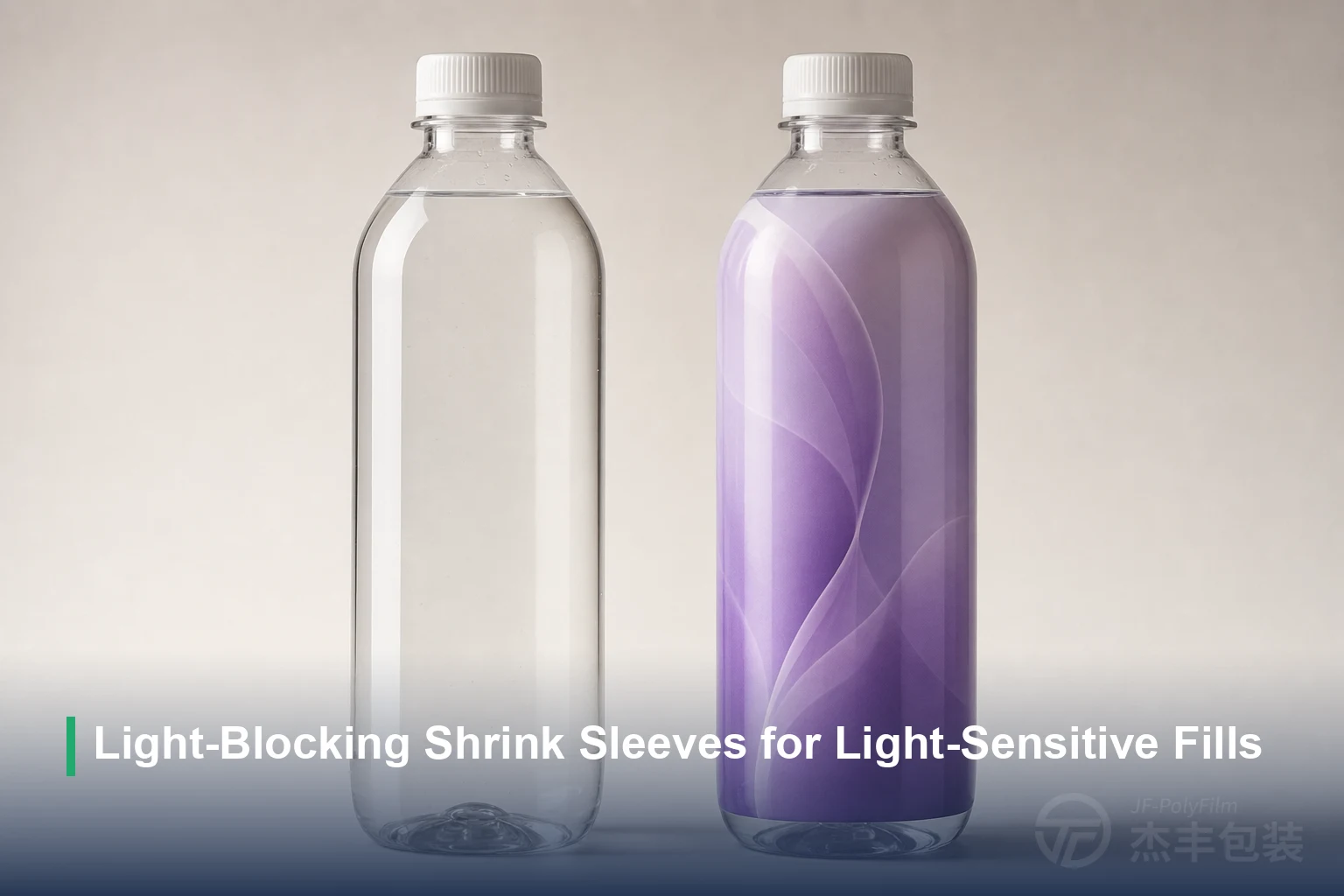
Light-Blocking Shrink Sleeves for Light-Sensitive Fills
Beer, dairy, supplements, and some medicines degrade under light. Which fills need protection, and how a full-body opaque PETG sleeve wraps the whole container to keep light off the contents.
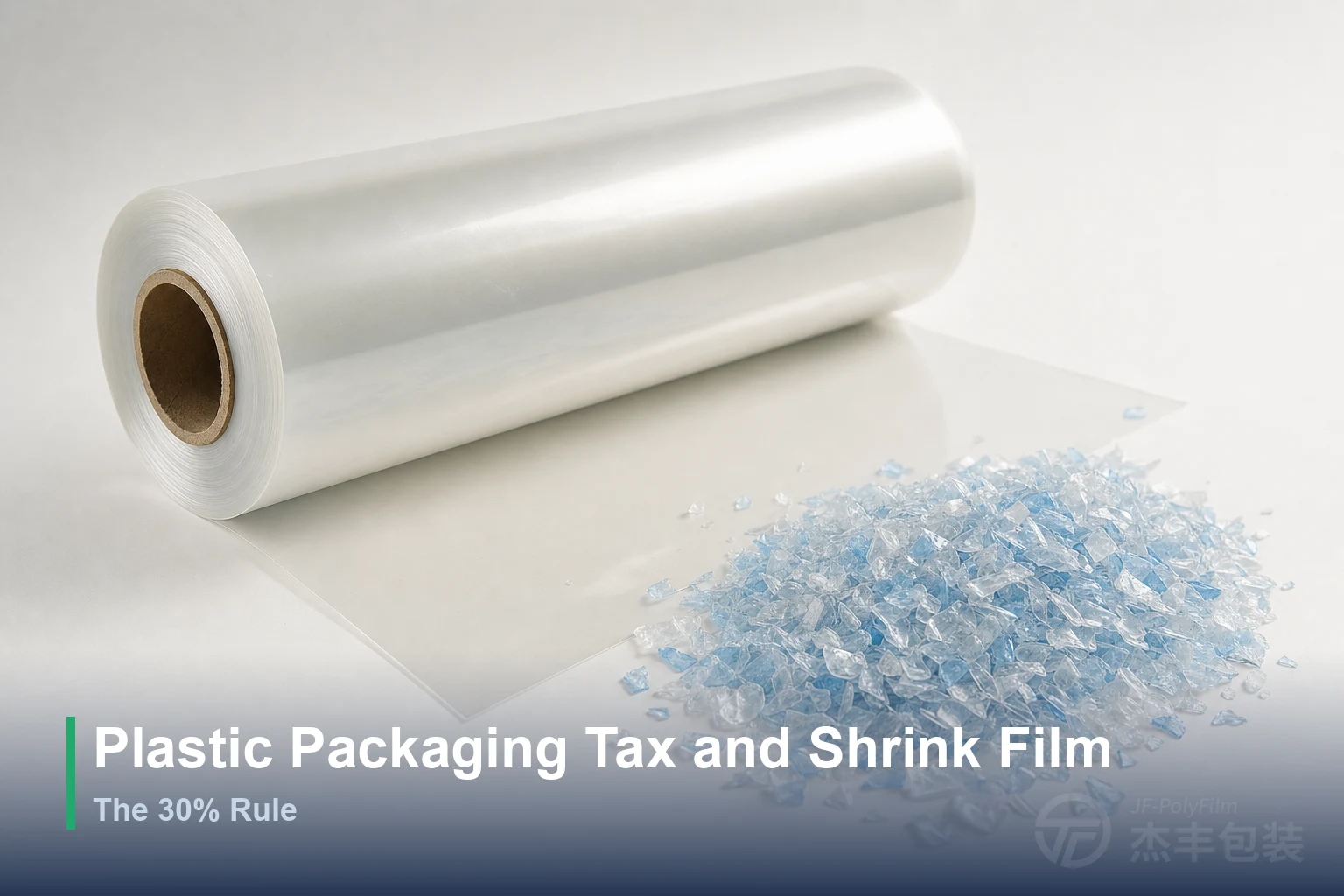
Plastic Packaging Tax and Shrink Film: The 30% Rule
How plastic packaging taxes in the UK, Spain, Italy and the EU treat shrink sleeves, why the 30% recycled-content threshold is the number worth remembering, and how RPET film helps a sleeve cross it.
Need Expert Advice on Shrink Film?
Our technical team can help you choose the right film for your application.
Contact Us